
مقدمة
Metal roofs and flat concrete roofs are widely used in commercial, industrial, and residential buildings. However, these roof types are rarely designed with solar performance in mind. Fixed roof slopes often fail to align with the sun’s optimal angle, resulting in permanent energy losses if solar panels are mounted flush.
Adjustable solar panel tilt mount brackets solve this problem through engineered tilt solutions, not guesswork. By allowing installers to select the correct tilt range based on latitude, seasonality, and structural limits, these brackets help maximize solar performance while maintaining long-term safety.
Below are seven clear, engineering-driven reasons why adjustable tilt brackets are the preferred mounting solution for metal and flat roofs.
Reason One: Correcting the Mismatch Between Roof Angle and Optimal Solar Angle
1.The Core Issue
Most metal and flat roofs slopes are built for drainage,wind resistance and architecture structural efficiency—not for solar energy performance.
- Flat roofs typically sit at 0–5°
- Metal roofs often follow fixed architectural slopes unrelated to solar latitude
In contrast, optimal solar tilt angles usually fall between 10° and 40°, depending on location.This mismatch causes panels to operate far below their potential.
2.Why Adjustable Tilt Brackets Are the Solution
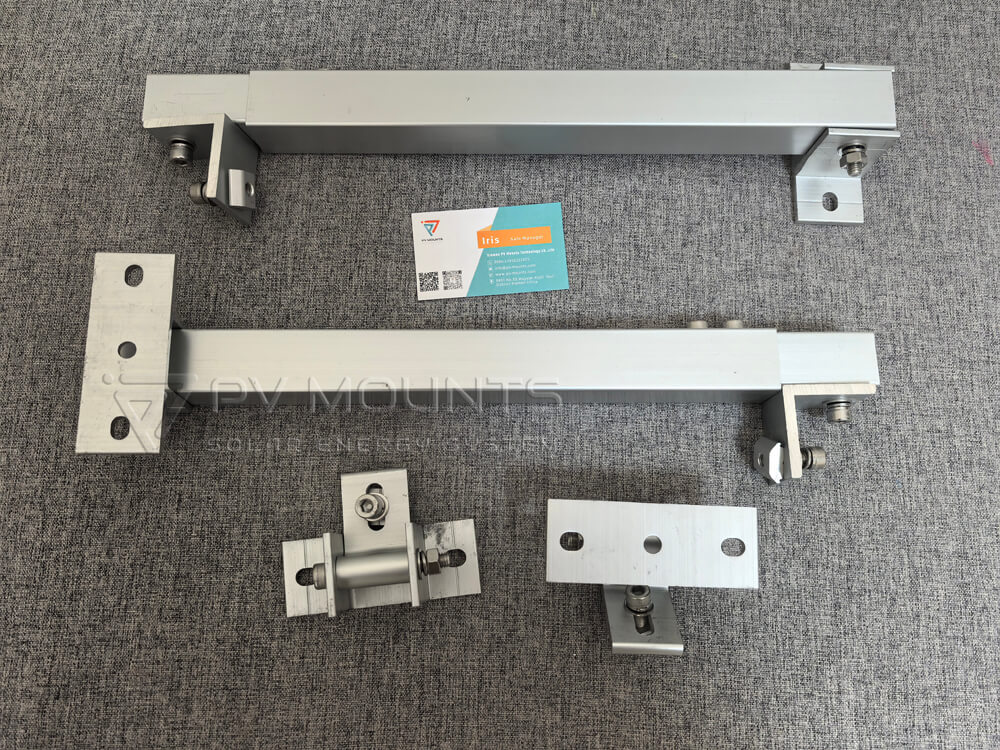
Adjustable brackets do not provide unlimited angle freedom. Instead, they use engineered tilt ranges, such as:
- 10°–15°
- 15°–30°
- 30°–60°
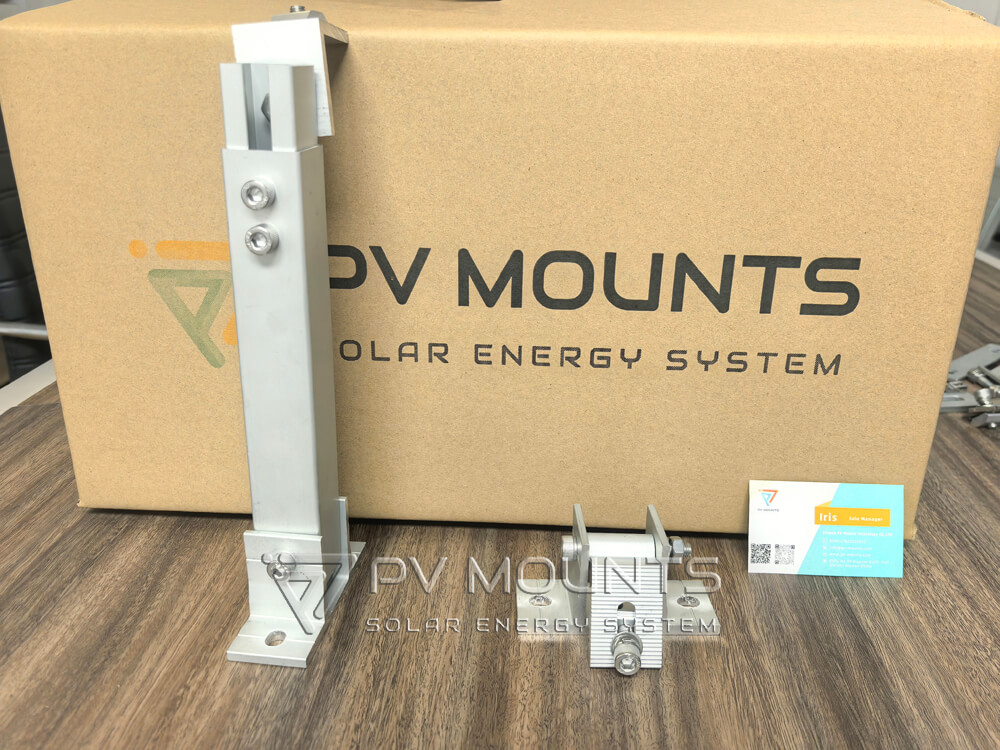
Each range is achieved through a dedicated front-leg and rear-leg structure, ensuring predictable load behavior.
This approach allows solar panels to operate at a designed solar angle, independent of roof slope—transforming a passive roof surface into a controlled energy platform.
Reason Two: Meaningful Energy Gains Without Mechanical Complexity
Adjustable Solar Panel Brackets vs Solar Trackers
Solar trackers offer maximum sun alignment—but at a cost.
| System Type | التكلفة | Complexity | Maintenance |
|---|---|---|---|
| Fixed Mount | Low | Low | Minimal |
| Adjustable Tilt Bracket | Moderate | Low | Minimal |
| Solar Tracker | High | High | Ongoing |
Solar trackers follow the sun automatically and can achieve maximum energy output. However, they also come with higher costs, moving parts, and maintenance requirements.
Adjustable tilt mount brackets deliver most of the energy benefit of trackers without:
- Motors
- Sensors
- Wiring
- Electrical components
- High maintenance risk
Adjustable solar panel tilt mount brackets offer a low-risk and practical alternative:
- Lower upfront cost
- No motors or electronic components
- Minimal maintenance
- Suitable for rooftop environments
By selecting the correct tilt range during installation—or adjusting seasonally—projects can achieve:
- 8–15% annual energy gain on low-slope roofs
- Higher winter output in high-latitude regions
- Improved performance without moving parts
For most rooftop projects, adjustable solar panel mounts offer the best balance between performance improvement and long-term reliability.
For EPCs and building owners, adjustable brackets represent the best cost-to-performance balance.
Reason Three: Seasonal Optimization Without Structural Compromise
Seasonal Sun Angle Changes Matter
The sun’s position changes throughout the year. Fixed systems cannot respond to this shift.
Adjustable tilt brackets allow planned seasonal optimization, typically:
- Lower tilt range for summer
- Steeper tilt range for winter
Because the adjustment occurs within a predefined structural range, load calculations remain valid and predictable—unlike ad-hoc angle changes that may compromise safety.
Reason Four: Improved Drainage, Cooling, and Module Reliability
Beyond Energy Output
Tilting panels improves more than just irradiation:
- Faster rainwater runoff
- Reduced dust and debris buildup
- Better airflow beneath modules
- Lower operating temperatures
These factors reduce hotspot risk and slow long-term degradation, directly improving module lifespan and system reliability.
Reason Five: Non-Penetrating Installation on Metal Roofs
Roof Integrity Is Non-Negotiable
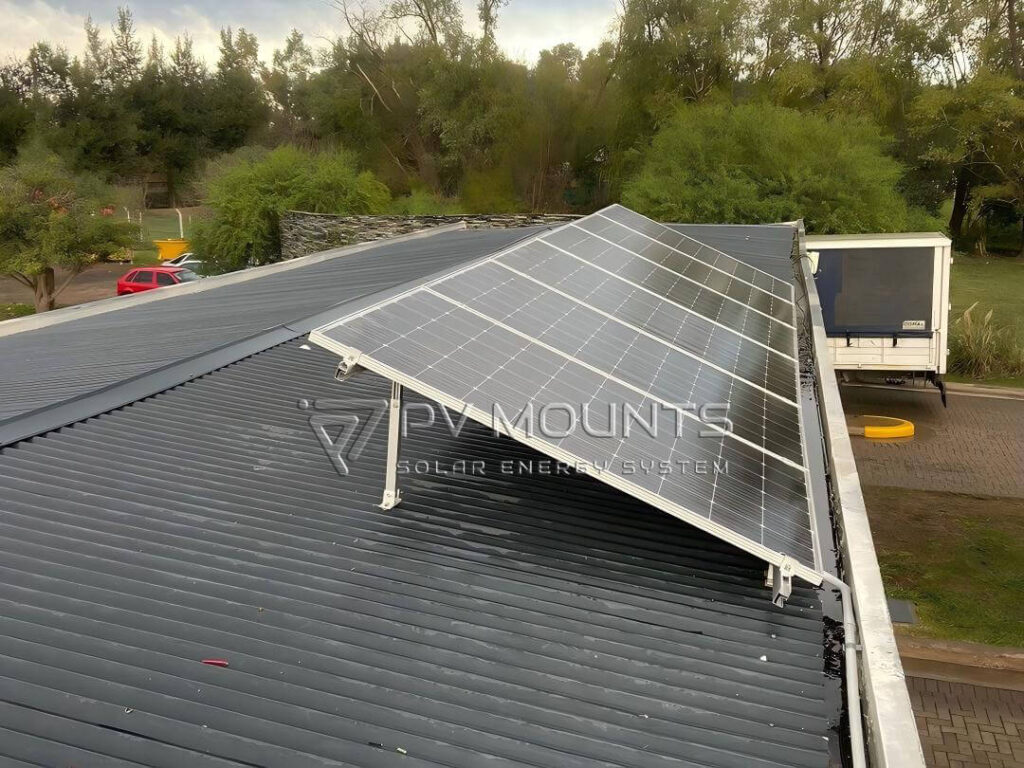
On standing seam and other metal roofs, adjustable tilt brackets can be paired with non-penetrating clamps.
This delivers:
- Zero roof drilling
- No waterproofing risk
- Faster installation
- Long-term roof warranty protection
For EPCs and building owners, this is often a decisive factor.
Reason Six: Predictable Engineering and Compliance
Why Engineers Prefer Adjustable Tilt Systems
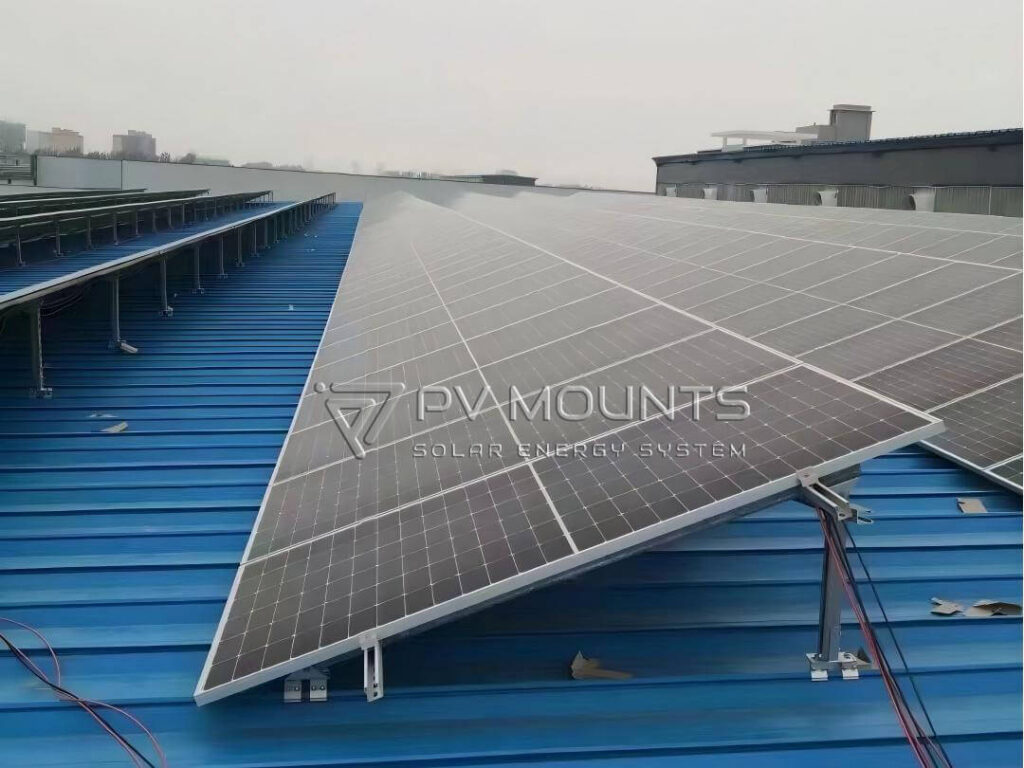
Each tilt bracket system is designed with:
- Defined tilt ranges
- Known wind and snow load behavior
- Aluminum structural components (e.g. AL6005-T5)
- Stainless steel fasteners (SUS304)
This predictability simplifies:
- Structural calculations
- Permit approvals
- Third-party inspections
Adjustable does not mean uncertain—it means engineered flexibility.
Reason Seven: Scalable Across Project Sizes and Roof Types
One Concept, Many Applications
Adjustable solar panel tilt mount brackets are used across:
- Residential flat roofs
- Commercial metal rooftops
- Industrial warehouses
- Hybrid metal + concrete structures
By selecting the appropriate tilt range and fixing method, the same system logic scales from small rooftops to large commercial arrays—simplifying procurement and standardization.
Key Takeaways
- Roof slope and optimal solar angle are rarely the same on metal roofs and flat concrete roofs. Adjustable tilt brackets help bridge this mismatch.
- Adjustable solar panel tilt mount brackets work within defined tilt ranges (such as 10–15°, 15–30°, and 30–60°), ensuring structural safety and predictable load performance.
- Compared with flush-mounted systems, adjustable tilt mounting improves seasonal energy yield without increasing roof penetration risk.
- Compared with solar trackers, adjustable tilt systems offer higher reliability, lower cost, and simpler maintenance.
- Non-penetrating or EPDM-sealed mounting solutions make adjustable tilt brackets suitable for both metal roofs and flat concrete roofs.
- For EPCs and installers, adjustable tilt brackets provide a practical balance between energy performance, installation efficiency, and long-term system durability.
الأسئلة الشائعة
Q1: What are adjustable solar panel tilt mount brackets?
Adjustable solar panel tilt mount brakets are mounting systems designed to intall solar panels at predegined tilt anles on metal roof or flat concrete roofs. Unlike fixed mounts, they allow angle optimization to improve solar exposure and overall energy performance.
Q2: Are adjustable tilt brackets suitable for metal roofs?
Yes. Adjustable tilt brackets are widely used on metal roof such as corrugated,trapezoidal and standing seam roofs. They are typically installed using self-drilling screws with EPDM sealing washers or non-penetrating standing seam clamps, depending on roof type.
Q3: Can adjustable solar panel mounts be installed on flat concrete roofs?
Yes. On flat concrete roofs, adjustable solar panel mounts are usually fixed with anchor bolts or ballasted-supported bases. The adjustable structure allows installers to set an optimal tilt angle independent of the roof’s flat surface.
Q4: Do adjustable solar panel tilt mounts allow unlimited angle ajustment?
No. Adjustable tilt mounts are engineered to work wtih specific tilt ranges, such as 10~15°,15~30°,or 30~60°. These defined ranges ensure structual safety,wind-load resistance, and predictable system performance rather tha nunlimited fre-angle adjustment.
Q5: Why is adjustable tilt important for metal roof solar installations?
Most metal roof slopes do not match the optimal solar angle for maximum energy production. Ajustable tilt brackets correct this mismatch by allowing panels to be installed at angles better aligned with the sun’s path, improving annual energy yield.
Q6: How much additional energy can adjustable tilt monting generate?
Depending on geographic loctation and seasonal optimization, adjustable tilt mounting can increase energy output by approximately 5% to 15% compared to flat or flush-mounted systems.
Q7: Are adjustable solar panel mounts better than solar trackers?
Adjustable tilt mounts offer a cost-effective alternative to solar trackers. While trackers provide continuous movement, adjustable mounts deliver relisable performance improvements with lower cost,simple installatio and minimal maintenance.
Q8: Will adjustable tilt brackets damage the roof?
When properly installed using correct fastners, sealing washers, or non-penetrating standing seam clamps, adjustable tilt brackets do not damage metal or concrete roofs. Professional installation ensures waterproofing and long-term roof integrity.
Q9: How often should the tilt angle be adjusted?
Most systems are adjusted seasonally(for example, summer and winner). Some projects chosoe a single optimized annual angle to balance performance gains with operational simplicity.
Q10: Who should consider using adjustable solar panel tilt mount brackets?
Adjustable tilt brackets are an idial for EPC contrctors, solar installers, commertical rooftop projects, and flat-roof installations where maximizing energy output and maintaining structural reliability are key priorities.
Conclusion
Adjustable solar panle tilt mount brackets provide a practical and efficient way to optimize soalr performance on metal and flat concrete roofs. By correcting roof angle limitations through engineered tilt ranges, these systems improve energy output,maintian structural safety, and adapt to a wide range of installation senarios. For installers and EPC contractors seeking higher performance without the complexity of tracking systems, ajustable tilt mounting offers a reliable, scalable and future-ready solution.

 Arabic
  English
  Spanish
  Portuguese
  Russian
  Hungarian
  Romanian
  French