
1. Introduction: Why Solar Mounting System Architecture Matters in EPC Projects
This article defines the solar mounting system as a complete structural engineering framework used in EPC photovoltaic projects.
In EPC photovoltaic projects, the solar mounting system functions as a structural engineering framework that defines how mechanical loads are transferred from PV modules to roof or ground structures.
This article explains the system-level architecture, load transfer logic, and engineering relationship between subsystems such as rails, roof hooks, clamps, and fastening components.
Component-level engineering decisions are executed in subsystem-specific design guides to ensure accurate load distribution, structural compatibility, and installation reliability within EPC project constraints. based on site-specific structural, environmental, and load-bearing requirements.
2. Definition of Solar Mounting System (Engineering Perspective)
A solar mounting system is a structural engineering framework that transfers mechanical loads from PV modules to building or ground structures.It ensures structural stability under wind, snow, and thermal conditions.
3. Solar Mounting System Structural Architecture
The PV mounting system is structured as a multi-layer engineering architecture:
| System Level | Component | Engineering Function |
|---|---|---|
| Level 1 | Solar Mounting System | Structural framework |
| Level 2 | Solar Rail System | Load distribution backbone |
| Level 2 | Roof Hook System | Structural anchoring interface |
| Level 2 | Clamping System | PV module fixation |
| Level 2 | Fastening System | Mechanical locking |
| Level 2 | Grounding System | Electrical bonding continuity |
This hierarchy defines how mechanical loads are transferred through the system.
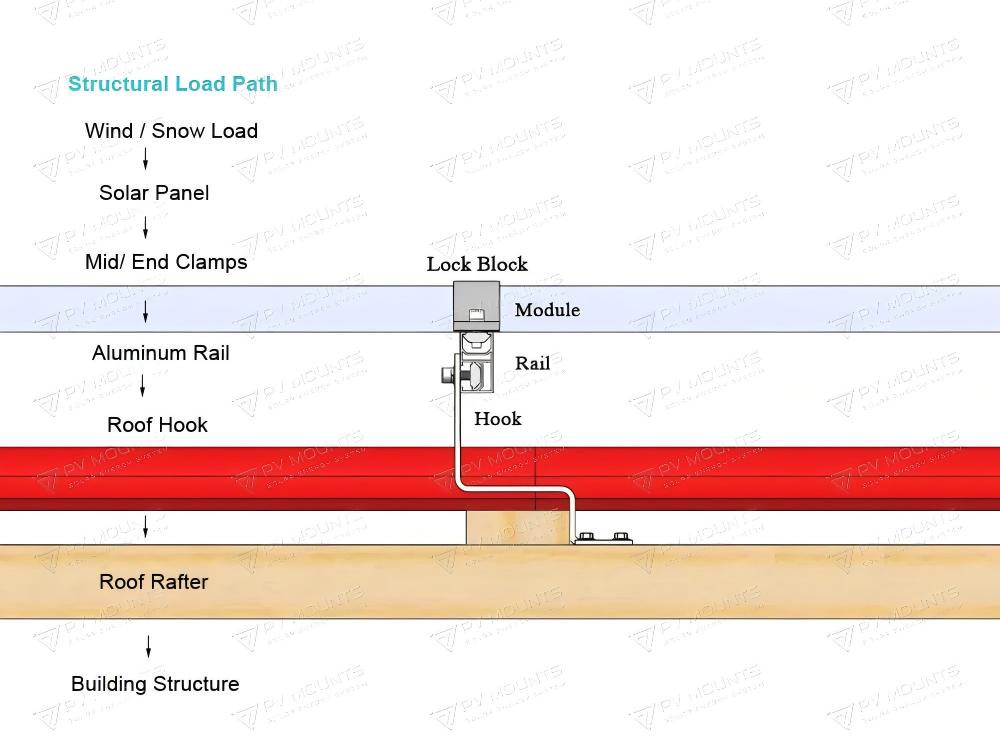
4. Load Transfer Engineering Path
PV systems operate based on a continuous mechanical load path:
PV Module
→ Mid/End Clamp
→ Solar Rail System
→ Roof Hook / Anchor System
→ Building Roof Structure
This load path ensures:
- Uniform load distribution
- Structural stability under wind uplift
- Snow load resistance
- Long-term mechanical reliability
The solar mounting system operates through a continuous mechanical load transfer path that ensures structural stability and force distribution across all components.
PV modules transfer loads into mid and end clamps, which transmit forces into the solar rail system. The rails distribute loads to roof hooks or anchoring systems, which finally transfer the forces into the building structure.
This engineered load path ensures resistance to wind uplift, snow accumulation, and long-term mechanical fatigue.
5. Engineering Boundary Definition (System-Level Isolation)
The solar mounting system must be evaluated as a complete engineering structure to ensure load continuity, structural compatibility, and system-level integration between all subsystems.
Rails, roof hooks, clamps, and fastening components are treated as functional interfaces within the system architecture rather than independent design entities.
Detailed engineering design and selection criteria for individual components are provided in subsystem-specific technical guides.
6. Engineering Risk Considerations in PV System Design
Improper system-level design may result in:
- Uneven load distribution across rail systems
- Structural failure at roof hook connection points
- Clamp slippage under wind uplift conditions
- Reduced system lifespan due to fatigue stress
Therefore, PV mounting system design should always be based on engineering validation rather than cost-driven component selection.
Improper system-level design in solar mounting systems may lead to structural mismatch between rails and roof hooks, uneven load distribution, and reduced long-term durability.
7. EPC Procurement Engineering Logic
For EPC contractors, procurement decisions should follow system-level engineering principles:
- Structural compatibility verification
- Load design validation (wind and snow zones)
- System integration efficiency
- Installation and labor optimization
- Long-term reliability and lifecycle cost control
PV MOUNTS supports global EPC contractors as a:
- solar mounting system supplier China
- PV mounting system manufacturer
- EPC solar mounting procurement solution provider
EPC procurement decisions for solar mounting systems should be based on engineering validation rather than component-level cost comparison.
Key evaluation factors include structural compatibility, load design validation based on wind and snow conditions, system integration efficiency, and lifecycle performance.
PV MOUNTS provides engineering-driven solar mounting system solutions to support EPC contractors in global photovoltaic projects.
8. System Engineering Capability of PV MOUNTS
PV MOUNTS provides complete engineering-driven solutions for EPC solar projects:
- Full PV mounting system design support
- OEM / ODM manufacturing capability
- System-level component matching
- Engineering validation for structural compatibility
- Global EPC project supply support
الأسئلة الشائعة
A structural framework that supports PV modules and transfers mechanical loads to roof or ground structures.
Rails, roof hooks, clamps, fasteners, and grounding systems.
Because it ensures structural safety, load transfer continuity, and long-term reliability.
It distributes mechanical loads across multiple support points.
They act as structural anchoring interfaces between system and roof.
It is not recommended due to system compatibility risks.
Aluminum alloys and stainless steel materials.
From PV modules → clamps → rails → hooks → roof structure.
Because it ensures structural consistency and reduces engineering risks.
Yes, including engineering design and manufacturing support.
It may cause structural mismatch, reduced stability, and system failure under load conditions.
System-level design focuses on the overall structural behavior and load transfer of the entire solar mounting system, while component-level selection focuses on choosing individual parts like rails, hooks, and clamps based on specifications and compatibility.
10. خاتمة
The solar mounting system is a fully integrated engineering architecture that determines the safety, stability, and lifecycle performance of photovoltaic installations.
EPC contractors should prioritize system-level engineering validation rather than individual component selection.
PV MOUNTS provides professional support as a solar mounting system supplier China, PV mounting system manufacturer, and EPC solar mounting procurement solution provider for global solar projects.


 Arabic
  English
  Spanish
  Portuguese
  Russian
  Hungarian
  Romanian
  French