
Quick Answer
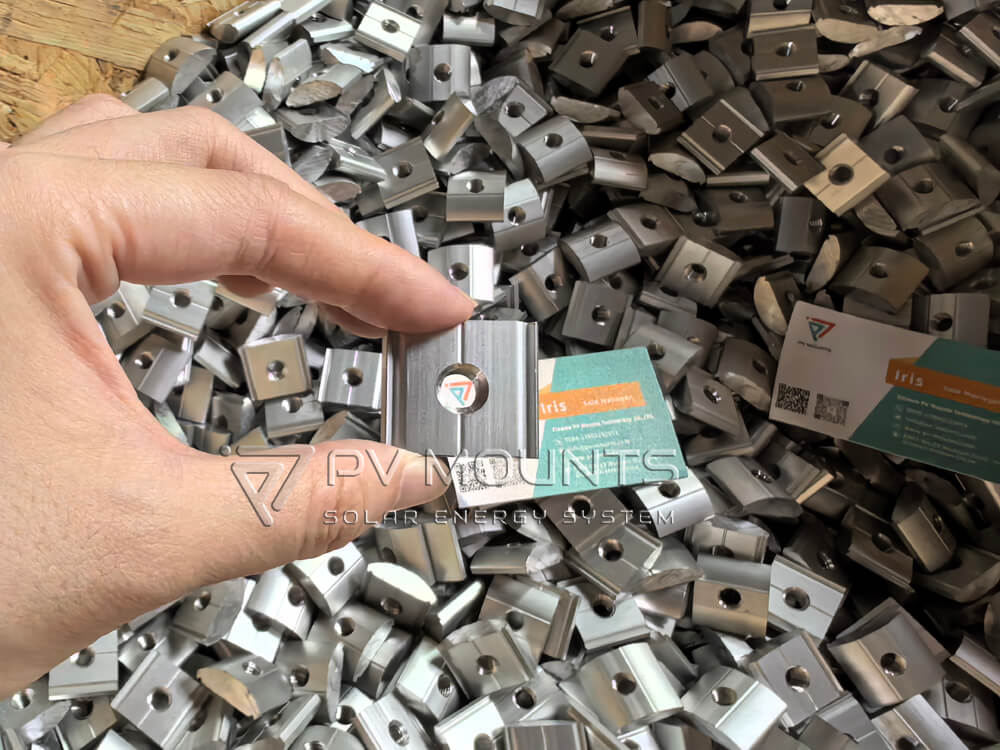
A Solar Rail Sliding Nut is a rail-specific threaded connection component that slides into the channel of a solar mounting rail. Its external dimensions and geometry must match the corresponding rail profile, while its M8 threaded hole provides the connection interface for an M8 bolt.
This makes the Solar Rail Sliding Nut an important compatibility interface between a solar rail and other PV mounting accessories.
Already have your own solar rail? You may not need to replace it.
There are three common sourcing situations:
1. You already have a solar rail + compatible sliding nut
→ You may be able to use compatible PV mounting accessories directly.
2. You already have a solar rail but need a sliding nut
→ A Solar Rail Sliding Nut can be matched to your existing rail profile.
3. You need a complete mounting connection
→ Solar rail + profile-matched sliding nut + M8 bolt + compatible PV mounting accessories can be supplied as a complete solution.
The basic connection principle is:
Solar Rail → Solar Rail Sliding Nut → M8 Bolt → PV Mounting Accessory
The M8 threaded hole is the key connection point between the sliding nut and the bolt. However, M8 does not define the complete size or geometry of the sliding nut. Different solar rail manufacturers use different rail profiles and channel dimensions, so the external geometry of the corresponding sliding nut can also be different.
1. What Is a Solar Rail Sliding Nut?
A Solar Rail Sliding Nut is a threaded block or nut designed to slide inside the channel of a solar mounting rail.
Unlike a standard nut, it performs two different interface functions:
- Rail-side interface: its external dimensions and geometry match the solar rail profile.
- Bolt-side interface: its M8 threaded hole connects with an M8 bolt.
The bolt can then connect the sliding nut with a compatible PV mounting accessory.
The connection can therefore be represented as:
Solar Rail Profile
↓
Solar Rail Sliding Nut
↓
M8 Threaded Hole
↓
M8 Bolt
↓
PV Mounting Accessory
This is why a Solar Rail Sliding Nut should not be specified only by its thread size.
M8 describes the bolt-side interface. The rail profile determines the sliding nut’s external geometry.
2. The Two Critical Interfaces of a Solar Rail Sliding Nut
The compatibility of a solar rail nut depends on two separate interfaces.
Interface 1: Sliding Nut Geometry → Solar Rail
The external dimensions and geometry of the sliding nut must correspond to the solar rail channel.
This determines whether the sliding nut can:
- Enter the rail channel
- Slide along the rail
- Engage correctly with the rail
- Remain properly positioned during tightening
Therefore:
Solar Rail Profile → Sliding Nut External Geometry
Interface 2: M8 Threaded Hole → M8 Bolt
The sliding nut has an M8 threaded hole that provides the threaded interface for the M8 bolt.
The connection is:
M8 Threaded Hole + M8 Bolt
The bolt can then connect the sliding nut to a compatible PV mounting accessory.
Therefore:
Sliding Nut → M8 Bolt → PV Accessory
These two interfaces have different functions and should always be evaluated separately.
3. Why Different Solar Rail Profiles Require Different Sliding Nut Dimensions
Solar mounting manufacturers can use different rail profiles and cross-sectional dimensions, including differences in channel width, opening, depth, internal geometry, and engagement surfaces.
Therefore, the external dimensions and geometry of the corresponding Solar Rail Sliding Nut may also differ.
Two sliding nuts can both have an M8 threaded hole but still be incompatible because their external geometry is designed for different rail profiles.
M8 defines the bolt-side interface; the rail profile determines the sliding nut’s external geometry.
4. Already Have Your Own Solar Rail? You May Not Need to Replace It
This is an important advantage for EPC contractors, installers, distributors, and solar mounting hardware buyers.
If you already have a specific or proprietary solar rail, you may not need to replace the rail simply because you want to use different PV mounting accessories.
There are two ways to proceed.
Option A: You Already Have a Compatible Sliding Nut
If your existing solar rail already has its matching Solar Rail Sliding Nut, and the sliding nut provides a compatible M8 bolt connection with the required accessory, you can potentially use our compatible PV mounting accessories directly.
The connection is:
Customer’s Existing Solar Rail
↓
Customer’s Existing Compatible Sliding Nut
↓
M8 Bolt
↓
PV Mounting Accessories
In this situation, there is no need to replace the existing rail or sliding nut solely to use compatible accessories.
The existing rail and sliding nut simply need to provide the required interface for the selected accessory.
Option B: You Have the Rail but Need a Sliding Nut
If you have your own solar rail but do not have a suitable sliding nut, we can evaluate the rail profile and provide a Solar Rail Sliding Nut matched to the existing rail channel.
The connection becomes:
Customer’s Existing Solar Rail
↓
Profile-Matched Solar Rail Sliding Nut
↓
M8 Bolt
↓
PV Mounting Accessories
This allows you to keep your existing rail while sourcing compatible mounting accessories separately.
5. How Does the Solar Rail Sliding Nut Enable Accessory Compatibility?
The Solar Rail Sliding Nut acts as a bridge between the customer’s rail and the mounting accessory.
Rail profile → matched sliding nut geometry → M8 threaded hole → M8 bolt → compatible PV accessory
This means a customer can potentially use a rail from one supplier with compatible mounting accessories from another supplier without replacing the rail.
However, M8 compatibility alone is not sufficient. The rail profile, sliding nut geometry, bolt arrangement, accessory interface, and complete assembly must be verified.
6. Three Common Solar Rail and Accessory Sourcing Scenarios
Scenario 1: Customer Has Rail + Sliding Nut
The existing rail and compatible sliding nut can potentially be retained if the sliding nut provides the required M8 connection for the selected accessory.
Scenario 2: Customer Has Rail but Needs Sliding Nut
The rail profile can be evaluated and a compatible or customized Solar Rail Sliding Nut can be supplied.
Scenario 3: Customer Needs a Complete Solution
PV Mounts can supply the solar rail, profile-matched sliding nut, M8 bolt, and compatible PV mounting accessories as a complete connection solution.
7. How a Solar Rail Sliding Nut Works
The basic operating process is straightforward.
Step 1: Identify the rail profile
Confirm the actual solar rail profile and channel dimensions.
Step 2: Match the sliding nut
Select or develop a Solar Rail Sliding Nut whose external geometry matches the rail channel.
Step 3: Insert the sliding nut
Insert the sliding nut into the appropriate rail channel.
Step 4: Position the sliding nut
Move the sliding nut along the rail to the required mounting position.
Step 5: Install the M8 bolt
Install the M8 bolt through the compatible mounting accessory and engage it with the M8 threaded hole.
Step 6: Tighten the assembly
Tighten the connection according to the requirements of the specific mounting system and accessory.
The exact assembly arrangement depends on the selected PV mounting accessory and system design.
8. Can a Solar Rail Sliding Nut Connect Accessories From Different Suppliers?
Yes, when the relevant interfaces are compatible.
For example:
Supplier A
Solar Rail
↓
Supplier B
Profile-Matched Solar Rail Sliding Nut
↓
M8 Bolt
↓
Supplier C
Compatible PV Mounting Accessory
This can allow an EPC contractor or distributor to source different components separately.
More importantly, a customer does not necessarily need to replace an existing rail simply because they want to purchase compatible accessories from another supplier.
If the customer already has a suitable sliding nut, the sliding nut can remain in the system.
If the customer needs a new sliding nut, the sliding nut can be matched to the existing rail profile.
This gives customers greater flexibility in multi-supplier procurement.
9. What PV Mounting Accessories Can Be Connected?
Depending on the mounting system and connection design, a Solar Rail Sliding Nut can be used with compatible PV mounting accessories such as:
- Solar mid clamps
- Solar end clamps
- L-feet
- Mounting brackets
- Adapter components
- Other rail-mounted PV accessories
The specific connection depends on the accessory design, M8 bolt arrangement, mechanical requirements, and project specifications.
The sliding nut should therefore be evaluated as part of the complete connection assembly.
10. How to Check Solar Rail Sliding Nut Compatibility
For an existing solar rail, compatibility should be checked systematically.
1. Identify the rail profile
Obtain the rail model, technical drawing, cross-sectional drawing, or physical sample.
2. Check the rail channel
Confirm the relevant channel dimensions and internal geometry.
3. Check the sliding nut geometry
Verify the sliding nut’s external dimensions against the rail channel.
4. Confirm the M8 threaded hole
Verify that the sliding nut provides the required M8 threaded interface.
5. Check the M8 bolt
Confirm the bolt specification and connection arrangement.
6. Check the mounting accessory
Confirm that the selected accessory can be connected through the proposed M8 bolt arrangement.
7. Verify the complete assembly
For a new or non-standard combination, a sample assembly or technical verification is recommended before bulk procurement.
11. Why the Rail Profile Is the Starting Point for Selection
When sourcing a sliding nut for solar rail, the rail profile should normally be identified first.
This is because the sliding nut is not defined by the M8 thread alone.
For an existing rail, provide:
- Rail cross-sectional drawing
- Rail technical drawing
- Rail model
- Channel dimensions
- Physical sample, if available
The supplier can then determine whether an existing sliding nut is suitable.
If no standard product matches the rail, the profile can be used as the basis for a customized sliding nut.
This is particularly useful for proprietary or non-standard solar rails.
12. Solar Rail Sliding Nut vs. Standard Nut
A standard nut is primarily a threaded fastening component.
A Solar Rail Sliding Nut has an additional rail-interface function.
| Feature | Standard Nut | Solar Rail Sliding Nut |
|---|---|---|
| Threaded connection | Yes | Yes |
| M8 threaded hole | Depends on product | Used for the specified bolt connection |
| Designed for rail channel | No | Yes |
| Slides inside solar rail | No | Yes |
| Rail-specific external geometry | No | Yes |
| Functions as rail interface | No | Yes |
The main difference is therefore:
Threaded Connection + Rail-Specific External Geometry
13. Why “M8 Solar Rail Nut” Is Not a Complete Specification
A purchasing request that only states:
M8 Solar Rail Nut
does not provide enough information to confirm compatibility.
The supplier still needs to know which rail profile the sliding nut must fit.
Two sliding nuts can both have:
M8 threaded hole
while having different:
- Body widths
- Body heights
- External dimensions
- Contact surfaces
- Rail engagement geometry
A better RFQ description is:
Solar Rail Sliding Nut with M8 threaded hole, matched to the specified solar rail profile and channel dimensions.
This clearly defines both critical interfaces:
M8 bolt interface + rail profile compatibility.
14. Keep Your Existing Rail and Source Compatible Accessories Separately
Customers may already have an approved, installed, inventoried, or preferred solar rail. Replacing it solely to use different mounting accessories may create unnecessary procurement or design work.
If a compatible sliding nut is already available, it can potentially be retained. If not, Крепления для фотоаппаратов can evaluate the rail profile and provide a profile-matched sliding nut.
Existing Solar Rail → Profile-Matched Sliding Nut → M8 Bolt → Compatible PV Accessories
All interfaces should be verified before bulk procurement.
15. Custom Solar Rail Sliding Nut for Customer-Owned Rails
When a customer has a rail with a unique or non-standard profile, a customized Solar Rail Sliding Nut can be considered.
The most useful information includes:
- Solar rail cross-sectional drawing
- Rail channel dimensions
- Rail model
- Sliding nut installation direction
- Required external dimensions
- M8 threaded hole requirement
- Connected PV accessory
- Required quantity
The rail cross-sectional drawing is particularly important because the sliding nut’s external geometry must correspond to the rail channel.
A physical rail sample can also help verify the fit when drawings are unavailable or when the interface requires practical validation.
16. What Should EPCs Include in a Solar Rail Sliding Nut RFQ?
A complete RFQ should describe both the rail-side and bolt-side interfaces.
Solar Rail Information
- Rail model
- Rail cross-sectional drawing
- Channel dimensions
- Rail profile
Sliding Nut Requirements
- Product: Solar Rail Sliding Nut
- M8 threaded hole
- External dimensions
- Rail-compatible geometry
- Материал
- Surface finish, if required
Connection Requirements
- M8 bolt
- Connected PV accessory
- Installation arrangement
- Required quantity
Validation Requirements
- Technical drawing
- Sample
- Compatibility confirmation
- Assembly test, if required
For a customer-owned rail, the rail cross-sectional drawing is usually the most important information for evaluating the sliding nut.
17. Common Solar Rail Sliding Nut Selection Mistakes
Mistake 1: Selecting only by M8 thread
An M8 threaded hole does not define the external dimensions of the sliding nut.
Mistake 2: Assuming similar rails use the same sliding nut
Similar-looking rails can have different channel dimensions or engagement geometry.
Mistake 3: Replacing an existing rail unnecessarily
If the existing rail can be matched with a suitable sliding nut, the customer may not need to replace the rail simply to use compatible mounting accessories.
Mistake 4: Replacing an existing sliding nut unnecessarily
If the customer’s existing sliding nut already provides a compatible M8 bolt interface for the required accessory, there may be no need to replace it.
Mistake 5: Assuming all supplier components are automatically compatible
Different suppliers’ components must still be checked for complete interface compatibility.
Mistake 6: Ordering before checking the rail profile
The sliding nut should be confirmed against the actual rail profile before bulk procurement.
FAQ: Solar Rail Sliding Nut
A Solar Rail Sliding Nut is a threaded connection component that slides into a solar mounting rail channel and connects the rail with compatible PV mounting accessories through an M8 threaded hole and bolt.
Yes. The M8 threaded hole provides the key threaded interface between the sliding nut and the M8 bolt.
No. M8 defines the bolt-side threaded interface. The sliding nut’s external geometry must match the rail profile.
Because different rails can have different channel dimensions and internal geometries. The sliding nut must match the specific rail.
Yes. The M8 threaded hole can be the same while the external dimensions and geometry differ to match different solar rail profiles.
Not necessarily. If your existing rail and sliding nut provide the required compatible interface, you can potentially keep both and use compatible PV mounting accessories without replacing them.
Yes. The existing rail profile can be evaluated, and a Solar Rail Sliding Nut can be selected or customized to match the rail channel.
Potentially, yes. If the existing sliding nut fits the rail and provides a compatible M8 bolt connection with the selected PV mounting accessory, it may be retained. The complete interface should be verified.
Potentially, provided that its external geometry matches the existing rail and its M8 bolt connection is compatible with the intended accessory.
Yes, subject to interface compatibility. If the existing rail already has a compatible sliding nut, it may be possible to use the existing rail and sliding nut with compatible PV mounting accessories. If a sliding nut is required, it can be matched to the rail profile.
Potentially, when the rail, sliding nut, M8 bolt connection, and accessory interfaces are compatible. The components should not be assumed to be interchangeable based only on the M8 thread.
Yes. A customized sliding nut can be evaluated based on the customer’s rail profile, cross-sectional drawing, dimensions, or physical sample.
The most useful information is the solar rail cross-sectional drawing, channel dimensions, rail model, M8 threaded-hole requirement, connected accessory, and required quantity.
Depending on the connection design, compatible accessories can include mid clamps, end clamps, L-feet, brackets, adapters, and other rail-mounted PV components.
The cross-sectional drawing shows the rail channel geometry that determines whether the sliding nut can fit and engage correctly. It is therefore more informative than specifying only an M8 thread.
No. An M8 threaded hole does not make the sliding nut universal; its external geometry must match the rail.
Yes, if the existing sliding nut fits your rail and provides a compatible M8 bolt connection with the required mounting accessories. In that case, replacing the sliding nut may not be necessary.
For a new rail profile or non-standard component combination, a sample assembly or compatibility verification is recommended before bulk procurement.
Заключение
A Solar Rail Sliding Nut is a rail-specific compatibility component with two critical interfaces:
External geometry → Solar Rail Profile
M8 threaded hole → M8 Bolt
The rail profile determines the sliding nut geometry, while the M8 threaded hole provides the bolt connection to compatible PV mounting accessories.
For customers with an existing rail, there are three practical options:
- Keep the existing rail and sliding nut if the interfaces are compatible.
- Keep the existing rail and source a profile-matched sliding nut.
- Source the complete rail, sliding nut, bolt, and mounting accessories.
For non-standard rails, provide the rail cross-sectional drawing or physical sample for compatibility evaluation before bulk procurement.
Need a Sliding Nut for Your Existing Solar Rail?
Send us your solar rail cross-sectional drawing, rail model, channel dimensions, or a physical sample. PV Mounts can evaluate the rail interface and provide a compatible Solar Rail Sliding Nut and related PV mounting accessories.
Request a Compatibility Evaluation → info@pv-mounts.com

 Russian
  English
  Spanish
  Portuguese
  Hungarian
  Arabic
  Romanian
  French