
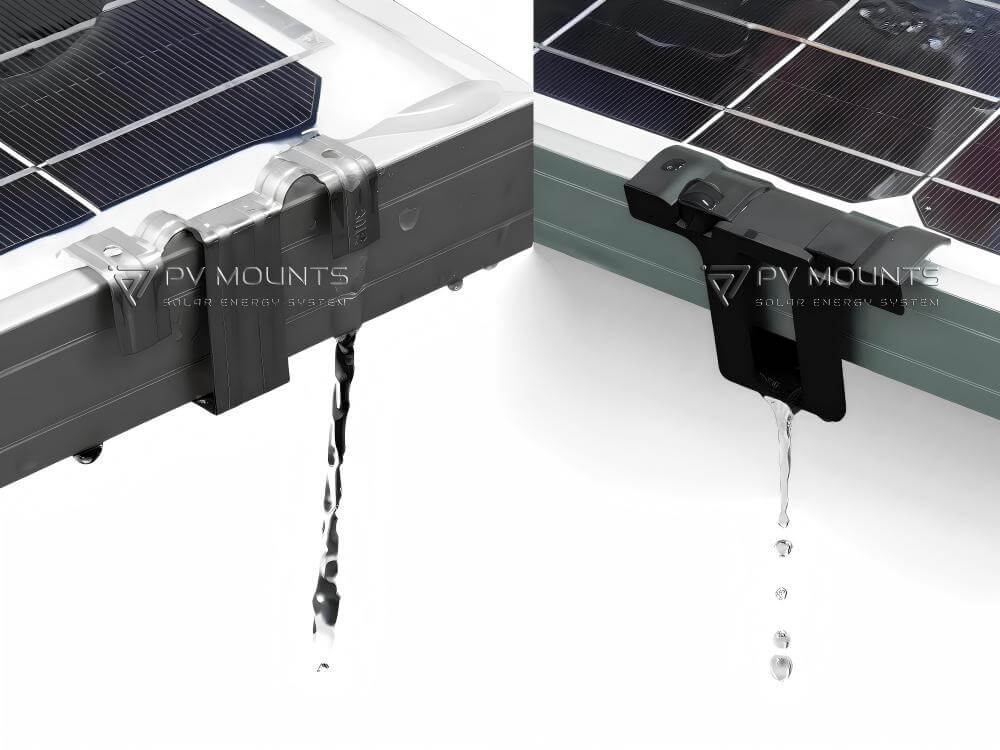
Solar panels are designed to withstand years of outdoor exposure, but many PV systems face a common issue that is often overlooked during installation: water accumulation along the lower edge of the module frame.
After rainfall, water can remain trapped inside the frame channel instead of draining away immediately. Over time, this retained water may collect dust, pollen, and debris, creating visible dirt strips along the lower edge of the solar panel.
To address this issue, many installers and EPC contractors have started incorporating solar water drainage clips into their mounting hardware procurement plans.
This guide explains how solar water drainage clips work, where they are used, how to select the correct type, and why they are becoming a popular accessory in modern solar installations.
1.Why Does Water Accumulate on Solar Panels?
Most framed solar modules use aluminum frames to improve structural strength and protect the panel edges.
However, the frame design can sometimes create small channels where rainwater becomes trapped.
When water remains inside the frame for extended periods, it may:
- Attract dust and airborne particles
- Create dirt accumulation near the lower edge of the panel
- Increase cleaning frequency
- Reduce the visual appearance of the PV array
- Contribute to localized shading in severe cases
Although water accumulation does not directly damage the solar panel, reducing water retention can help improve long-term system cleanliness and maintenance efficiency.
2.What Is a Solar Water Drainage Clip?
A solar water drainage clip is a small accessory installed at the lower edge of the solar panel frame.
Its purpose is to create a drainage path that allows water to exit the frame more quickly after rainfall.
By improving drainage efficiency, the clip helps reduce water retention and minimize dirt accumulation near the module edge. It can help
*Reduce dirt accumulation
*Improve drainage efficiency
*Reduce maintenance frequency
Because of their simple design and low cost, water drainage clips are increasingly used in residential, commercial, and industrial solar projects.
3.How Do Solar Water Drainage Clips Work?
The working principle is simple:
Rainwater enters the lower frame channel.
↓
Water becomes trapped inside the frame.
↓
A water drainage clip creates a drainage outlet.
↓
Water flows out more efficiently.
↓
Less standing water remains inside the frame.
↓
Reduced dirt build-up over time.
While drainage clips do not directly increase solar panel power output, they can help maintain cleaner module surfaces and reduce maintenance requirements.
4.Can Water Drainage Clips Help Reduce Hotspots?
This is one of the most frequently asked questions among solar installers.
Water drainage clips do not directly prevent hotspots.
However, by reducing water retention and minimizing dirt accumulation near the lower edge of the module, they may help reduce localized shading conditions that can contribute to hotspot formation over time.
For this reason, some EPC contractors include drainage clips as part of their long-term maintenance strategy for large rooftop solar systems.
5.Where Are Solar Water Drainage Clips Commonly Used?
Solar water drainage clips can be used in a wide range of PV applications, including:
*Rooftop Solar Systems
Residential and commercial rooftop installations often benefit from improved drainage and reduced dirt accumulation.
*Ground-Mounted Solar Systems
Utility-scale and commercial ground-mounted projects may use drainage clips to help maintain cleaner module surfaces.
*Solar Carports
Carport systems are exposed to rain, dust, and environmental contaminants, making drainage management beneficial.
*Agricultural Solar Projects
Agricultural environments often contain higher levels of dust and organic debris, increasing the importance of effective drainage.
*RV and Off-Grid Solar Systems
Compact solar systems can also benefit from improved water flow and reduced dirt accumulation.
6.Stainless Steel vs ABS Water Drainage Clips
The two most common drainage clip materials are stainless steel and ABS plastic.
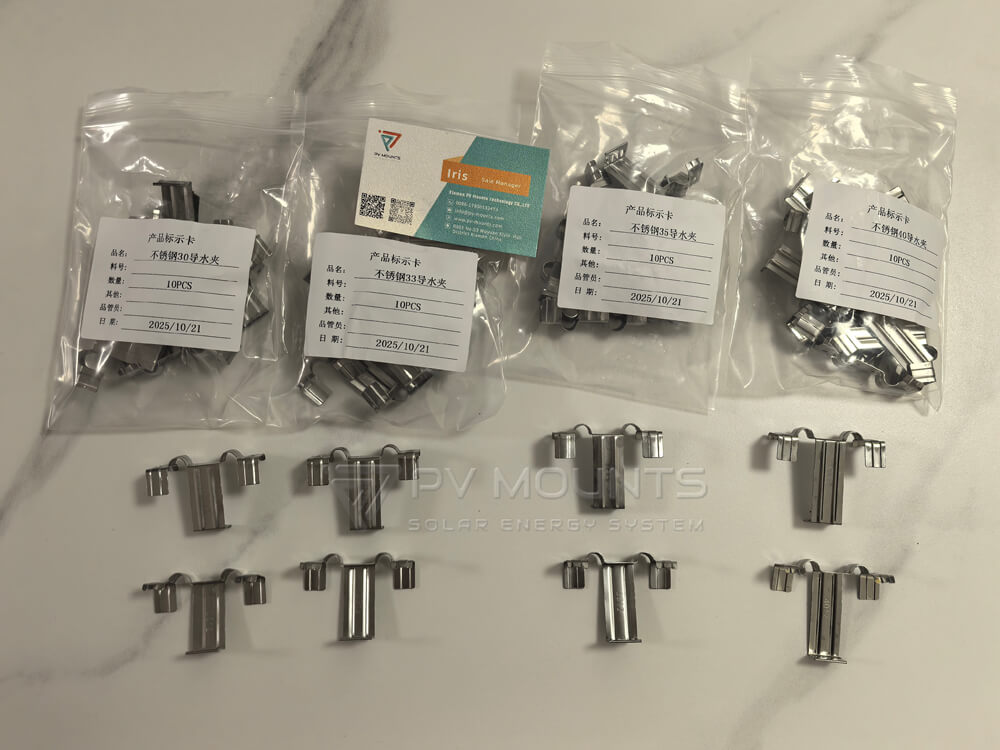
6.1 Stainless Steel Water Drainage Clips
Advantages:
- Excellent corrosion resistance
- High mechanical strength
- Long service life
- Suitable for harsh outdoor environments
- Strong retention on module frames
Stainless steel drainage clips are commonly used in commercial rooftop, ground-mounted, and coastal solar projects.
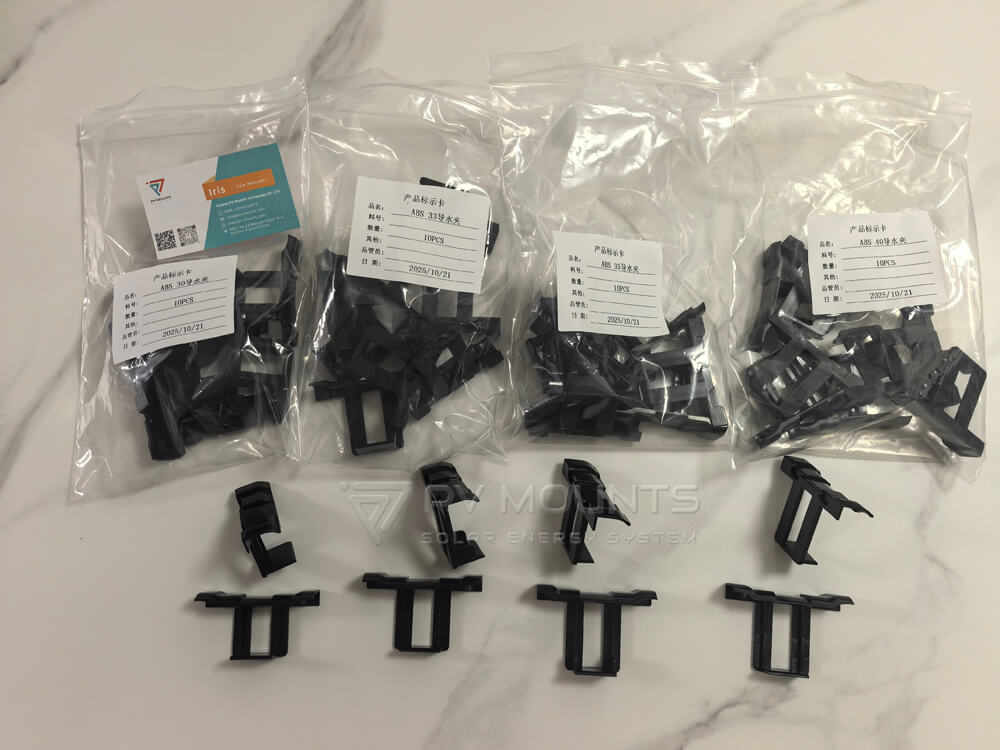
6.2 ABS Water Drainage Clips
Advantages:
- Lightweight
- Cost-effective
- Easy installation
- Suitable for standard environmental conditions
ABS drainage clips are often selected for residential rooftop solar systems and cost-sensitive projects.
Both options can provide effective drainage when properly matched to the solar module frame.
7.Stainless Steel vs ABS Solar Water Drainage Clips Comparison
Not all solar water drainage clips are manufactured from the same material. The two most common options in the market are stainless steel and ABS plastic.
The best choice depends on the installation environment, project requirements, and expected service life.
| Comparison Item | Stainless Steel Water Drainage Clip | ABS Water Drainage Clip |
|---|---|---|
| Material | SUS304 Stainless Steel | UV-Resistant ABS |
| Resistencia a la corrosión | Excellent | Good |
| UV Resistance | Excellent | Good |
| Mechanical Strength | High | Medium |
| Service Life | Long-Term Outdoor Use | Standard Outdoor Use |
| Coastal Projects | Recommended | Acceptable |
| High Temperature Resistance | Excellent | Good |
| Rooftop Solar | Adecuado | Adecuado |
| Ground Mount Solar | Adecuado | Adecuado |
| Solar Carport | Adecuado | Adecuado |
| RV Solar Systems | Adecuado | Adecuado |
| Custom Sizes Available | Yes | Yes |
| Common Frame Thickness | 30mm / 33mm / 35mm / 40mm | 30mm / 33mm / 35mm / 40mm |
For long-term commercial and industrial solar projects, many EPC contractors prefer stainless steel solar water drainage clips due to their superior durability and corrosion resistance.
For residential or cost-sensitive installations, ABS drainage clips can provide an economical solution while still delivering effective water drainage performance.
Industry suppliers commonly offer drainage clips compatible with module frames from approximately 28 mm to 40 mm, reflecting the range of frame thicknesses used in modern PV modules.
Recommended Drainage Clip Selection
| Project Condition | Recommended Material |
|---|---|
| Residential Rooftop | ABS or SUS304 |
| Commercial Rooftop | SUS304 |
| Ground Mount | SUS304 |
| Coastal Environment | SUS304 |
| High Humidity Area | SUS304 |
| RV Solar | ABS or SUS304 |
| Custom Module Frame | Customized Solution |
8.How to Select the Right Water Drainage Clip
Unlike grounding clips, drainage clip selection is primarily based on module frame thickness.
Before selecting a drainage clip, installers should verify the solar panel frame size.
Common frame thicknesses include:
- 30 mm
- 33 mm
- 35 mm
- 40 mm
Using the correct size ensures proper installation and secure attachment.
For projects using non-standard module frames, customized drainage clip solutions may also be available.
9.Standard and Customized Drainage Clip Solutions
Not all solar modules use identical frame dimensions.
For this reason, many EPC contractors prefer working with a solar mounting accessories manufacturer that can provide both standard and customized drainage clips.
At PV MOUNTS, drainage clips are available for common module frame thicknesses including:
- 30 mm
- 33 mm
- 35 mm
- 40 mm
Customized solutions can also be developed for special module frame requirements.
10.Common Mistakes When Installing Water Drainage Clips
*Selecting the Wrong Frame Size
Always verify module frame thickness before ordering.
*Installing Too Few Clips
Insufficient drainage points may reduce effectiveness.
*Ignoring Environmental Conditions
Projects in dusty or coastal regions may benefit from more durable drainage clip materials.
*Using Low-Quality Materials
Poor-quality clips may lose retention performance over time.
11.Real Project Example: Why Water Drainage Clips Were Added to the BOM
A commercial rooftop solar project in a coastal environment experienced recurring dirt accumulation along the lower edge of the solar modules.
During routine maintenance inspections, technicians observed that rainwater remained trapped inside the lower aluminum frame channel after rainfall. Over time, dust and airborne particles accumulated in the same area, creating visible dirt bands near the bottom edge of the modules.
To improve drainage performance, the EPC contractor added water drainage clips to the maintenance upgrade plan.
Project Conditions:
| Item | Project Information |
|---|---|
| Aplicación | Commercial Rooftop Solar |
| Module Frame Thickness | 35 mm |
| Installation Angle | Low-Tilt Rooftop |
| Environment | Coastal Area |
| Challenge | Water Retention and Dirt Build-Up |
| Selected Solution | SUS304 Water Drainage Clips |
After installation, rainwater was able to exit the frame channel more efficiently, reducing water retention and helping minimize future dirt accumulation.
Although water drainage clips are not designed to increase power output directly, many installers consider them a practical accessory for improving module cleanliness and reducing long-term maintenance requirements. Similar products are marketed in the industry for reducing water pooling and soiling, especially on low-tilt installations.
12.Why More EPC Contractors Are Including Water Drainage Clips in Their Procurement Plans
As solar projects continue to focus on long-term performance and reduced maintenance costs, many EPC contractors are paying greater attention to small accessories that improve system quality.
Although drainage clips represent only a small portion of total project cost, they can help improve drainage performance, reduce dirt accumulation, and support cleaner module operation over the system lifetime.
For this reason, solar water drainage clips are becoming a standard consideration in rooftop solar hardware procurement.
13.Why Water Drainage Clips Are Often Included in Premium Solar Mounting Hardware Packages
For many years, water drainage clips were considered optional accessories.
Today, more EPC contractors and solar installers are including them in premium solar mounting hardware packages, particularly for commercial rooftop and industrial solar projects.
Compared with the overall project cost, drainage clips represent a very small investment. However, they can help improve drainage performance, reduce dirt accumulation, and support cleaner module operation throughout the system life cycle.
As project owners place greater emphasis on long-term maintenance and system appearance, water drainage clips are becoming a standard accessory in many solar mounting hardware procurement plans.
14.Why More EPC Contractors Are Standardizing Water Drainage Clips
In the past, water drainage clips were often treated as optional accessories.
Today, more EPC contractors are including them as standard items within rooftop solar mounting BOMs, particularly for commercial and industrial projects.
The cost of drainage clips is relatively low compared with overall project investment, while the potential benefits include reduced dirt accumulation, improved module cleanliness, and lower maintenance requirements.
As a result, water drainage clips are becoming a common consideration during solar mounting hardware procurement.
15.Recommended Water Drainage Clip Selection by Module Frame Thickness
Selecting the correct drainage clip size is critical for secure installation.
| Solar Module Frame Thickness | Recommended Drainage Clip |
|---|---|
| 30 mm | 30 mm Drainage Clip |
| 33 mm | 33 mm Drainage Clip |
| 35 mm | 35 mm Drainage Clip |
| 40 mm | 40 mm Drainage Clip |
| Special Frame Size | Customized Solution |
At PV MOUNTS, both SUS304 stainless steel water drainage clips and ABS water drainage clips are available for common module frame thicknesses including 30 mm, 33 mm, 35 mm, and 40 mm. Customized solutions can also be developed according to customer requirements.
16.Conclusion
Solar water drainage clips are simple accessories that help improve water flow and reduce dirt accumulation on solar panels.
Whether using stainless steel or ABS versions, selecting the correct clip size based on module frame thickness is the most important factor.
For standard 30 mm, 33 mm, 35 mm, and 40 mm module frames, properly selected drainage clips can help support cleaner solar panels and reduce long-term maintenance requirements.
For special module designs, customized drainage clip solutions can provide optimal compatibility and installation performance.
PREGUNTAS FRECUENTES
A solar water drainage clip is an accessory installed on the lower edge of a solar panel frame to improve water drainage and reduce dirt accumulation.
Yes. They help water exit the module frame more efficiently, reducing water retention and dirt build-up over time.
Not directly. However, by reducing dirt accumulation and localized shading, they may help lower hotspot risks in certain situations.
The most important factor is solar panel frame thickness. Common sizes include 30 mm, 33 mm, 35 mm, and 40 mm.
Both work effectively. Stainless steel offers greater durability and corrosion resistance, while ABS provides a lightweight and economical solution.
Yes. They are commonly used in residential and commercial rooftop solar installations.
Yes. They are suitable for both rooftop and ground-mounted PV systems.
Yes. PV MOUNTS supplies drainage clips compatible with 30 mm, 33 mm, 35 mm, and 40 mm solar module frames.
Yes. PV MOUNTS can develop customized drainage clip solutions for special module frame dimensions and project requirements.
PV MOUNTS provides both stainless steel and ABS drainage clips, supports standard and customized sizes, offers engineering assistance, and helps EPC contractors improve compatibility across different solar projects.


 Spanish
  English
  Portuguese
  Russian
  Hungarian
  Arabic
  Romanian
  French