
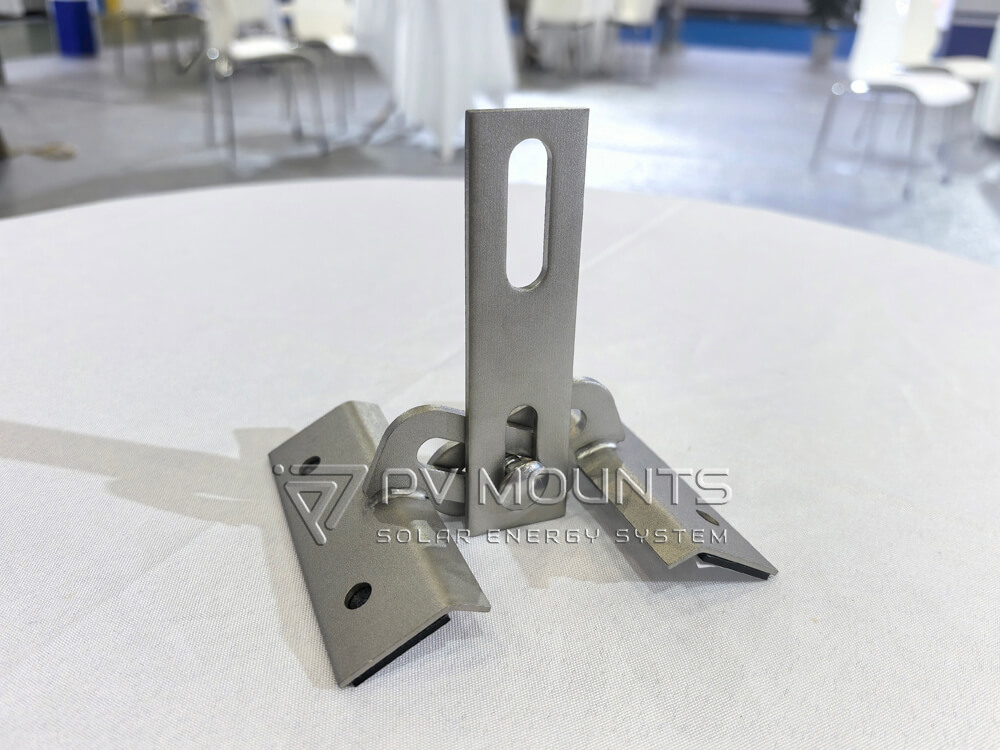
Trapezoidal metal roofs are widely used in commercial and industrial buildings because they are lightweight, durable, and cost-effective. These roofs provide an excellent surface for solar photovoltaic installations.
However, installing solar panels on trapezoidal metal roofs requires the correct mounting hardware to ensure structural safety and waterproof performance.
One of the most reliable solutions is the adjustable tin roof hook, which allows installers to adapt the mounting system to different roof profiles and heights.
This guide explains how to install solar panels on trapezoidal metal roofs using adjustable tin roof hooks in a safe and efficient way.
What Is an Adjustable Tin Roof Hook?
An adjustable tin roof hook is a solar mounting bracket designed for metal sheet roofs such as trapezoidal or corrugated roofing.
Unlike fixed brackets, adjustable hooks allow installers to modify the height or position of the mounting point to match different roof profiles.
Typical features include:
- Adjustable height structure
- Stainless steel or aluminum construction
- Compatibility with aluminum solar rails
- Fast installation on metal roofs
These adjustable features make the system more flexible for various industrial roof designs.
Why Trapezoidal Metal Roofs Are Ideal for Solar Installation
Trapezoidal metal roofing is widely used in industrial facilities across Europe.
This roof structure is common in countries such as Germany, Poland, Netherlands, and France.
Key advantages include:
- Large continuous roof area
- Simple structural framework
- Strong load-bearing capacity
- Fast installation for solar systems
These characteristics make trapezoidal roofs ideal for large commercial photovoltaic projects.
Tools and Materials Required
Before starting the installation, prepare the necessary tools and mounting components.
Tools
- Electric drill
- Llave dinamométrica
- Measuring tape
- Marker pen
- Safety equipment
Mounting components
- Adjustable tin roof hooks
- Self-drilling stainless steel screws with EPDM sealing washers
- Aluminum mounting rails
- Rail connectors
- Mid clamps and end clamps
Using high-quality stainless steel fasteners improves corrosion resistance and ensures long-term durability.
Step 1: Inspect the Roof Structure
The first step is to inspect the roof and confirm the structural conditions.
Check the following items:
- Metal sheet thickness
- Trapezoidal rib spacing
- Purlin spacing under the roof sheet
- Structural condition of the building
The adjustable tin roof hooks must be fixed into the structural purlins, not only into the metal sheet.
Proper anchoring ensures the system can withstand wind and snow loads.
Step 2: Mark Installation Positions
After evaluating the roof structure, mark the installation points for the adjustable tin roof hooks.
The spacing depends on several engineering factors:
- Solar module size
- Rail span distance
- Local wind load
- Snow load requirements
Accurate positioning ensures even load distribution and improves system stability.
Step 3: Install Adjustable Tin Roof Hooks
Place the adjustable hook at the marked position on the trapezoidal roof rib.
Secure the hook using stainless steel self-drilling screws.
Important installation recommendations:
- Use screws with EPDM waterproof washers
- Fix screws directly into the purlin below
- Avoid overtightening the screws
- Ensure the hook base sits flat on the roof surface
When tightening the screws, the EPDM washer compresses to create a reliable waterproof seal.
Step 4: Adjust Hook Height
One key advantage of adjustable tin roof hooks is the ability to adjust the mounting height.
After fixing the base bracket:
- Adjust the upper hook section to the required height
- Ensure the hook aligns correctly with the mounting rail
- Tighten the adjustment bolts securely
This flexibility allows installers to adapt the system to different roof shapes and maintain proper rail alignment.
Step 5: Install Aluminum Mounting Rails
Once all adjustable hooks are installed, the aluminum mounting rails can be attached.
Steps include:
- Align rails horizontally
- Connect rail sections using rail connectors
- Fix rails to the hooks with stainless steel bolts
Correct rail alignment is essential to ensure solar panels are installed evenly.
Step 6: Install Solar Panels
With the rail system complete, the solar modules can be mounted.
Typical installation process:
- Place the first solar module on the rail
- Secure the edge using end clamps
- Install the next modules using mid clamps
- Tighten all clamps according to torque specifications
Proper clamping ensures the panels remain secure under wind loads.
Final Inspection and Safety Check
Before finishing the installation, perform a final inspection of the system.
Check the following:
- All mounting screws are tightened properly
- EPDM sealing washers are correctly compressed
- Rails are aligned and securely fixed
- Solar modules are properly clamped
A thorough inspection helps ensure the system operates safely for many years.
Advantages of Adjustable Tin Roof Hook Systems
Adjustable tin roof hooks provide several important benefits for metal roof solar installations.
Key advantages include:
Flexible height adjustment for different roof profiles
Strong structural connection to roof purlins
Reliable waterproof sealing
Compatibility with standard solar mounting rails
Because of this flexibility, adjustable hooks are widely used in commercial solar installations.
Conclusión
Installing solar panels on trapezoidal metal roofs requires reliable mounting hardware to ensure safety, durability, and waterproof performance.
Adjustable tin roof hooks provide a flexible and efficient solution for different roof profiles and structural conditions.
By following proper installation procedures and using high-quality components, installers can ensure a stable solar mounting system with long-term performance.
PREGUNTAS FRECUENTES
Q1: Why use adjustable tin roof hooks instead of fixed brackets?
Adjustable hooks allow installers to adapt to different roof heights and profiles, improving installation flexibility.
Q2: Do adjustable tin roof hooks damage the roof?
When installed correctly with EPDM sealing washers, the waterproof integrity of the roof is maintained.
Q3: What materials are recommended for tin roof hooks?
Stainless steel or aluminum materials are commonly used to ensure corrosion resistance and long service life.



 Spanish
  English
  Portuguese
  Russian
  Hungarian
  Arabic
  Romanian
  French