
Quick Answer
A solar EPDM pad or gasket is a flexible rubber interface component used in selected rooftop solar mounting applications to provide sealing, cushioning, surface separation, and weather-resistant interface protection.
Depending on the mounting design, EPDM may be used with:
- Solar mini rails
- Adjustable solar tilt brackets
- Solar L feet
- Tin roof hooks
- Selected standing seam clamps
- Solar hanger bolts
- Self-tapping roofing screws with EPDM sealing washers
EPDM can also be supplied as a sealing strip between solar panels or PV modules where a flexible sealing interface is required.
The correct EPDM specification depends on the application, including its shape, thickness, dimensions, compression requirements, installation environment, and mating components. For custom applications, customers can provide drawings, dimensions, samples, photos, CAD files, or other technical details for evaluation.
For solar mounting procurement, EPDM should be specified as an interface and sealing component, not as a structural load-bearing component.
1. What Is a Solar EPDM Pad or Gasket?
EPDM stands for ethylene propylene diene monomer, a synthetic rubber commonly used where flexible sealing and weather-resistant interface properties are required.
In rooftop solar mounting, EPDM is typically installed between metal components and the roof-side interface or around a fastener connection.
Its exact form depends on the product:
- EPDM Pad — generally used as a larger interface layer or cushioning/sealing pad.
- EPDM Gasket — shaped to match a specific component or connection.
- EPDM Sealing Washer — used around a roofing screw or fastener to provide a sealing interface.
- EPDM Sealing Strip — supplied as a continuous or cut strip for applications such as sealing between solar panels.
The terminology should therefore be selected according to the actual application rather than treating every EPDM component as a generic rubber washer.
2. Why Is EPDM Used in Rooftop Solar Mounting?
EPDM is mainly used as an interface material between components.
Its functions can include:
2.1 Sealing
EPDM can help create a flexible sealing interface around roof penetrations or between mating components.
This is particularly relevant to:
- Hanger bolts
- Self-tapping roofing screws
- Roof-side mounting components
- Selected roof clamps
2.2 Cushioning
EPDM can provide a flexible layer between metal components and the supporting surface.
This can help accommodate minor surface irregularities and reduce direct metal-to-surface contact.
2.3 Surface Separation
EPDM can act as an interface layer between different materials or between a metal mounting component and the roof surface.
The exact requirement depends on the mounting design and material combination.
2.4 Weather-Resistant Interface
For outdoor rooftop applications, EPDM is selected where a flexible sealing or interface material is required to remain exposed to outdoor conditions.
The required material specification should be based on the project’s environmental and service requirements.
Engineering note: EPDM is not normally the structural load-bearing component of a solar mounting system. Structural loads are transferred through the metal mounting hardware and supporting roof structure according to the system design.
3. EPDM Pad vs EPDM Gasket vs EPDM Sealing Washer vs Sealing Strip
These terms are related but should not be used interchangeably.
| EPDM Type | Typical Application | Main Function |
|---|---|---|
| EPDM Pad | Mini rail, L foot, tilt bracket, hanger bolt, roof hook | Sealing, cushioning, interface |
| EPDM Gasket | Component-specific mounting interface | Sealing and surface interface |
| EPDM Sealing Washer | Self-tapping roofing screw | Fastener sealing interface |
| EPDM Sealing Strip | Between solar panels / PV modules | Flexible panel-to-panel sealing interface |
For procurement, the safest approach is to specify the application, dimensions, profile, material, and drawing rather than ordering only by the word “EPDM.”
4. Where Is EPDM Used in Rooftop Solar Mounting?
EPDM is not required on every solar mounting component.
Its use depends on the product design.
Common applications include:
- Solar Mini Rail
- Adjustable Solar Tilt Bracket
- Solar L Foot
- Cârlig cu acoperiș de tablă
- Selected Standing Seam Clamps
- Solar Hanger Bolt
- Self-Tapping Roofing Screw
- Solar Panel / PV Module Sealing Strip
The following sections explain these applications in more detail.
5. EPDM for Solar Mini Rail
Solar mini rails are commonly installed directly on metal roofing or other roof surfaces.
An EPDM pad can be placed between the mini rail and the roof surface to provide a flexible interface.
Typical functions include:
- Sealing at the roof-side interface
- Cushioning between aluminum and roof sheet
- Surface separation
- Accommodation of minor surface irregularities
The EPDM profile should match the mini rail base and the roof application.
When sourcing a mini rail with EPDM, procurement specifications should identify:
- Rail profile
- Rail length
- Aluminum alloy
- EPDM dimensions
- EPDM thickness
- EPDM attachment method
- Screw type
- Roof profile
6. EPDM for Adjustable Solar Tilt Brackets
Adjustable solar tilt brackets may use EPDM at the roof-side contact area.
The EPDM layer can provide a flexible interface between the bracket and the roof surface.
Depending on the bracket design, EPDM can help with:
- Sealing
- Cushioning
- Surface protection
- Weather-resistant interface
The required EPDM shape should be matched to the bracket base.
For procurement, the bracket and EPDM should be evaluated as an assembly rather than selecting the EPDM separately without checking the bracket geometry.
7. EPDM for Solar L Feet
Solar L feet can use EPDM at the roof-side interface, depending on the roof mounting configuration.
The EPDM pad may be installed between the L foot and the roof surface.
Typical functions include:
- Providing a flexible interface
- Supporting roof-side sealing
- Reducing direct metal-to-surface contact
- Accommodating minor interface irregularities
The L foot, EPDM pad, fastener, and roof structure should be considered together when determining the correct specification.
For example, PV mounting L feet may be supplied with:
- Aluminum L foot
- EPDM pad
- Fastener
- Flange nut or other connection hardware
The exact assembly depends on the roof structure and mounting system.
8. EPDM for Tin Roof Hooks
Some tin roof hook designs use EPDM at the roof-side interface.
For trapezoidal or corrugated metal roof applications, EPDM can provide a flexible sealing interface between the metal mounting component and the roofing sheet.
Typical considerations include:
- Roof sheet profile
- Hook geometry
- EPDM profile
- EPDM thickness
- Fastener arrangement
- Roof sheet thickness
- Supporting structure
The EPDM specification should therefore be matched to the specific tin roof hook design.
Important: EPDM should not be assumed to be required for every solar roof hook. The requirement depends on the specific hook and roof application.
9. EPDM for Selected Standing Seam Clamps
Some standing seam clamp models use EPDM, while others do not.
Where EPDM is incorporated into a standing seam clamp, it may provide an interface between the clamp and the standing seam roof surface.
Potential functions include:
- Surface protection
- Cushioning
- Sealing interface
- Material separation
Whether EPDM is required depends on the clamp construction and the roof system.
For procurement, confirm the exact clamp model and whether an EPDM component is included in the assembly.
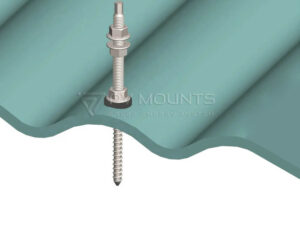
10. EPDM for Solar Hanger Bolts
EPDM is also used with solar hanger bolt assemblies.
A typical assembly can include:
M10 SUS410 Solar Hanger Bolt + SUS304 Flange Nut + EPDM Pad + Mounting Component
The upper mounting component can be:
- AL6005-T5 aluminum L foot
- AL6005-T5 aluminum plate
- SUS304 stainless steel plate
The hanger bolt fixing end depends on the roof supporting structure.
Steel Purlin Version
For suitable steel purlins, the hanger bolt uses a self-tapping screw thread at the fixing end.
Wood Purlin Version
For suitable timber structures, the hanger bolt uses a wood screw thread at the fixing end.
Standard PV Mounts sizes include:
- M10 × 200 mm
- M10 × 250 mm
- M10 × 300 mm
The EPDM pad provides the roof-side sealing/interface function within the hanger bolt assembly.
The required dimensions and installation arrangement should be confirmed according to the roof structure and mounting system.
11. EPDM Sealing Washer for Self-Tapping Roofing Screws
EPDM can also be integrated with self-tapping roofing screws as a sealing washer.
In this application, the EPDM washer is located beneath the screw head or flange area and forms a flexible sealing interface against the roofing sheet.
A typical assembly is:
Screw Head → EPDM Sealing Washer → Roofing Sheet
The correct washer dimensions depend on:
- Screw diameter
- Screw head geometry
- Washer diameter
- EPDM thickness
- Roofing sheet profile
- Required sealing interface
When purchasing self-tapping roofing screws for solar mounting, it is important to specify whether an EPDM sealing washer is required and whether it is supplied pre-assembled.
12. EPDM Sealing Strip for Solar Panels
EPDM can also be supplied as a sealing strip between solar panels or PV modules where a flexible sealing interface is required.
Unlike a roof-side EPDM pad, this application uses EPDM as a strip between adjacent panel surfaces or at a designated panel interface.
The required profile can depend on:
- Solar panel configuration
- Joint or interface design
- Strip width
- Strip thickness
- Strip length
- Cross-sectional profile
- Installation method
The EPDM sealing strip should be specified according to the actual panel application rather than using a standard roof-mounting pad specification.
Custom EPDM Solar Panel Sealing Strips
Xiamen PV Mounts accepts customized EPDM orders.
Customers can provide:
- Technical drawings
- Dimensions
- Cross-sectional drawings
- CAD files
- Physical samples
- Photos
- Application details
Based on the supplied information, PV Mounts can evaluate the required EPDM profile and specifications for the application.
This allows EPCs, distributors, mounting-system manufacturers, and other buyers to source application-specific EPDM components rather than adapting a standard size to a non-standard requirement.
13. How to Specify EPDM Pad Thickness
There is no single EPDM thickness suitable for every solar mounting application.
The required thickness depends on:
- Component geometry
- Roof surface
- Fastener arrangement
- Compression requirement
- Sealing interface
- EPDM profile
- Installation method
For this reason, thickness should be specified together with the component drawing and application.
For example:
EPDM Pad Specification
- Material: EPDM
- Thickness: [required value]
- Length: [required value]
- Width: [required value]
- Profile: [required profile]
- Application: Solar L Foot
- Drawing: Attached
This is more precise than simply requesting “solar EPDM gasket.”
14. EPDM Material Specifications
When purchasing EPDM components for solar applications, the material specification should be considered together with the application.
Typical procurement information can include:
Parameter Procurement Requirement Material EPDM Aplicație Roof mounting / panel sealing Grosime According to design Width According to component Length According to component Profile Flat / formed / custom Hardness According to application Outdoor exposure Project requirement Temperature range Project requirement Desen Recommended Sample Recommended for custom applications Material requirements should be agreed according to the actual operating environment rather than assuming one EPDM formulation is suitable for every project.
15. Selecting the Correct EPDM Geometry
For solar mounting applications, geometry can be just as important as material.
An EPDM pad or gasket may need to match:
- Mounting-hole position
- Fastener diameter
- Component base dimensions
- Roof profile
- Contact area
- Compression area
- Panel interface
- Sealing joint
For an EPDM sealing strip between solar panels, additional information may include:
- Panel-to-panel interface dimensions
- Required strip width
- Required thickness
- Cross-sectional shape
- Required length
- Installation method
For custom EPDM, a drawing or physical sample is the best starting point.
16. Pre-Assembled vs Separate EPDM Supply
EPDM can be supplied either separately or pre-assembled with the mounting component.
Pre-Assembled
Examples include:
- Mini rail + EPDM
- L foot + EPDM
- Hanger bolt + EPDM
- Self-tapping screw + EPDM sealing washer
Advantages can include:
- Easier installation
- Reduced component handling
- Lower risk of missing parts
- Easier packing and procurement
Separate Supply
Separate EPDM components may be preferable when:
- The customer already has the metal hardware
- The EPDM needs to be replaced
- A customer has its own mounting system
- The customer requires a custom EPDM profile
- The customer wants to source hardware and EPDM separately
The supply method should therefore match the customer’s procurement model.
17. EPDM Compatibility With Solar Mounting Components
EPDM should be evaluated together with its mating components.
For rooftop solar mounting, compatibility can involve:
EPDM → Metal Component → Fastener → Roof Surface → Supporting Structure
Important questions include:
- Does the EPDM geometry match the component?
- Is the thickness suitable for the interface?
- Does the hole position match the fastener?
- Is the EPDM profile suitable for the roof surface?
- Is the material suitable for the expected outdoor environment?
- Does the assembled component maintain the intended sealing/interface function?
For solar panel sealing strips:
EPDM Strip → Panel Interface → Joint Geometry → Installation Method
The strip should be evaluated based on the actual panel interface.
18. Common EPDM Procurement Mistakes
Mistake 1: Ordering only by “EPDM”
EPDM describes the material, not the complete product specification.
A buyer should also provide:
- Shape
- Dimensions
- Grosime
- Aplicație
- Drawing or sample
Mistake 2: Assuming all solar mounting components need EPDM
EPDM is application-dependent.
For example, some standing seam clamps use EPDM while others do not.
Mistake 3: Using the same EPDM profile for different products
An EPDM pad designed for a mini rail may not be suitable for an L foot or hanger bolt.
Mistake 4: Treating EPDM as a structural component
EPDM is generally an interface/sealing component. The structural load path should be evaluated through the metal mounting hardware and supporting structure.
Mistake 5: Specifying thickness without checking compression
A thicker pad is not automatically a better solution.
The required thickness depends on the actual interface and assembly.
Mistake 6: Ignoring the mating component
EPDM geometry must match the metal component, fastener, roof surface, or panel interface.
Mistake 7: Using a generic sealing washer where a custom gasket is required
Different applications can require different profiles.
For custom applications, a drawing or sample should be used to confirm the geometry.
19. EPC RFQ Checklist for Solar EPDM Components
For EPC projects and distributor purchasing, the RFQ should include sufficient technical information.
Item Required Information EPDM application Mini rail / L foot / hanger bolt / screw / panel sealing strip Material EPDM Product type Pad / gasket / sealing washer / sealing strip Grosime Required value Width Required value Length Required value Profile Drawing or cross-section Mating component Product model or drawing Tipul de acoperiș Metal / other applicable roof Fastener Type and size Installation environment Outdoor rooftop Cantitate Project quantity Ambalaje Bulk / pre-assembled / custom Sample If required For custom EPDM, the RFQ should include the drawing or sample whenever possible.
20. Custom EPDM Orders From Xiamen PV Mounts
Xiamen PV Mounts can accept customized EPDM orders for solar mounting and related applications.
Customers do not necessarily need to start with a standard catalog dimension.
You can provide:
- 2D drawings
- CAD files
- Dimensions
- Cross-sectional drawings
- Physical samples
- Product photos
- Existing component samples
- Application details
Typical customization information includes:
Material → Profile → Length → Width → Thickness → Hardness → Application → Mating Component
For solar mounting applications, custom EPDM can be developed or supplied for specific component interfaces where standard products do not match the required dimensions.
This is particularly useful for EPCs, distributors, mounting-system manufacturers, and buyers who already have their own hardware design.
21. EPDM in Multi-Supplier Solar Mounting Procurement
EPDM can be sourced as part of a complete solar mounting assembly or as an individual component.
For example, an EPC may purchase:
Solar Rail + L Foot + Hanger Bolt + EPDM + Fasteners
from one supplier.
Alternatively, the EPC may already have its own:
Rail + Fastener System
and only require a compatible EPDM component.
For custom requirements, providing the existing component drawing or sample allows the EPDM geometry to be evaluated before production.
This approach can give EPCs and distributors greater flexibility when managing multiple suppliers.
22. Quick EPDM Selection Guide
Aplicație EPDM Type Main Interface Solar Mini Rail EPDM Pad / Gasket Rail ↔ Roof Adjustable Tilt Bracket EPDM Pad / Gasket Bracket ↔ Roof Solar L Foot EPDM Pad / Gasket L Foot ↔ Roof Cârlig cu acoperiș de tablă EPDM Pad / Gasket Hook ↔ Roof Selected Standing Seam Clamp EPDM Pad / Gasket Clamp ↔ Roof Solar Hanger Bolt EPDM Pad Hanger Bolt ↔ Roof Self-Tapping Roofing Screw EPDM Sealing Washer Screw ↔ Roof Sheet Solar Panel / PV Module EPDM Sealing Strip Panel ↔ Panel Interface
23. Frequently Asked Questions
A solar EPDM pad is a flexible EPDM component used in selected solar mounting applications to provide sealing, cushioning, surface separation, or a weather-resistant interface.
EPDM may be used with mini rails, adjustable tilt brackets, L feet, tin roof hooks, selected standing seam clamps, hanger bolts, and self-tapping roofing screws with EPDM sealing washers.
Some standing seam clamp models use EPDM, while others do not. The requirement depends on the specific clamp design.
Normally, EPDM functions as a sealing, cushioning, or interface component rather than a structural load-bearing component. Structural loads are transferred through the metal mounting hardware and supporting structure according to the system design.
An EPDM pad or gasket is generally used as a larger component interface, while an EPDM sealing washer is typically used with a roofing screw or fastener.
Yes. EPDM can also be supplied as a sealing strip between solar panels or PV modules where a flexible sealing interface is required.
Yes. Xiamen PV Mounts can accept customized EPDM orders. Customers can provide drawings, dimensions, CAD files, physical samples, photos, or application details for evaluation.
At minimum, provide the application, material requirement, dimensions, thickness, profile, and mating component. A drawing or physical sample is recommended.
Yes. Depending on the product, EPDM can be supplied as part of a pre-assembled mounting component or separately.
There is no universal thickness. The correct thickness depends on the component geometry, sealing interface, compression requirement, and installation design.
Yes, depending on the application. Separate EPDM supply can be suitable when a customer already has the metal mounting hardware or requires replacement/custom components.
An EPDM sealing washer is commonly used with self-tapping roofing screws to provide a flexible sealing interface between the fastener and roofing sheet.
EPCs should provide the application, EPDM type, dimensions, thickness, profile, mating component, quantity, drawings or samples, and packaging requirements.
Yes. Custom EPDM components can be evaluated according to customer drawings, dimensions, CAD files, samples, photos, and application requirements.
24. Conclusion
EPDM is an important sealing and interface material in selected rooftop solar mounting and PV module applications.
The main applications can be summarized as:
EPDM Pad / Gasket → Mini Rail, Adjustable Tilt Bracket, L Foot, Tin Roof Hook, Selected Standing Seam Clamp, Hanger Bolt
EPDM Sealing Washer → Self-Tapping Roofing Screw
EPDM Sealing Strip → Solar Panel / PV Module Interface
For procurement, the correct EPDM specification should be based on the application, profile, dimensions, thickness, mating component, and installation environment rather than material name alone.
For non-standard requirements, customers can provide drawings, CAD files, dimensions, samples, photos, or application details. Xiamen PV Mounts accepts customized EPDM orders for solar mounting and related applications.
If you are sourcing EPDM components together with rooftop solar mounting hardware, provide your component drawing or sample so the required EPDM profile and specifications can be evaluated before production.

 Romanian
  English
  Spanish
  Portuguese
  Russian
  Hungarian
  Arabic
  French