
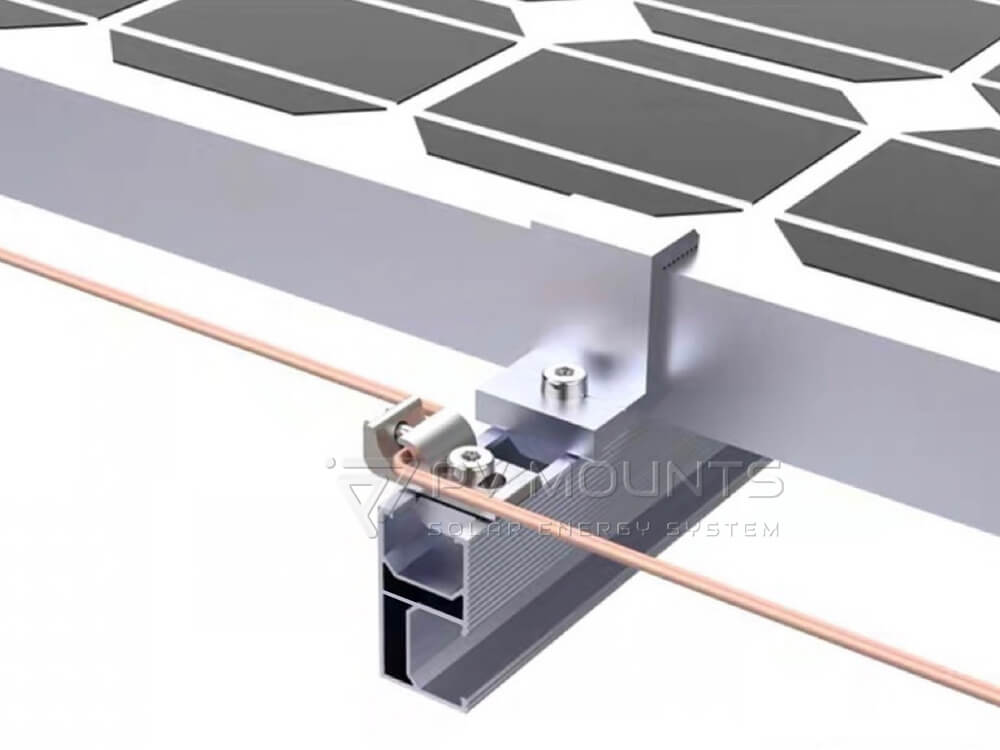
Definition
Solar grounding mistakes are installation, material selection, or component compatibility errors that may reduce the electrical reliability and safety performance of photovoltaic systems.
A properly designed PV grounding system requires correct selection and installation of:
- Solar grounding clips
- Earthing lugs (grounding lugs)
- Grounding conductors
- Mounting rails
- Bonding components
For EPC contractors and solar installers, avoiding PV grounding mistakes is critical because grounding performance directly affects:
- Electrical safety
- Fault current path reliability
- Long-term PV system operation
- Maintenance requirements
PV Mounts provides SUS304 stainless steel solar grounding clips y aluminum alloy earthing lugs designed for reliable photovoltaic grounding applications.
1. Why Solar Grounding Is Critical in PV Systems
A PV grounding system helps maintain electrical continuity and supports the fault current path within the PV grounding system and ensures electrical continuity between photovoltaic modules, mounting rails, and grounding conductors.
A complete grounding pathway typically includes:
PV Module Frame
↓
Solar Grounding Clip
↓
Carril de montaje
↓
Toma de tierra
↓
Grounding Conductor
↓
Grounding Electrode System
Each component has a specific function.
Incorrect installation or unsuitable component selection may cause:
- Poor electrical bonding
- Increased resistance
- Corrosion problems
- Grounding failure risk
Therefore, professional EPC projects require careful grounding component selection and installation control.
Quick Answer: What Are the Most Common Solar Grounding Mistakes?
| Mistake | Main Cause | Solution |
|---|---|---|
| Wrong grounding component selection | Confusing grounding clip with earthing lug | Use each component according to its electrical function |
| Wrong rail compatibility | Incorrect clip design | Match grounding clip with rail profile |
| Poor material selection | Low corrosion resistance | Use SUS304 stainless steel grounding components |
| Incorrect installation | Wrong torque or position | Follow manufacturer installation requirements |
2. Solar Grounding Mistake #1: Using Grounding Clips and Earthing Lugs Incorrectly
Mistake:
Assuming grounding clips and earthing lugs perform the same function.
Why It Happens:
Both components are photovoltaic grounding accessories, but their applications are different.
Correct Practice:
| Component | Función |
|---|---|
| Solar Grounding Clip | Creates bonding between PV module frame and mounting rail |
| Toma de tierra | Connects mounting structure to grounding conductor |
A grounding clip cannot replace an earthing lug.
An earthing lug cannot replace a grounding clip.
A complete PV grounding system requires both components working together.
3. Solar Grounding Mistake #2: Selecting the Wrong Grounding Clip for the Rail Profile
Mistake:
Using one grounding clip design for different mounting rail sections.
Why It Happens:
Solar rails have different:
- Cross-section designs
- Material thickness
- Surface treatments
- Installation structures
Risk:
Incorrect grounding clip selection may result in:
- Insufficient contact pressure
- Poor electrical continuity
- Unstable installation
Correct Selection Method:
Before selecting a grounding clip, confirm:
| Selection Factor | Requirement |
|---|---|
| Rail profile | Match grounding clip design |
| Rail material | Check compatibility |
| Module frame thickness | Ensure proper penetration |
| Installation method | Confirm mounting structure |
Engineering principle:
A grounding clip must match both the PV module frame and mounting rail design.
4. Solar Grounding Mistake #3: Choosing Low-Quality Materials
Mistake:
Selecting grounding components only based on price.
Risk:
Low-quality materials may cause:
- Corrosion
- Reduced mechanical stability
- Loss of electrical continuity
Recommended Materials:
| Component | Recommended Material |
|---|---|
| Solar Grounding Clip | SUS304 Stainless Steel |
| Earthing Lug Body | Aluminum Alloy |
| Fasteners | SUS304 Stainless Steel |
SUS304 stainless steel is preferred for grounding clips because it provides:
- Resistencia a la corrosión
- Stable spring performance
- Long outdoor durability
5. Solar Grounding Mistake #4: Mixing Incompatible Metals
Mistake:
Combining unsuitable materials in outdoor PV environments.
Risk:
Galvanic corrosion may occur when incompatible metals are exposed to moisture.
Common examples:
- Incorrect stainless steel selection
- Poor-quality fasteners
- Unsuitable aluminum connections
Correct Practice:
Use compatible photovoltaic grounding components designed for outdoor solar applications.
Material compatibility should be considered together with:
- Climate condition
- Installation environment
- Project lifetime
6. Solar Grounding Mistake #5: Incorrect Installation Torque
Mistake:
Over-tightening or under-tightening grounding connections.
Problems:
Incorrect torque may cause:
| Issue | Result |
|---|---|
| Too loose | Poor electrical connection |
| Too tight | Component damage |
| Incorrect fastening | Long-term reliability issues |
Correct Practice:
Follow the manufacturer’s recommended installation requirements.
Proper torque ensures:
- Mechanical stability
- Reliable electrical contact
- Long-term system performance
7. Solar Grounding Mistake #6: Installing Grounding Components Without Removing Contamination
Mistake:
Installing grounding components on contaminated surfaces.
Possible contaminants:
- Paint
- Dirt
- Oxidation
- Protective coatings
Risk:
Contamination may reduce electrical contact quality.
Correct Practice:
Ensure proper contact surfaces according to the mounting system design.
Through controlled mechanical penetration of anodized aluminum surfaces, Grounding clips with conductive teeth are designed to establish reliable contact with PV module frames and rails.
8. Solar Grounding Mistake #7: Reusing Damaged Grounding Components
Mistake:
Reusing grounding clips or damaged accessories during installation or maintenance.
Risk:
Repeated use may reduce:
- Spring force
- Mechanical reliability
- Contact performance
Correct Practice:
Replace damaged grounding components during installation or maintenance.
For long-life PV systems, component reliability is more important than short-term cost saving.
9. Solar Grounding Mistake #8: Ignoring Environmental Conditions
Mistake:
Using identical grounding components for every project environment.
PV systems operate in different conditions:
- Coastal areas
- High humidity regions
- Industrial environments
- Desert solar farms
Engineering Considerations:
| Environment | Recommended Consideration |
|---|---|
| Coastal PV | High corrosion resistance materials |
| Humid area | Stainless steel components |
| Industrial environment | Material compatibility |
| Utility-scale projects | Long lifecycle reliability |
SUS304 stainless steel grounding clips are commonly selected for demanding outdoor PV applications.
10. Solar Grounding Mistake #9: Not Considering PV System Lifecycle
Mistake:
Selecting grounding components based only on initial purchase price.
Reality:
Solar projects are designed for:
- 20–25 years electrical performance
- Long-term outdoor exposure
- Minimal maintenance
Professional EPC contractors evaluate:
- Initial cost
- Installation efficiency
- Maintenance requirements
- Long-term reliability
High-quality PV grounding accessories provide better lifecycle value.
11. Solar Grounding Mistake #10: Buying From Suppliers Without Manufacturing Capability
Mistake:
Purchasing grounding components without understanding supplier capability.
Risks:
- Inconsistent quality
- Material uncertainty
- Limited customization
- Poor project support
Professional Supplier Evaluation:
| Evaluation Factor | Requirement |
|---|---|
| Material control | SUS304 and aluminum verification |
| Manufacturing process | Precision production capability |
| Quality inspection | Dimension and performance checks |
| OEM capability | Customization support |
| Supply ability | Stable EPC project delivery |
Working with a professional stainless steel grounding clip manufacturer or PV grounding accessories manufacturer helps EPC buyers achieve consistent quality.
12. How EPC Contractors Prevent PV Grounding Mistakes
Professional EPC companies usually follow these steps:
Step 1: Confirm Component Function
Identify whether the project requires:
- Grounding clips
- Earthing lugs
- Grounding conductors
Step 2: Check Compatibility
Verify:
- Module frame
- Rail profile
- Grounding component design
Step 3: Confirm Material Quality
Select:
- SUS304 grounding clips
- Aluminum alloy earthing lugs
- Compatible fasteners
Step 4: Follow Installation Requirements
Ensure:
- Correct torque
- Correct installation position
- Proper inspection
How to Evaluate a Solar Grounding Components Manufacturer
| Evaluation Factor | What EPC Buyers Should Check |
|---|---|
| Material Control | SUS304 verification |
| Manufacturing Capability | Stamping and forming capability |
| Control de calidad | Dimension inspection |
| Personalización | OEM capability |
| Supply Stability | Bulk project support |
13. Soportes FV Solar Grounding Components Solution
PV Mounts provides photovoltaic grounding accessories for global solar projects.
| Product | Material | Función |
|---|---|---|
| Solar Grounding Clip | SUS304 Stainless Steel | Module-to-rail bonding |
| Toma de tierra | Aluminum Alloy + SUS304 Fastener | Ground conductor connection |
| Grounding Accessories | SUS304 / Aluminum | PV electrical bonding |
Our solutions support:
- EPC contractors
- Solar installers
- PV mounting system manufacturers
- Distributors
- Wholesale buyers
14.How EPC Buyers Prevent Solar Grounding Problems
表格:
| Procurement Factor | Recommended Practice |
|---|---|
| Material | Use SUS304 stainless steel grounding clips |
| Compatibility | Match module frame and rail profile |
| Supplier | Choose experienced PV grounding accessories manufacturer |
| Testing | Verify material and dimensional quality |
| Supply | Select supplier with stable production capability |
15.FAQ
The most common mistakes include incorrect component selection, poor compatibility, wrong installation method, and unsuitable materials.
No. Grounding clips and earthing lugs perform different electrical functions.
Common causes include:
*Incorrect grounding components
*Poor installation
*Material corrosion
*Incompatible connections
Because SUS304 provides corrosion resistance, mechanical stability, and long-term outdoor durability.
Select according to:
*Module frame design
*Rail profile
*Material compatibility
*Installation requirements
Routine PV inspection should verify:
Connection condition
Corrosion status
Mechanical stability
Most professional installations avoid grounding problems through correct engineering design and component selection.
Common materials include:
*SUS304 stainless steel
*Aluminum alloy
*Conductive metals designed for PV applications
Typical components include:
*Grounding clips
*Earthing lugs
*Grounding conductors
*Grounding hardware
Yes.PV Mounts provides OEM and wholesale photovoltaic grounding components for global solar customers.
Yes. Poor grounding connections may increase electrical safety risks and reduce system reliability.
Common causes include:
*incorrect rail compatibility
*improper installation
*corrosion
*insufficient mechanical contact
During regular PV maintenance according to project requirements and local regulations.
A complete PV grounding system usually includes grounding clips, earthing lugs, grounding conductors, bonding hardware, and compatible mounting components.
Yes, but material compatibility and galvanic corrosion considerations should be evaluated according to system design and installation environment.
A grounding clip bonds module frames to rails, while a grounding washer improves electrical contact between connected components.
Manufacturers provide better control over material quality, production consistency, customization, and project supply.
16.Conclusion
Solar grounding mistakes can reduce the reliability and safety performance of photovoltaic systems if components are incorrectly selected or installed.
Understanding the difference between grounding clips and earthing lugs, selecting compatible materials, and following proper installation practices are essential for long-term PV system performance.
PV Mounts supplies:
- SUS304 stainless steel solar grounding clips
- Aluminum alloy earthing lugs with SUS304 fasteners
- Complete photovoltaic grounding accessories
for EPC contractors, solar installers, distributors, and PV mounting system manufacturers worldwide.

 Spanish
  English
  Portuguese
  Russian
  Hungarian
  Arabic
  Romanian
  French