
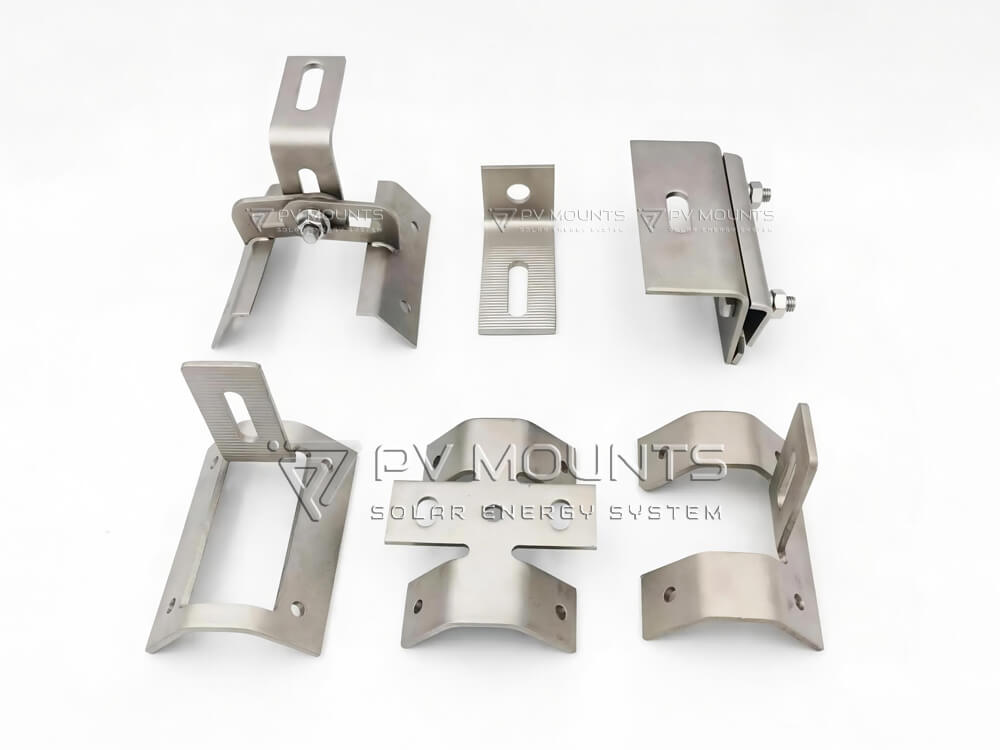
A practical sourcing, specification and procurement guide for EPC contractors, solar distributors, wholesalers, importers and PV mounting hardware buyers
Introducción
Solar mounting accessories are small components, but they have a major influence on the reliability, compatibility and installation efficiency of a photovoltaic mounting system.
A typical rooftop PV project may require roof attachments, rails, module clamps, stainless steel fasteners, cable clips, drainage accessories, grounding components and sealing materials. These components must work together with the PV module, mounting rail, roof structure and project-specific loads.
Acero inoxidable SUS304 is widely used for many solar mounting accessories because it offers a practical balance of corrosion resistance, mechanical performance, formability and cost for many outdoor PV applications.
However, a professional solar mounting system does not necessarily require every component to be made from SUS304.
Depending on the application, a complete system may combine:
- Acero inoxidable SUS304
- Aluminio AL6005-T5
- EPDM sealing components
- Other project-specified materials
The correct procurement principle is therefore:
Select the appropriate material, product and specification for each component rather than assuming that the complete mounting system should use one material.
This guide provides a complete B2B sourcing framework for SUS304 solar mounting accessories, including roof attachments, L feet, standing seam clamps, fasteners, cable management, drainage, grounding hardware, preliminary BOM estimation, quality control, packaging and RFQ requirements.
What This Guide Covers
This guide focuses on the selection, specification, sourcing and procurement of solar mounting accessories, with particular emphasis on SUS304 stainless steel components.
It is intended as a practical reference for:
- EPC contractors
- Solar project procurement teams
- Distributors
- Importers
- Wholesalers
- PV mounting system engineers
- Solar installation companies
It does not replace project-specific structural calculations, roof engineering, electrical design or the final approved mounting-system drawings.
For detailed product selection and installation procedures, this guide links to dedicated product and engineering resources throughout the PV MOUNTS website.
1. What Are SUS304 Solar Mounting Accessories?
SUS304 solar mounting accessories are photovoltaic mounting components manufactured from, or incorporating, Acero inoxidable SUS304.
They are commonly used in:
- Residential rooftop solar
- Commercial and industrial rooftop PV
- Tile roof mounting
- Corrugated metal roof mounting
- Trapezoidal metal roof mounting
- Standing seam roof mounting
- Cocheras solares
- Ground-mounted PV systems
- PV cable management
- Grounding and bonding systems
Typical SUS304 solar hardware may include:
- Tile roof hooks
- Selected metal roof attachments
- L pies
- Standing seam clamps
- T-bolts
- Nuts and washers
- Solar cable clips
- Grounding clips
- Earthing lugs
- Other stainless steel mounting accessories
The exact material should always be confirmed against the approved product drawing, technical datasheet and purchase-order specification.
2. Why Is SUS304 Widely Used in Solar Mounting Hardware?
PV mounting systems are exposed to outdoor environmental conditions for many years. Mounting components therefore need to maintain their mechanical and functional performance while resisting environmental exposure.
SUS304 is widely selected for solar hardware because it provides a useful combination of:
- Resistencia a la corrosión
- Mechanical performance
- Formability
- Outdoor suitability
- Manufacturing availability
- Cost efficiency
For many rooftop PV applications, SUS304 provides a practical stainless steel solution.
However, material selection should always consider the actual project environment.
For example:
- Standard outdoor environments may use SUS304.
- More aggressive chloride or chemical environments may require a separate material evaluation.
- AL6005-T5 is commonly used for lightweight structural rails and other aluminum mounting components.
- EPDM may be used for sealing, waterproofing and isolation.
Therefore:
SUS304 is a material option within a PV mounting system, not necessarily the material of every component.
3. Complete Solar Mounting Accessories Product Matrix
A complete PV mounting hardware package can be organized into five major procurement categories.
| Category | Core Products | Typical Material Options | Main Procurement Considerations |
|---|---|---|---|
| Roof Attachments | Tile roof hooks, tin roof hooks, L feet, standing seam clamps | SUS304 / AL6005-T5 / product-specific | Roof profile, structural load, waterproofing |
| Rail & Module Fastening | T-bolts, nuts, bolts, washers, mid clamps, end clamps | SUS304 / AL6005-T5 / product-specific | Rail compatibility, module frame, torque |
| Gestión de cables | 2-wire and 4-wire cable clips | SUS304 | Cable diameter, frame retention, corrosion resistance |
| Drainage Hardware | Water drainage and debris-management accessories | SUS304 / product-specific | Module frame and drainage geometry |
| Grounding & Bonding | Grounding clips, earthing lugs and bonding hardware | SUS304 / project-specified materials | Electrical continuity, compatibility and applicable standards |
This matrix provides a practical starting point for an EPC or distributor RFQ.
4. Solar Mounting Accessories by Roof Type
The correct mounting accessory is determined first by the roof structure and profile, and then by the required material and system configuration.
| Tipo de tejado | Main Mounting Hardware | Common Material Options | Key Selection Factor |
|---|---|---|---|
| Tile Roof | Tile roof hooks + rails + clamps | SUS304 / aluminum | Tile profile and rafter position |
| Trapezoidal Metal Roof | Tin roof hooks / TRH + rails | SUS304 / aluminum / product-specific | Roof rib geometry |
| Corrugated Metal Roof | L feet / roof attachments + rails | SUS304 / aluminum | Sheet and structural connection |
| Standing Seam Roof | Standing seam clamps + rails | SUS304 / aluminum | Exact seam profile |
| Other Rooftops | Project-specific mounting structures | Project-specific | Structural and waterproofing requirements |
This distinction is particularly important for B2B procurement.
For example, specifying:
“SUS304 solar mounting brackets”
is not enough to select the correct roof attachment.
The supplier also needs to know:
- Tipo de tejado
- Roof profile
- Module dimensions
- Structural conditions
- Design loads
- Required mounting configuration
5. SUS304 Tile Roof Hooks
Solar tile roof hooks connect the PV rail system to the supporting roof structure beneath the tiles.
They may be used with compatible:
- Clay tile roofs
- Concrete tile roofs
- Ceramic tile roofs
- Glazed tile roofs
- Other pitched tile roof systems
SUS304 is widely used for tile roof hooks because the hook forms an important part of the mechanical load path and is exposed to the outdoor environment.
Key Tile Roof Hook Specifications
When sourcing tile roof hooks, confirm:
- Stainless steel grade
- Material thickness
- Base plate dimensions
- Hook height
- Offset
- Adjustment range
- Tile clearance
- Rafter connection
- Rail interface
- Fastener specification
The load path can be simplified as:
PV Module
↓
Carril de montaje
↓
Gancho para tejado de tejas
↓
Fastener
↓
Rafter / Roof Structure
Therefore, tile hook quantity should not be determined using a universal number of hooks per module.
Final attachment spacing depends on factors such as:
- Wind load
- Snow load
- Rail span
- Cantilever
- Roof structure
- Module layout
- Hook capacity
- Fastener capacity
Deep-Dive Resource
Use the dedicated Solar Tile Roof Hook Guide for detailed hook selection, roof compatibility and installation considerations.
6. Tin Roof Hooks and Trapezoidal Metal Roof Attachments
Trapezoidal and corrugated metal roofs require mounting attachments that match the geometry of the roofing sheet and its supporting structure.
Common solutions include:
- Trapezoidal tin roof hooks
- Fixed metal roof hooks
- Adjustable metal roof hooks
- L pies
- Fastener assemblies
- EPDM sealing components
A metal-roof attachment assembly may therefore contain several different materials.
For example:
- Stainless steel mounting component
- Aluminum rail
- Stainless steel fastener
- Roofing screw
- EPDM sealing component
The correct procurement approach is to evaluate the complete attachment assembly, rather than judging the product only by its material.
Key Selection Factors
Confirm:
- Roof rib width
- Rib height
- Sheet thickness
- Purlin position
- Fastener position
- Waterproofing method
- Rail interface
- Wind load
- Snow load
- Required adjustment range
Deep-Dive Resources
Link this section to the existing:
Complete Guide to Trapezoidal Metal Roof Hooks
and:
Fixed vs Adjustable Metal Roof Hooks for Trapezoidal Roofs
These articles should remain the detailed product-selection resources rather than duplicating their full engineering content here.
7. SUS304 and AL6005-T5 Solar L Feet
Solar L feet are commonly used to connect mounting rails to metal roof structures.
Importantly, L feet are available in different material configurations.
Depending on the product and project requirements, L feet may be supplied as:
- SUS304 stainless steel L feet
- AL6005-T5 aluminum L feet
- Aluminum L feet with SUS304 stainless steel hardware
- L-foot assemblies incorporating EPDM sealing components
This gives EPC contractors flexibility to balance:
- Resistencia a la corrosión
- Structural requirements
- System weight
- Coste
- Installation requirements
When Should You Specify SUS304 L Feet?
SUS304 L feet may be appropriate when:
- Stainless steel is specified for the attachment
- Corrosion resistance is a major procurement consideration
- The project specification requires stainless steel
- The buyer wants a stainless steel attachment component
When Is an Aluminum L Foot Appropriate?
AL6005-T5 may be preferred when:
- Lightweight construction is important
- The mounting design is based on aluminum components
- The system is optimized for weight and cost
- The engineering design specifies aluminum
Therefore, an RFQ should clearly state the required configuration.
For example:
L Foot: SUS304 stainless steel
or:
L Foot: AL6005-T5 + SUS304 stainless steel hardware
Deep-Dive Resource
Link this section to your dedicated Solar L Feet Specification Guide.
8. Standing Seam Clamps: SUS304 and Aluminum Configurations
Standing seam clamps provide a mounting connection to compatible standing seam metal roofs without conventional penetration through the roof sheet.
Depending on the product design, standing seam mounting components may use:
- Acero inoxidable SUS304
- Aluminio AL6005-T5
- SUS304 stainless steel fasteners
- EPDM or other project-specific components
Therefore:
A SUS304 standing seam clamp is one available configuration; not every standing seam clamp should automatically be assumed to be SUS304.
Key Selection Factors
Before ordering, confirm:
- Roof manufacturer
- Exact roof profile
- Seam width
- Seam height
- Seam geometry
- Clamp opening
- Contact area
- Fastener specification
- Rail interface
- Structural load requirements
A clamp that physically fits a seam is not automatically suitable for structural loading.
The selected clamp should be verified against the roof profile and the applicable project requirements.
Deep-Dive Resource
Link to your existing Standing Seam Clamp Guide for detailed profile compatibility and installation information.
9. Rail and Module Fastening Hardware
Roof attachments connect the mounting system to the building structure.
Rails and module clamps then connect the mounting structure to the PV modules.
Typical hardware includes:
- T-bolts
- Hex socket bolts
- Flange nuts
- Lock nuts
- Washers
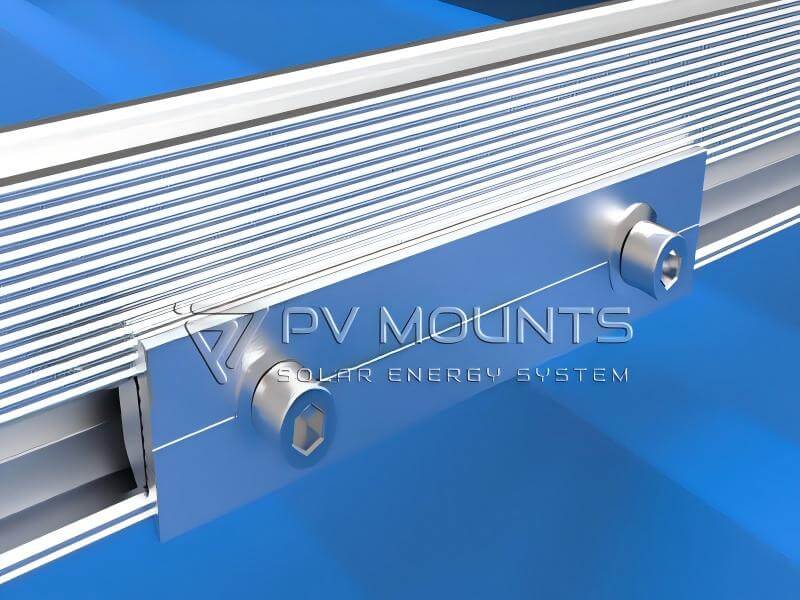
- Rail connectors
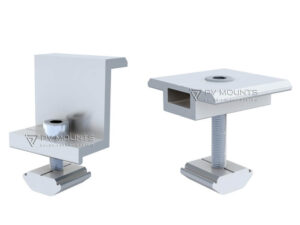
- Mid clamps
- End clamps
SUS304 stainless steel is commonly used for outdoor fasteners where corrosion resistance is required.
What Should an EPC Buyer Specify?
A professional purchase specification should identify:
- Thread size
- Bolt length
- Head type
- Material grade
- Nut type
- Washer type
- Rail compatibility
- Clamp compatibility
- Installation torque
For example:
M8 × 25 SUS304 stainless steel bolt + compatible PV mounting nut + washer
is significantly more useful than: Stainless steel solar bolt
The first specification gives the manufacturer a clear basis for production and quotation.
10. SUS304 Solar Cable Clips
Solar cable clips are used to organize and retain PV cables on module frames or approved mounting locations.
Typical functions include:
- Cable retention
- Wire organization
- Reduced cable movement
- Reduced abrasion risk
- Cleaner cable routing
- Reduced exposure of loose cables
SUS304 stainless steel cable clips are commonly selected for outdoor PV applications because they combine mechanical retention with corrosion resistance.
Cable Clip Selection Parameters
Confirm:
- Number of cables
- Cable outer diameter
- Cable cross-section
- Module frame thickness
- Clip opening
- Retention characteristics
- Installation position
- Environmental conditions
Different cable clip configurations may be designed for two-wire or four-wire applications.
Therefore:
Do not assume that one cable clip configuration fits every PV cable arrangement.
Deep-Dive Resources
Link this section to:
- What Is a Solar Cable Clip?
- Solar Cable Clip Selection Guide
- How to Install Solar Cable Clips
The Master Hub answers what to source, while the installation article answers how to install it.
11. Water Drainage and Debris-Management Hardware
Water drainage accessories are designed to help manage water and debris around PV module frames.
Depending on the product design, they may help reduce:
- Dirt accumulation
- Mud accumulation
- Leaf buildup
- Water retention around the module frame
However, drainage accessories should not be presented as a universal solution for eliminating PV module hot spots.
Their primary function is drainage and debris management.
Procurement Parameters
Confirm:
- Module frame profile
- Drainage-hole dimensions
- Clip geometry
- Material
- Installation position
- Module compatibility
- Environmental requirements
Deep-Dive Resource
Link this section to your existing Solar Water Drainage Clip Guide.
12. SUS304 Grounding and Bonding Hardware
Grounding and bonding components provide electrical continuity between conductive parts of a PV mounting system where required by the system design.
Common components include:
- Grounding clips
- Earthing lugs
- Bonding components
- Grounding washers
- Grounding fasteners
These components are not necessarily interchangeable.
Pinza de puesta a tierra
A grounding clip may establish electrical bonding between a PV module frame and mounting rail.
Toma de tierra
An earthing lug provides a connection point between the mounting structure and the grounding conductor.
A simplified grounding path may be:
PV Module Frame
↓
Pinza de puesta a tierra
↓
Carril de montaje
↓
Toma de tierra
↓
Grounding Conductor
↓
Grounding System
The actual grounding design must follow the applicable project electrical requirements and approved system design.
Deep-Dive Resource
Link this section to:
Solar Grounding Clip Installation Guide: Step-by-Step PV Bonding Procedure
13. SUS304 vs SUS316 vs AL6005-T5: Which Material Should You Choose?
A professional PV mounting system should use a multi-material engineering approach.
| Material | Main Advantage | Typical Applications |
|---|---|---|
| SUS304 | Corrosion resistance and mechanical performance | Hooks, fasteners, cable clips, grounding hardware, selected L feet and clamps |
| SUS316 | Higher corrosion resistance for selected aggressive environments | Project-specific coastal or chemically aggressive applications |
| AL6005-T5 | Lightweight structural material | Rails, L feet, clamps and other aluminum components |
| EPDM | Sealing and weather resistance | Waterproofing, sealing and isolation |
The Correct Procurement Question
Do not ask:
“Can the entire mounting system be SUS304?”
Instead ask:
“Which components should be SUS304, and which components should use aluminum or other materials?”
This allows the system to balance:
- Structural requirements
- Resistencia a la corrosión
- Peso
- Coste
- Installation efficiency
14. Can SUS304 Stainless Steel Be Used with Aluminum Solar Rails?
Yes.
SUS304 stainless steel hardware can be used with AL6005-T5 aluminum rails in PV mounting systems, provided that the connection is appropriate for the application.
A typical mounting configuration may include:
Rail → AL6005-T5
Roof Attachment → SUS304
Fasteners → SUS304
Cable Clips → SUS304
Sealing → EPDM
This is a multi-material mounting system, not a material contradiction.
The complete connection should still be evaluated for:
- Mechanical compatibility
- Corrosion environment
- Surface condition
- Electrical bonding
- Isolation requirements
- Applicable project standards
15. 1 MW Solar Mounting Hardware BOM: Preliminary Budgetary Benchmark
A 1 MW mounting hardware BOM cannot be finalized from system capacity alone.
The final quantity depends on:
- Module wattage
- Module dimensions
- Module layout
- Tipo de tejado
- Roof structure
- Wind load
- Snow load
- Rail span
- Attachment spacing
- Cable routing
- Drainage requirements
- Grounding design
For example, if a project uses 550 W modules:
1,000,000 W ÷ 550 W ≈ 1,818 modules
This provides a useful starting point for preliminary procurement estimation.
Preliminary Budgetary Benchmark
| Component | Estimating Basis | Budgetary Benchmark | Final Quantity |
|---|---|---|---|
| PV Modules | 1 MW ÷ module wattage | ~1,818 @ 550 W | Project-specific |
| Rieles | Module layout | Layout-based | Engineering BOM |
| Roof Hooks | Structural attachment points | No fixed module ratio | Structural design |
| Pies L | Structural attachment points | No fixed module ratio | Structural design |
| Abrazaderas de costura | Seam attachment points | Layout + seam design | Structural design |
| Mid Clamps | Module interfaces | Layout-dependent | Final layout |
| End Clamps | Row ends | Layout-dependent | Final layout |
| Cable Clips | Cable routing | ~2–4 pcs/module for preliminary budgeting | Project-specific |
| Drainage Clips | Applicable module design | ~1–2 pcs/module where applicable | Project-specific |
| Grounding Clips | Bonding design | System-dependent | Electrical design |
| Earthing Lugs | Grounding connections | System-dependent | Electrical design |
| Small Hardware | Bolts/nuts/washers | BOM + spare allowance | Final BOM |
Important Engineering Note
The quantities above are budgetary benchmarks, not universal installation requirements.
For example:
- Cable clip quantity depends on cable routing.
- Drainage clip quantity depends on module-frame design.
- Grounding quantity depends on the electrical bonding design.
- Roof hook quantity depends on structural design.
- L-foot quantity depends on attachment layout.
- Mid/end clamp quantity depends on module arrangement.
Therefore:
A preliminary BOM should never be treated as the final construction BOM without engineering verification.
16. Engineering Quantity vs Budgetary Quantity
This distinction is critical for EPC procurement.
Budgetary Quantity
Used for:
- Early project costing
- Supplier comparison
- Preliminary RFQ
- Budget preparation
- Container planning
Engineering Quantity
Used for:
- Final procurement
- Construction
- Instalación
- Structural approval
- Electrical approval
The recommended workflow is:
Budgetary Estimate
↓
Preliminary BOM
↓
Engineering Review
↓
Approved Layout
↓
Final BOM
This distinction allows suppliers to provide useful preliminary quantities without presenting an estimate as a guaranteed engineering requirement.
17. Stainless Steel Fastener Torque and Galling Prevention
Stainless steel fasteners require controlled installation.
One important issue is thread galling, sometimes referred to as cold welding.
Galling can occur when stainless steel threads experience high friction during tightening.
Recommended Practices
- Use the specified bolt and nut combination.
- Keep threads clean.
- Avoid damaged threads.
- Control installation speed.
- Use calibrated torque tools.
- Follow the manufacturer’s specified torque.
- Use approved anti-seize products where permitted.
- Avoid repeated unnecessary tightening and loosening.
- Do not exceed the specified torque.
What Torque Should Be Used for M8, M10 and M12 Stainless Steel Fasteners?
There is no single universal torque value that should be applied to every M8, M10 or M12 stainless steel PV fastener.
Actual torque depends on:
- Bolt size
- Fastener grade
- Nut configuration
- Thread condition
- Lubrication
- Washer configuration
- Connection design
- Manufacturer specification
Therefore, the purchase and installation documentation should specify:
Installation torque: according to the approved product specification and manufacturer’s installation instructions.
18. SUS304 Solar Hardware Quality Control
A professional B2B supplier should have a defined material and production quality-control process.
18.1 Material Certificates
For project orders, buyers may request:
- Material Test Reports
- Mill Test Reports
- Batch information
- Material-grade documentation
18.2 PMI Testing
Positive Material Identification, or PMI, can be used to verify alloy composition for selected components or incoming materials.
Where a project specifically requires SUS304 verification, the applicable inspection method should be agreed between buyer and supplier.
18.3 Dimensional Inspection
Typical inspection points include:
- Espesor
- Width
- Height
- Hole diameter
- Hole position
- Slot dimensions
- Thread dimensions
- Overall dimensions
18.4 Mechanical Testing
Depending on the product, testing may include:
- Tensile testing
- Pull-out testing
- Load testing
- Clamp strength testing
- Structural performance testing
The required test should correspond to the function of the component.
18.5 Corrosion Testing
Salt-spray testing may be used to evaluate corrosion resistance or surface-treatment performance where applicable.
However:
Salt-spray test hours should not automatically be interpreted as a guaranteed outdoor service life.
Actual durability depends on:
- Material
- Product design
- Environment
- Instalación
- Exposure
- Maintenance
- Surface condition
19. Packaging and Logistics for B2B Solar Hardware
Small mounting accessories can create significant procurement problems if packaging, labeling and quantity control are inconsistent.
Typical export packaging may include:
Small Hardware
- Poly bags
- Inner boxes
- Cajas de cartón
Larger Components
- Cajas de cartón
- Pallets
- Protective packaging where required
B2B Packaging Information
Cartons may be labeled with:
- Product model
- Cantidad
- Batch number
- Customer PO
- Carton number
- Net weight
- Gross weight
For container shipments, buyers should also confirm:
- Carton dimensions
- Pallet dimensions
- Pallet quantity
- Estimated container loading
- Moisture protection
- Product labeling
- OEM/private-label requirements
For large projects, packaging should be considered part of the procurement specification rather than an afterthought.
20. How to Build a Complete Solar Mounting Hardware RFQ
A professional RFQ should provide enough information for the manufacturer to identify the correct products and prepare an accurate quotation.
Project Information
Provide:
- Project location
- Project capacity
- Tipo de tejado
- Roof drawings
- Roof structure
- Wind load
- Snow load
Module Information
Provide:
- Module manufacturer
- Module model
- Module dimensions
- Module thickness
- Frame height
- Module quantity
- Portrait or landscape orientation
Mounting Information
Specify:
- Roof attachment
- Rail type
- Material requirements
- Module clamps
- Grounding requirements
- Cable management
- Drainage requirements
Commercial Information
Provide:
- Estimated quantity
- Destination port
- Required delivery date
- Certification requirements
- Packaging requirements
- OEM/private-label requirements
The more complete the RFQ, the more accurately a manufacturer can prepare:
- Product selection
- Preliminary BOM
- Cantidad
- Embalaje
- Quotation
- Lead time
21. Why Source Multiple Solar Hardware Components from One Manufacturer?
For EPC contractors and distributors, sourcing every mounting component from a different supplier can create:
- Dimensional incompatibility
- Different material specifications
- Rail-interface problems
- Inconsistent packaging
- Multiple QC processes
- Different production schedules
- Higher communication costs
- BOM coordination problems
A qualified solar mounting hardware manufacturer can coordinate:
Roof Attachment
↓
Ferrocarril
↓
Fastener
↓
Module Clamp
↓
Gestión de cables
↓
Drainage
↓
Grounding
This can simplify:
- Technical communication
- BOM management
- Quality control
- Embalaje
- Container loading
- Delivery coordination
For large EPC projects, supplier consolidation may reduce the overall procurement workload even when the lowest unit price is not the only consideration.
22. How to Evaluate a Solar Mounting Hardware Manufacturer
A professional supplier should be evaluated across several dimensions.
Manufacturing Capability
Can the manufacturer consistently produce the required components and quantities?
Engineering Capability
Can the supplier understand:
- Roof profiles
- Wind loads
- Snow loads
- Rail spans
- Module dimensions
- Attachment methods?
Material Control
Can the supplier clearly identify and document:
- SUS304
- SUS316 where applicable
- AL6005-T5
- EPDM
- Other project-specified materials?
Product Range
Can one supplier provide:
- Tile roof hooks
- Tin roof hooks
- L pies
- Standing seam clamps
- Rieles
- Mid clamps
- End clamps
- Fasteners
- Cable clips
- Drainage accessories
- Grounding components?
OEM Capability
Can the supplier support:
- Custom dimensions
- Custom tooling
- Private labeling
- Custom packaging
- Project-specific components?
Procurement Flexibility
Can the supplier support:
- Samples
- Trial orders
- Distributor orders
- Container quantities
- Project BOMs?
For B2B buyers, the best supplier is not necessarily the one offering the lowest unit price.
A more useful evaluation is:
Engineering capability + manufacturing consistency + material control + quality documentation + procurement flexibility + total project cost.
23. SOPORTES FOTOVOLTAICOS Solar Mounting Hardware Supply
PV MOUNTS supplies a broad range of rooftop PV mounting hardware and accessories, including:
- SUS304 tile roof hooks
- Tin roof hooks
- Trapezoidal roof hooks
- SUS304 L feet
- AL6005-T5 L feet
- SUS304 standing seam clamp configurations
- Aluminum standing seam clamp configurations
- Solar rails
- Mid clamps
- End clamps
- Mounting fasteners
- SUS304 solar cable clips
- Water drainage clips
- Grounding clips
- Earthing lugs
- Other PV mounting accessories
The product range follows a multi-material mounting-system approach.
Different components can therefore use different materials according to their engineering function.
For example:
SUS304 roof attachment + AL6005-T5 rail + SUS304 fasteners + SUS304 cable clips + grounding hardware + EPDM sealing
can form a complete mounting solution without requiring every component to be stainless steel.
This gives EPC contractors and distributors greater flexibility to balance:
- Structural requirements
- Resistencia a la corrosión
- Peso
- Coste
- Installation efficiency
24. How to Request a Complete Solar Mounting Hardware Quotation
To receive an accurate quotation, provide the manufacturer with as much project information as possible.
Proyecto
- Project location
- Project capacity
- Tipo de tejado
- Roof drawing
- Wind speed/load
- Snow load
Module
- Module model
- Module dimensions
- Module thickness
- Frame height
- Module quantity
- Module layout
Montaje
- Required roof attachment
- Rail requirement
- Material requirement
- Module clamp
- Grounding requirement
- Cable management
- Drainage requirement
Commercial
- Estimated quantity
- Destination port
- Required delivery date
- Certification requirements
- Packaging requirements
- OEM/private-label requirements
If the project is still at the preliminary stage, a supplier can often begin with:
Project capacity + location + roof type + module datasheet + approximate quantity
and develop a preliminary mounting hardware BOM.
25. 1 MW Solar Mounting Hardware BOM & Procurement Checklist
For EPC contractors and procurement teams, a preliminary BOM is often required before the final engineering package is completed.
A project-oriented checklist should cover:
- Module quantity calculation
- Roof attachment selection
- Rail configuration
- Mid/end clamp estimation
- Cable clip estimation
- Drainage hardware
- Grounding hardware
- Material specification
- Spare allowance
- Embalaje
- QC documentation
- RFQ requirements
Download the 1 MW Solar Mounting Hardware BOM & Procurement Checklist
For a project-specific BOM, provide your roof drawing and module datasheet.
26. Final Takeaway: How to Source SUS304 Solar Mounting Accessories
SUS304 is an important material for photovoltaic mounting hardware, but professional solar mounting procurement should not be based on the assumption that every component must be stainless steel.
The correct approach is:
Select the right product, material and specification for each component, then verify that the complete mounting system works together as an engineered system.
A complete rooftop PV mounting package may include:
- Roof Attachments
- Rieles
- Module Fasteners
- Gestión de cables
- Drainage
- Grounding
- Waterproofing
- QC Documentation
- Embalaje
The recommended procurement workflow is:
Project Data
↓
Roof & Module Analysis
↓
Mounting System Selection
↓
Selección de materiales
↓
Preliminary BOM
↓
Budgetary Quotation
↓
Engineering Verification
↓
Final BOM
↓
Sample / Approval
↓
Producción
↓
QC & Documentation
↓
Export Packaging
This workflow allows EPC contractors, distributors and importers to compare suppliers based on technical specification, material, quality, quantity and total project cost, rather than simply comparing unit prices.
FAQ: SUS304 Solar Mounting Accessories
Yes. SUS304 is widely used for many PV mounting components because it provides a practical combination of corrosion resistance and mechanical performance. The appropriate material still depends on the component, environment and project specification.
Depending on the product configuration, SUS304 may be used for tile roof hooks, selected metal-roof attachments, L feet, standing seam clamps, fasteners, cable clips, grounding clips and earthing hardware.
Yes. L feet can be supplied in SUS304 stainless steel or AL6005-T5 aluminum configurations, depending on the product and project requirements.
Yes. SUS304 stainless-steel standing seam clamp configurations are available. Aluminum configurations may also be used depending on the product design and project requirements.
Not universally. SUS304 is suitable for many outdoor PV applications, while SUS316 may be considered for selected environments with higher corrosion exposure. Material selection should be based on the actual project environment and specification.
Yes. SUS304 stainless steel hardware can be combined with AL6005-T5 aluminum rails when the connection is properly designed for the application. Mechanical compatibility, corrosion considerations and electrical bonding should be evaluated.
There is no universal number. Hook quantity depends on wind load, snow load, rail span, cantilever, roof structure, hook capacity and module layout.
At 550 W per module:
1,000,000 ÷ 550 ≈ 1,818 modules
The actual quantity depends on the selected module power and project design.
For preliminary budgeting, approximately 2–4 cable clips per module can be used as a starting benchmark. The final quantity should be based on cable routing, module design and installation requirements.
Depending on the project requirements, buyers can request material certificates, MTR documentation, batch information and PMI testing.
Control tightening speed, use the specified torque, keep threads clean, avoid damaged threads and use approved anti-seize products where permitted by the product specification.
Yes. A qualified solar mounting hardware manufacturer may supply roof attachments, L feet, standing seam clamps, rails, module clamps, fasteners, cable clips, drainage accessories and grounding hardware under one coordinated BOM.
Request a Complete SUS304 Solar Mounting Hardware Package
For EPC Contractors
Send your: Roof Drawing + Module Datasheet + Project Location for mounting hardware selection and preliminary BOM development.
Request a Preliminary 1 MW Mounting Hardware BOM
For Solar Distributors
Request the: Complete Product Range + Specifications + Wholesale Pricing
For Importers
Request: Container-Level BOM + Packaging Plan + Bulk Quotation
For Engineers
Request: Product Drawings + Technical Datasheets + Material Specifications + Engineering Support
For New Projects
Request a: Sample Kit for Product and Installation Evaluation
Need a Complete Solar Mounting Hardware Package?
Send us your project information and mounting requirements. PV MOUNTS can help identify the appropriate roof attachments, rails, fasteners, cable-management, drainage and grounding components for your project.
[REQUEST A QUOTATION] info@pv-mounts.com

 Spanish
  English
  Portuguese
  Russian
  Hungarian
  Arabic
  Romanian
  French