
Introducción
A solar mounting rail is a structural component of a rooftop photovoltaic mounting system. It supports PV modules and transfers mechanical loads through the mounting attachments to the building structure.
For EPC contractors, installers, distributors, and solar mounting system buyers, evaluating a solar rail should involve more than checking its appearance or price.
Important factors include:
- aluminum alloy
- rail profile
- dimensional consistency
- mechanical performance
- attachment compatibility
- surface treatment
- manufacturing quality
- test documentation
Third-party testing can provide additional evidence for product evaluation.
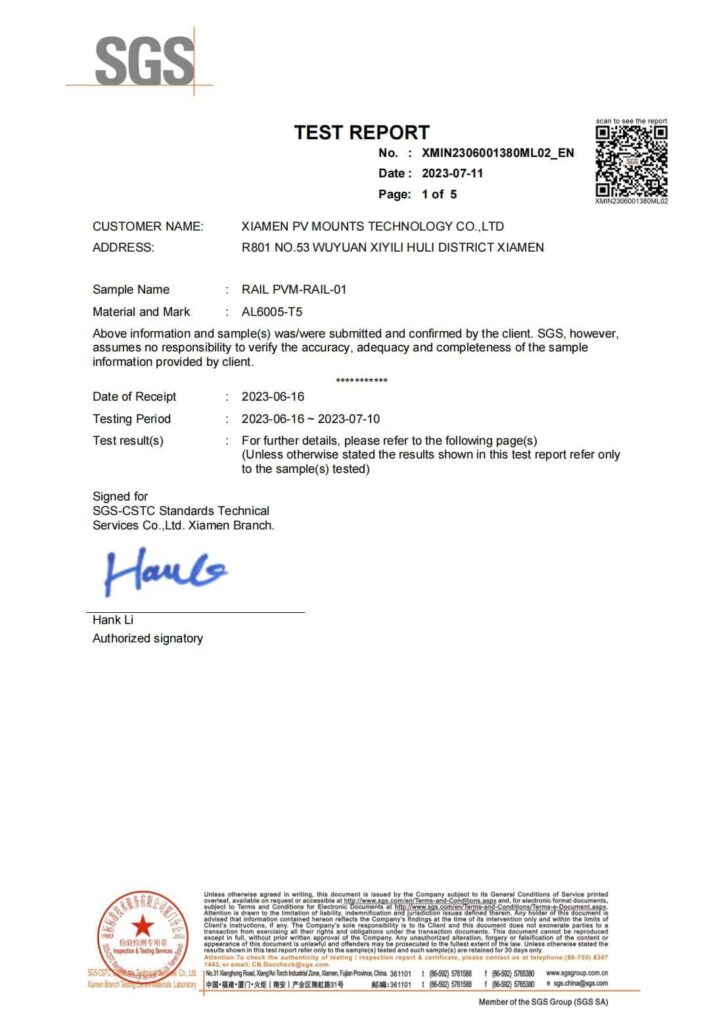
PV-MOUNTS PVM-RAIL-01 was tested by SGS in 2023. The SGS test report identifies the sample as RAIL PVM-RAIL-01 con AL6005-T5 material. The report includes chemical composition analysis, compression testing, and dimensional measurement.
This guide explains what the SGS test results show, how EPC buyers should interpret them, and why a test report should be evaluated together with project-specific structural requirements.
Quick Answer: What Does the SGS Test Report Show for PVM-RAIL-01?
An SGS-tested solar mounting rail has been evaluated under defined laboratory conditions, providing third-party evidence of the tested product’s performance. However, an SGS test result should not be treated as a universal allowable load. Final rail selection and attachment spacing must be verified according to project-specific wind, snow, span, support, and structural requirements.
According to SGS Test Report No. XMIN2306001380ML02_EN, the tested PVM-RAIL-01Fwas identified as AL6005-T5 and underwent three main evaluation areas:
| Test / Evaluation | SGS Result |
|---|---|
| Chemical composition | Pass |
| Compression test | Maximum force: 5,613 N |
| Compression test span | 600 mm |
| Loading rate | 5 mm/min |
| Dimensional measurement | 5 measured dimensions |
| Test period | June 16–July 10, 2023 |
| Report date | July 11, 2023 |
The compression result of 5,613 N was obtained under the specific test configuration described in the SGS report. It should not be interpreted as a universal allowable load or project design capacity.
1. What Is an SGS-Tested Solar Mounting Rail?
An SGS-tested solar mounting rail is a solar rail that has been submitted for testing under a defined SGS test program.
In the case of PV-MOUNTS PVM-RAIL-01, SGS tested a sample identified as:
Sample: RAIL PVM-RAIL-01
Material: AL6005-T5
Report No.: XMIN2306001380ML02_EN
The report was issued by SGS-CSTC Standards Technical Services Co., Ltd., Xiamen Branch on July 11, 2023.
The report states that the results refer to the sample tested. Therefore, buyers should distinguish between:
tested sample performance y project-specific design performance.
This distinction is particularly important when evaluating solar mounting rails for commercial and industrial PV projects.
2. What Was Tested on the PVM-RAIL-01 Solar Rail?
The SGS report contains three major evaluation areas:
- Chemical composition analysis
- Compression testing
- Dimensional measurement
These three areas provide different types of information.
| Evaluation | Main Purpose |
|---|---|
| Chemical composition | Verifies material composition against the specified requirement |
| Compression test | Evaluates mechanical behavior under the defined test condition |
| Dimensional measurement | Records critical physical dimensions |
Together, they provide a more useful quality picture than visual inspection alone.
3. SGS Chemical Composition Analysis of AL6005-T5 Solar Rail
Material verification is important because the aluminum alloy affects the mechanical and manufacturing characteristics of the rail.
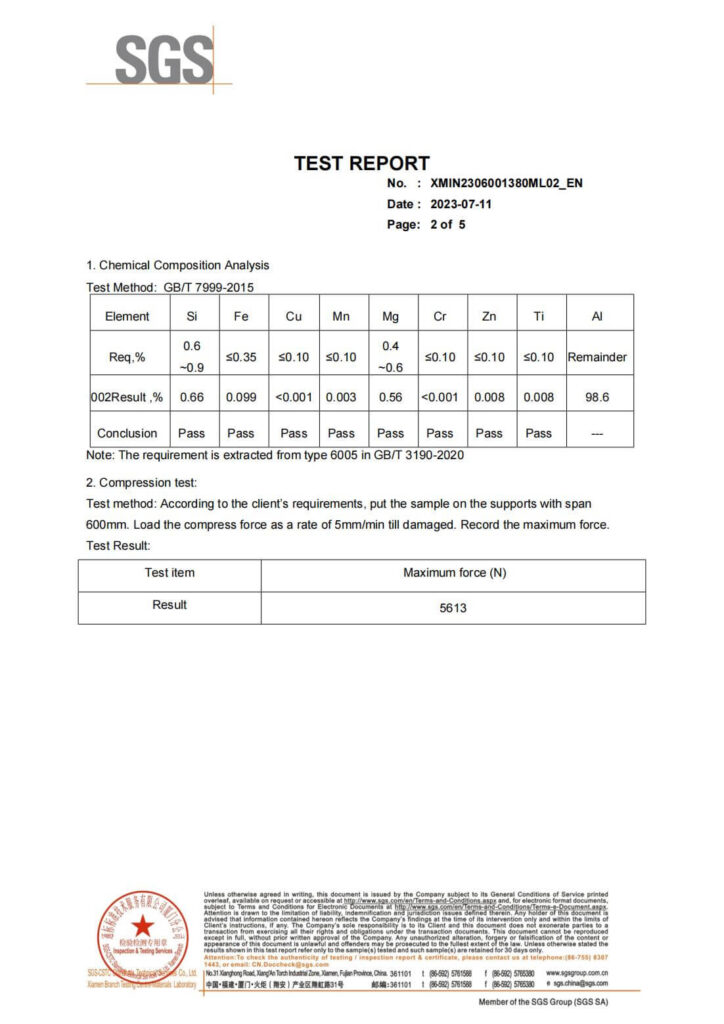
The SGS report identifies the PVM-RAIL-01 sample as AL6005-T5. The chemical composition analysis was conducted according to GB/T 7999-2015, with the requirements extracted from type 6005 in GB/T 3190-2020. The listed chemical composition requirements were reported as passing.
The reported results include:
| Element | SGS Result |
|---|---|
| Si | 0.66% |
| Fe | 0.099% |
| Cu | <0.001% |
| Mn | 0.003% |
| Mg | 0.56% |
| Cr | <0.001% |
| Zn | 0.008% |
| Ti | 0.008% |
| Al | 98.6% |
The report records Pass for the listed element requirements.
Why Does Aluminum Composition Matter?
For solar mounting rails, material selection needs to be considered together with:
- profile geometry
- wall thickness
- support spacing
- connection method
- applied loads
Therefore, identifying the aluminum alloy is important, but material grade alone does not determine the structural capacity of a solar rail.
4. SGS Compression Test of PVM-RAIL-01: 5,613 N Maximum Force
The compression test is one of the most important technical results in the report.
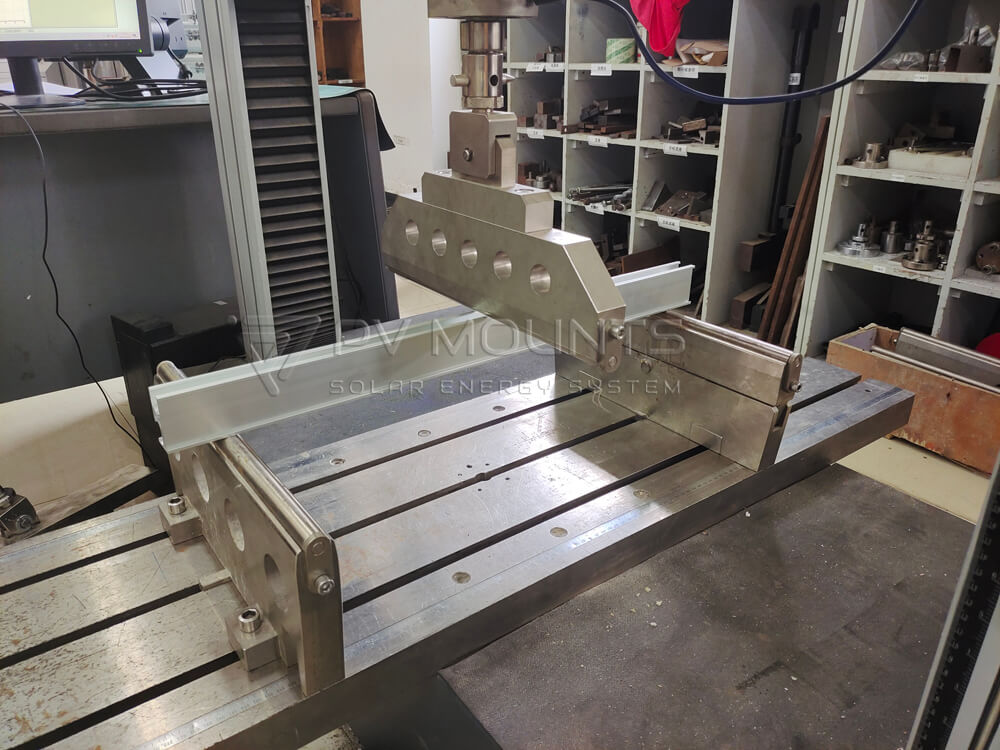
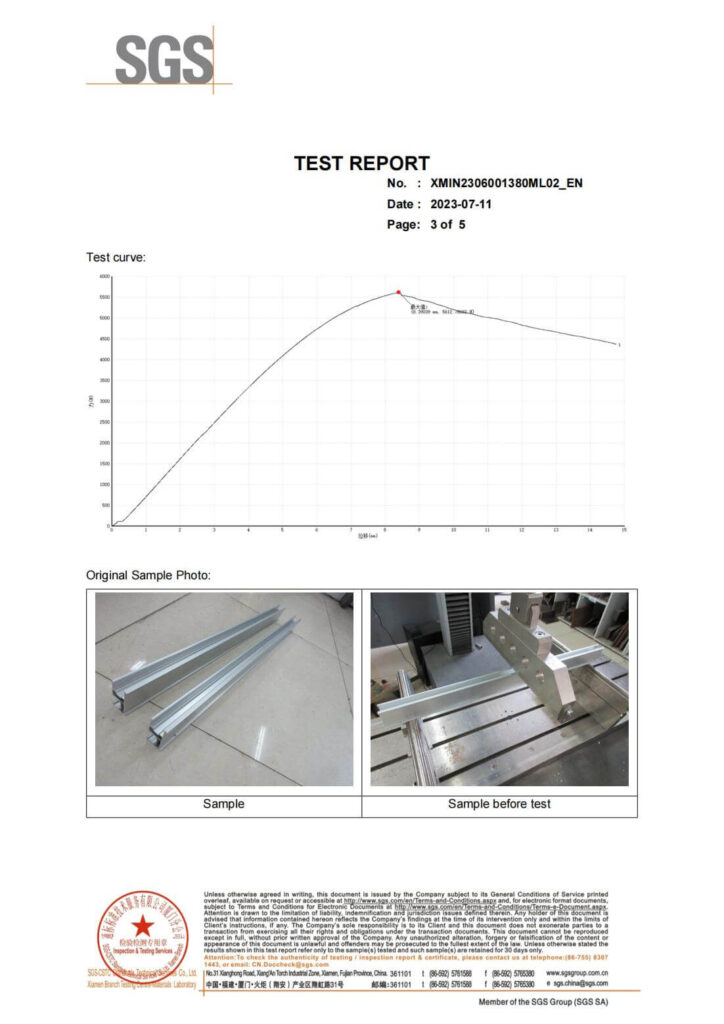
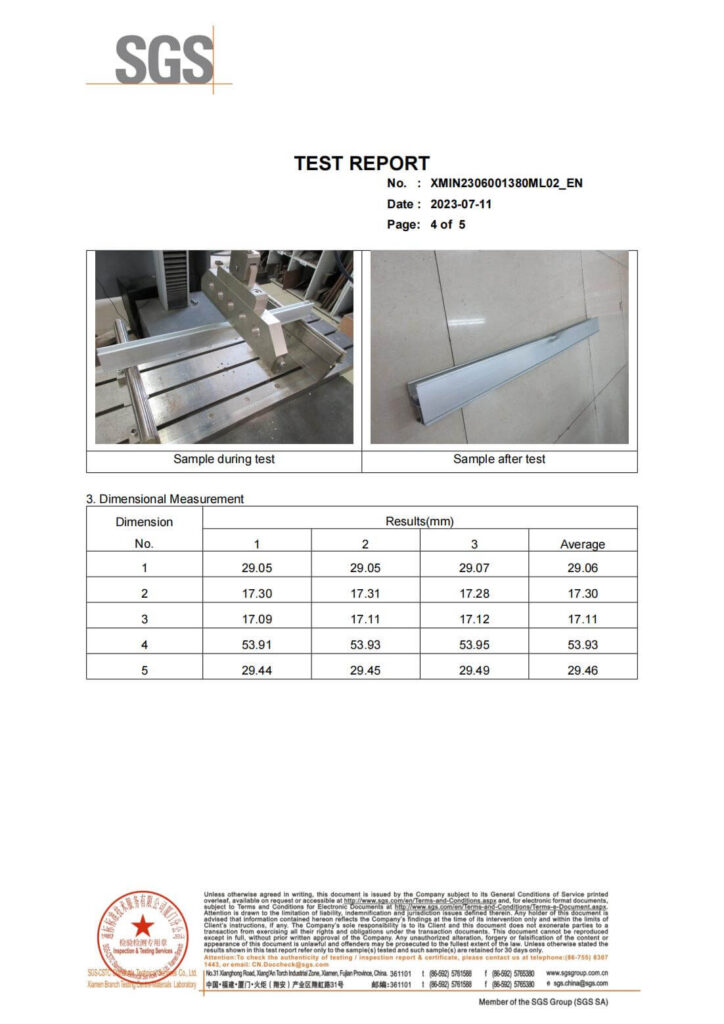
According to the SGS report, the sample was placed on supports with a 600 mm span.
Compression force was applied at a rate of 5 mm/min until the sample was damaged, and the maximum force was recorded.
SGS Test Result
Maximum force: 5,613 N
This is the maximum force recorded under the defined test configuration.
The result can therefore be summarized as:
PVM-RAIL-01
↓
600 mm support span
↓
Compression loading
↓
5 mm/min loading rate
↓
Maximum recorded force: 5,613 N
5. What Does the 5,613 N Result Mean?
The 5,613 N result demonstrates the mechanical response of the tested PVM-RAIL-01 sample under the specific compression test conditions described in the report.
However, it should not be described as:
- universal rail capacity
- allowable project load
- universal wind-load capacity
- universal snow-load capacity
- maximum safe span for every PV project
This is because the actual structural performance of a solar mounting rail depends on the complete installation configuration.
Important variables include:
- rail profile
- rail span
- support spacing
- load direction
- attachment method
- module configuration
- wind load
- snow load
- roof structure
Therefore:
The SGS result provides test evidence for the defined configuration; project-specific structural design is still required to determine the appropriate rail configuration.
This distinction is particularly important for EPC procurement and engineering approval.
6. Why Solar Rail Profile Matters
Two solar rails may use the same aluminum alloy but have different structural performance.
The reason is that structural behavior depends strongly on the cross-sectional geometry.
Important profile characteristics include:
- profile height
- profile width
- wall thickness
- internal geometry
- cross-sectional properties
The rail therefore needs to be evaluated as a complete structural profile.
A simple comparison is:
- Material
- Rail Profile
- Support Conditions
- Span
- Applied Load
=
Structural Performance
This is why an EPC buyer should not select a solar mounting rail based only on the statement “AL6005-T5 aluminum.”
7. SGS Dimensional Measurement of PVM-RAIL-01
Dimensional consistency is important for solar mounting rail installation because the rail must interface correctly with:
- mid clamps
- end clamps
- roof attachments
- fasteners
- other mounting components
The SGS report records five dimensional measurement items, with three measurements taken for each item and an average reported.
The reported averages were:
| Measurement | Average |
|---|---|
| No. 1 | 29.06 mm |
| No. 2 | 17.30 mm |
| No. 3 | 17.11 mm |
| No. 4 | 53.93 mm |
| No. 5 | 29.46 mm |
The SGS report provides these measured values as part of the dimensional evaluation of the tested sample.
For production procurement, buyers should also compare the production drawing and inspection requirements with the supplied product.
8. Why Dimensional Accuracy Matters for Solar Mounting Rails
A solar mounting rail needs to work consistently with the complete mounting system.
Dimensional consistency affects:
- clamp compatibility
- attachment connection
- installation efficiency
- module alignment
- system assembly
For large EPC projects, even relatively small dimensional inconsistencies can create installation problems when hundreds or thousands of components are assembled.
Therefore, rail quality verification should include both:structural performance y dimensional control.
9. Solar Rail Testing and the Complete Load Path
A solar mounting rail does not work independently.
The typical rooftop PV load path is:
PV Module
↓
Mid Clamp / End Clamp
↓
Solar Mounting Rail
↓
Roof Attachment
↓
Fastener / Clamp
↓
Roof Structure
Depending on the roof application, the attachment may include:
- Solar L Feet
- TRH Tin Roof Hooks
- Tile Roof Hooks
- Abrazaderas de costura
- Adjustable Tilt Brackets
- Tripod systems
Therefore, rail performance needs to be considered together with the selected attachment and support structure.
10. Solar Rail Span and Structural Performance
Rail span is an important engineering parameter.
The same solar rail can behave differently when installed with different support spacing.
For example:
Shorter Span
Rail → Support → Rail → Support
Generally reduces the bending demand on the rail.
Longer Span
Rail →———— Support
Generally increases bending demand.
The appropriate span depends on:
- wind load
- snow load
- module size
- rail profile
- support conditions
- attachment spacing
- project design requirements
Therefore, the 600 mm span used in the SGS compression test should not automatically be converted into a universal installation span.
The test configuration and actual project configuration must be evaluated separately.
11. SGS Test Report vs Solar Project Structural Calculation
An SGS test report and a project structural calculation serve different purposes.
| SGS Test Report | Project Structural Calculation |
|---|---|
| Physical test evidence | Engineering analysis |
| Defined test configuration | Site-specific conditions |
| Measured test results | Design verification |
| Tests a specific sample | Evaluates proposed system |
| Supports product evaluation | Supports project design |
A third-party test report can therefore strengthen supplier and product evaluation, but it does not replace project-specific engineering.
For an EPC project, engineers may still need to evaluate:
- site wind conditions
- snow loads
- building height
- roof geometry
- module dimensions
- rail span
- attachment spacing
- roof structure
- applicable design requirements
12. What Should EPC Buyers Check in an SGS Solar Rail Test Report?
Before accepting an SGS test report, buyers should verify:
1. Product Identification
Does the report identify the same:
- product model
- rail profile
- manufacturer
- material
as the product being purchased?
2. Test Method
What test method or procedure was used?
3. Test Configuration
What were the:
- support conditions?
- span?
- loading direction?
- loading rate?
4. Test Result
What was actually measured?
5. Report Traceability
Does the report have:
- report number
- date
- manufacturer
- sample identification?
6. Applicability
Does the tested configuration reasonably represent the proposed application?
This approach is much more useful for professional procurement than simply checking whether a supplier says “SGS tested.”
13. What Does the PVM-RAIL-01 SGS Report Prove?
Based on the report, the following can be stated directly:
Material
The tested sample was identified as AL6005-T5, and the listed chemical composition requirements were reported as passing.
Compression Test
The sample reached a maximum recorded force of 5,613 N under the defined compression test conditions with a 600 mm support span y 5 mm/min loading rate until damage.
Dimensions
Five dimensional items were measured, with three measurements recorded for each and average values reported.
Traceability
The report identifies the sample as RAIL PVM-RAIL-01 and provides the test report number XMIN2306001380ML02_EN.
Solar Mounting Rail SGS Test Results: What the Report Shows
| SGS Test Item | PVM-RAIL-01 Result |
|---|---|
| Product | PVM-RAIL-01 |
| Material | AL6005-T5 Aluminum |
| Test Type | Compression Test |
| Support Span | 600 mm |
| Loading Rate | 5 mm/min |
| Maximum Recorded Force | 5,613 N |
| Dimensional Measurement | Performed |
| Chemical Composition Analysis | Performed |
| SGS Report No. | XMIN2306001380ML02_EN |
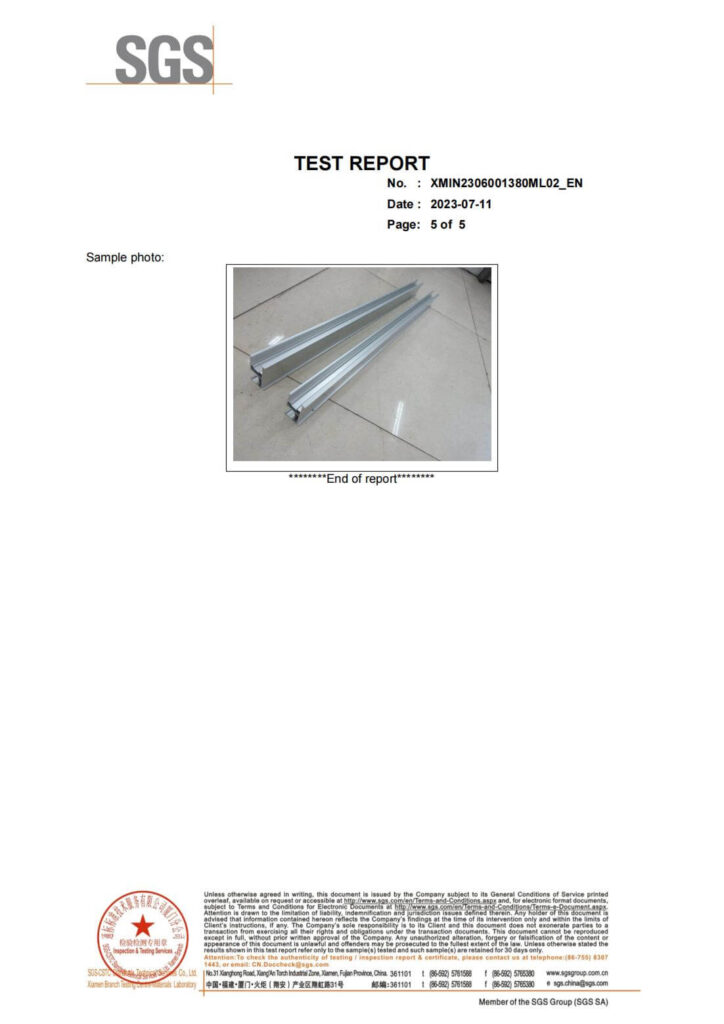
An SGS solar rail test result should be interpreted within the specific test configuration used by the laboratory.
The reported maximum force demonstrates the performance of the tested rail under the defined support conditions, loading method, and test setup. It should not be directly converted into a universal allowable load for every rooftop PV project.
For project design, EPC engineers should consider the rail profile, support span, attachment spacing, roof structure, wind load, snow load, module configuration, and applicable structural design requirements.
Therefore, SGS testing provides independent product verification, while project-specific structural calculations determine the appropriate rail configuration for a particular installation.
14. What Does the SGS Report Not Prove?
The report should not be interpreted as proving that the rail:
- has the same capacity under every span
- can withstand every wind condition
- can withstand every snow condition
- is suitable for every roof structure
- has a universal allowable load of 5,613 N
- can replace project-specific structural calculations
The report itself states that the results refer to the sample tested.
This is an important technical limitation and should remain clear in the article.
What Does the SGS Solar Rail Test Result Mean for EPC Projects?
The SGS test result provides evidence of the tested rail under a defined laboratory configuration. EPC engineers should not directly convert the reported maximum force into an allowable design load. The final rail span, attachment spacing, and structural configuration should be verified against project-specific wind, snow, roof, and support conditions.
15. Solar Mounting Rail Quality Verification Beyond SGS Testing
Third-party testing is valuable, but professional quality evaluation should not rely on one document alone.
EPC buyers should also review:
Calidad del material
- aluminum alloy specification
- material documentation
- production consistency
Dimensional Quality
- rail profile
- wall thickness
- critical dimensions
- connection dimensions
Tratamiento de superficies
- anodized finish
- surface consistency
- outdoor durability requirements
Manufacturing Quality
- extrusion quality
- cutting accuracy
- hole accuracy where applicable
- burr control
- packaging
Technical Documentation
- product drawings
- specifications
- test reports
- inspection documentation
- installation information
A strong supplier should be able to provide both physical product quality y technical documentation.
16. What Documents Should a Solar Rail Supplier Provide?
For EPC and distributor procurement, buyers may request:
| Document | Purpose |
|---|---|
| Product drawing | Confirm profile and dimensions |
| Material specification | Confirm aluminum alloy |
| SGS test report | Review third-party test results |
| Inspection documentation | Verify production quality |
| Installation guide | Support field installation |
| Packing information | Support logistics planning |
| Technical specifications | Support engineering review |
The exact documentation required depends on the project specification and customer requirements.
Request the SGS-Tested Solar Rail Documentation
For EPC projects, distributors, and solar mounting system buyers, PV-MOUNTS can provide product drawings, material specifications, SGS test documentation, installation information, and project-based BOM support for evaluation.
When requesting a quotation, buyers can provide the roof type, module layout, required rail length, attachment system, project location, and estimated quantity.
17. How EPC Contractors Should Evaluate an SGS-Tested Solar Rail
A professional evaluation can follow this process:
Step 1 — Confirm the Product
Check the exact rail model and profile.
Step 2 — Confirm Material
Verify the aluminum alloy specification.
Step 3 — Review the SGS Report
Check:
- test method
- test configuration
- span
- loading condition
- test result
Step 4 — Compare the Test Configuration With the Project
Check whether the proposed:
- rail span
- support spacing
- attachment method
- loading conditions
are appropriate.
Step 5 — Complete Project-Specific Structural Verification
Evaluate the actual project loads and installation conditions.
Step 6 — Confirm Production Consistency
Make sure the production product corresponds to the tested product.
This is the correct way to use third-party test evidence in EPC procurement.
18. SOPORTES FOTOVOLTAICOS PVM-RAIL-01 Solar Mounting Rail
PV-MOUNTS provides aluminum solar mounting rail solutions for rooftop PV applications.
The PVM-RAIL-01 rail identified in the SGS report is manufactured using Aluminio AL6005-T5. The SGS report includes material composition analysis, compression testing, and dimensional measurement.
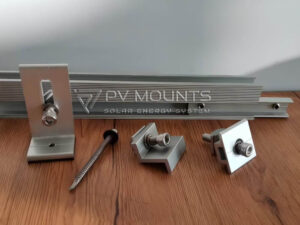
PV-MOUNTS solar rail solutions can be integrated with different rooftop attachment systems, including:
General Rail Applications
- Solar L Feet
- TRH Tin Roof Hooks
- Tile Roof Hooks
- Abrazaderas de costura
- Adjustable Tilt Brackets
- Tripod systems
Minicarril Applications
Mini rail is used as a specific compact rail solution where the mounting system is designed around short rail sections.
The rail and attachment should always be selected as a compatible system.
PV-MOUNTS supports EPC contractors, installers, distributors, and solar mounting system buyers with:
- product drawings
- technical documentation
- test documentation
- BOM support
- project quotations
- OEM/private-label support
What Should EPC Buyers Check in a Solar Rail Test Report?
| Item | What Buyers Should Verify |
| Product model | Confirm the tested rail matches the supplied product |
| Material | Verify aluminum alloy specification |
| Test method | Understand what was actually tested |
| Support span | Check the tested span |
| Loading condition | Review how the load was applied |
| Maximum force | Identify the reported test result |
| Report number | Confirm document traceability |
| Test laboratory | Verify the independent testing organization |
| Applicability | Check whether the result fits the intended project |
19. SGS Tested Solar Mounting Rail Buyer Checklist
Before purchasing, EPC buyers can ask the supplier:
| Question | Why It Matters |
|---|---|
| What exact rail model was tested? | Confirms product identity |
| What aluminum alloy was tested? | Confirms material |
| What test method was used? | Defines test scope |
| What was the support span? | Affects structural behavior |
| What load was applied? | Defines test condition |
| What was the maximum recorded force? | Shows test result |
| Was deformation recorded? | Helps evaluate structural behavior |
| Were dimensions measured? | Supports product verification |
| Does the production rail match the tested sample? | Ensures traceability |
| Can the complete report be provided? | Supports EPC approval |
20. Frequently Asked Questions
An SGS-tested solar mounting rail is a rail sample that has undergone a defined test program by SGS. The exact meaning depends on the test scope and conditions documented in the test report.
Yes. SGS Test Report No. XMIN2306001380ML02_EN identifies the tested sample as RAIL PVM-RAIL-01 and identifies the material as AL6005-T5.
The SGS report identifies the sample material as AL6005-T5.
The reported maximum force was 5,613 N under the defined compression test conditions.
The sample was tested with a 600 mm support span.
The SGS report states that compression force was applied at 5 mm/min until damage.
No. The 5,613 N result is the maximum force recorded under the specific SGS compression test configuration. It should not be treated as a universal allowable project load.
No. Project-specific structural verification is still required because actual performance depends on span, support conditions, wind load, snow load, roof structure, and the complete mounting configuration.
The report also includes chemical composition analysis and dimensional measurement.
AL6005-T5 provides a combination of aluminum material properties useful for solar mounting applications. However, structural performance also depends on rail geometry, span, support conditions, and loading.
The rail needs to interface correctly with clamps, attachments, and other mounting components. Consistent dimensions support reliable assembly and installation.
Buyers should check the exact product, material, test method, support span, loading condition, test result, report identification, and whether the tested configuration is relevant to the proposed project.
A compatible general solar rail can be used with different attachment systems, but compatibility should be confirmed for the specific rail, clamp, attachment, and fastener configuration.
PVM-RAIL-01 can be evaluated as part of compatible rooftop PV mounting configurations. The final rail selection and span should be based on the actual roof, attachment system, loads, and project engineering requirements.
Conclusion: What Does an SGS-Tested Solar Rail Really Mean?
An SGS-tested solar mounting rail provides valuable third-party test evidence, but professional buyers should look beyond the phrase “SGS tested.”
For the PV-MOUNTS PVM-RAIL-01, SGS Test Report No. XMIN2306001380ML02_EN identifies the tested sample as AL6005-T5 and reports chemical composition analysis, compression testing, and dimensional measurement.
The compression test recorded a maximum force of 5,613 N under a 600 mm support span and a 5 mm/min loading rate until damage.
The correct interpretation is:
SGS testing provides evidence of the tested product under defined conditions; project-specific structural design determines whether the rail configuration is suitable for a particular PV installation.
Engineering Note
Important: An SGS test result should not be interpreted as a universal allowable load for every solar mounting installation. Rail capacity depends on the tested configuration, rail span, support conditions, attachment system, wind load, snow load, and project-specific structural requirements.
For EPC contractors, installers, and distributors, reliable solar rail procurement should therefore combine:
Third-party testing
- Material verification
- Dimensional quality
- Manufacturing consistency
- Engineering documentation
- Project-specific structural verification
This approach provides a more reliable basis for selecting an aluminum solar mounting rail than comparing price or product appearance alone.

 Spanish
  English
  Portuguese
  Russian
  Hungarian
  Arabic
  Romanian
  French