
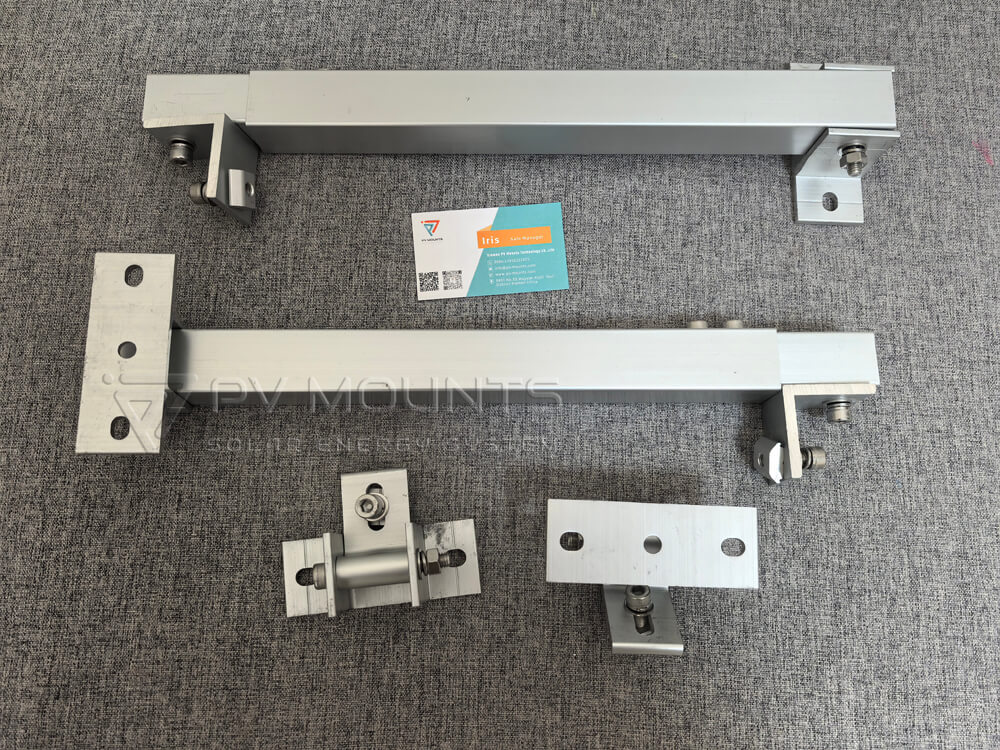
A Structural, Anchored Solution for Zero-Slope Rooftop PV Systems
1.Why Flat Concrete Roofs Require Adjustable Tilt Mounts
Flat concrete roofs offer large, unobstructed installation areas, but they present a fundamental limitation for solar systems: zero roof slope.
Without tilt, PV modules installed flat on concrete surfaces typically suffer from:
- Poor solar incidence angles
- Reduced annual energy yield
- Water pooling and dust accumulation
- Higher module operating temperatures
In real-world projects, flat-mounted systems often lose 10–25% of annual output, depending on latitude and climate.
Adjustable tilt mounts solve this issue by introducing a controlled and engineered inclination, allowing modules to operate closer to their optimal solar angle.
For flat concrete roof projects, adjustable tilt is not a design preference — it is the foundation of a safe and efficient PV system.
| Selection Factor | Adjustable Tilt for Metal Roof | Adjustable Tilt for Flat Concrete Roof |
|---|---|---|
| Tető típusa | Standing seam / Corrugated | Concrete slab |
| Fixing Method | Clamp or sealed penetration | Anchors |
| Waterproof Risk | Very low (with EPDM) | None |
| Tilt Angle Options | 10°–15° / 15°–30° / 30°–60° | 10°–15° / 15°–30° / 30°–60° |
| Anyag | AL6005-T5 + SUS304 | AL6005-T5 + SUS304 |
| Wind Resistance | Structural fixation | Weight-based + deflectors |
| Maintenance | Minimal | Minimal |
| Typical Application | Industrial rooftops | Commercial & utility rooftops |
2.Structural Fixation Method: Anchored to Concrete Piers
Professional adjustable tilt systems on flat concrete roofs are mechanically fixed, not ballasted.
Correct installation method:
- Adjustable tilt brackets are mounted on pre-cast or poured concrete piers
- Fixed using expansion anchor bolts
- Structural loads are transferred directly into the concrete
This approach ensures:
- Predictable wind-load resistance
- No dependence on ballast weight
- Clean system layout with smaller footprint
- Compliance with structural and building code requirements
There is no ballast, no adhesive bonding, and no reliance on roof membrane friction.
3.Engineering Advantages of Adjustable Tilt on Flat Concrete Roofs
Anchored adjustable tilt mounting provides both performance optimization and structural control:
- Creates optimal solar angle on zero-slope surfaces
- Improves natural self-cleaning and drainage
- Enhances airflow to reduce module temperature
- Allows flexible array spacing and orientation
- Supports project-specific or seasonal tilt selection
For flat concrete roofs, adjustable tilt is not an optional feature — it is a core design requirement.
4.Defined Tilt Angle Ranges for Structural Safety
Instead of unlimited adjustment, professional systems use pre-engineered tilt ranges:
- 10°–15° → Low wind zones or equatorial regions
- 15°–30° → Balanced annual energy performance
- 30°–60° → Winter optimization or high-latitude projects
Segmented tilt ranges help maintain:
- Controlled center of gravity
- Stable load paths
- Predictable wind performance across the array
This design philosophy prioritizes long-term reliability over theoretical flexibility.
5.Wind Load Management on Flat Concrete Roofs
Wind uplift is the dominant engineering challenge for flat-roof solar installations.
Anchored adjustable tilt systems manage wind forces through:
- Low-profile front legs
- Reinforced rear tilt legs
- Direct anchoring into concrete piers
- Optimized row spacing to reduce turbulence
Because the structure is mechanically fixed, wind resistance is achieved structurally, not through added weight.
6.Typical Installation Process
A standard installation sequence includes:
- Concrete pier positioning and alignment
- Base plate placement
- Drilling and installing expansion anchor bolts
- Assembly of adjustable front and rear legs
- Module installation and clamping
- Final torque check and inspection
Pre-assembled aluminum components significantly reduce on-site labor time and installation risk.
7.Materials and Long-Term Durability
High-quality adjustable tilt systems for flat concrete roofs typically use:
- AL6005-T5 aluminum structure for strength and corrosion resistance
- SUS304 stainless steel fasteners for long-term durability
- Engineered components designed for outdoor exposure and thermal cycling
This material combination ensures reliable performance over decades of operation.
8.Conclusion (Engineering Takeaway)
Flat concrete roofs cannot rely on roof geometry to achieve optimal solar performance.
By anchoring adjustable tilt mounts directly to concrete piers using expansion bolts, engineers gain full control over tilt angle, wind resistance, and system stability.
For zero-slope rooftops, adjustable tilt mounting is not a workaround — it is the structural foundation that enables safe, efficient, and predictable solar generation.
Roof-Type Selection FAQ for Adjustable Solar Panel Tilt Mounts
Q1. How do I choose the correct adjustable tilt mounting system based on roof type?
Start with the roof structure, not the tilt angle.
- Standing seam metal roof → Clamp-on adjustable tilt system (no penetration)
- Corrugated or trapezoidal metal roof → Penetrating adjustable tilt system fixed into purlins
- Flat concrete roof → Adjustable tilt system anchored to concrete piers using expansion bolts
Each roof type requires a different load transfer and waterproofing strategy.
Q2. Why are clamp-based adjustable tilt mounts recommended for standing seam metal roofs?
Standing seam roofs allow structural fixation without roof penetration.
Clamp-based adjustable tilt systems:
- Transfer loads through the seam profile
- Eliminate waterproofing risks
- Preserve roof warranty
- Require minimal maintenance
This makes clamp + adjustable tilt the safest option for standing seam roofs.
Q3. Can adjustable tilt mounts be installed on corrugated or trapezoidal metal roofs without penetration?
Nem.
Corrugated and trapezoidal metal roofs must be penetrated for structural safety.
Adjustable tilt mounts on these roofs are:
- Fixed into purlins or structural members
- Sealed using EPDM washers and waterproof pads
- Designed to prevent long-term leakage when installed correctly
Avoiding penetration on these roof types compromises wind resistance.
Q4. How is waterproofing handled for adjustable tilt mounts on metal roofs?
Waterproofing strategy depends on roof type:
- Standing seam roof → No penetration, no waterproofing required
- Corrugated / trapezoidal roof → EPDM sealing washers + controlled penetration
- Flat concrete roof → Roof sheet not involved; waterproofing is not roof-dependent
Correct sealing design is critical only for penetrated metal roofs.
Q5. Why are adjustable tilt mounts essential on flat concrete roofs?
Flat concrete roofs have zero slope, which causes:
- Suboptimal solar incidence
- Water pooling and dust buildup
- Reduced annual energy yield
Adjustable tilt mounts introduce a designed inclination, allowing solar panels to operate at an optimal angle.
Without adjustable tilt, flat roof systems typically underperform by 10–25%.
Q6. Are ballasted adjustable tilt systems suitable for flat concrete roofs?
Not in most engineered commercial projects.
Professional flat concrete roof systems use:
- Concrete piers
- Expansion anchor bolts
- Structurally fixed adjustable tilt brackets
Anchored systems provide predictable wind resistance and eliminate reliance on ballast weight.
Q7. What tilt angle ranges are typically used across different roof types?
Professional adjustable tilt systems use defined tilt ranges, not infinite adjustment:
- 10°–15°
- 15°–30°
- 30°–60°
These ranges are selected based on latitude, wind zone, and structural design.
Q8. Does roof slope eliminate the need for adjustable tilt?
Rarely.
Most roof slopes (0°–10°) do not match the optimal solar angle for energy production.
Adjustable tilt mounts correct the mismatch between roof geometry and solar geometry.
9. How does wind load influence roof-type mounting decisions?
Wind load determines how forces are transferred:
- Standing seam → Load transferred via seam clamps
- Corrugated metal → Load transferred into purlins
- Flat concrete → Load transferred into concrete via anchors
Choosing the wrong fixation method increases movement, fatigue, and long-term risk.
Q10. Can one adjustable tilt system be used for all roof types?
No. Adjustable tilt mounting is roof-dependent, not universal.
Each roof type requires:
- A specific fixation method
- A defined waterproofing approach
- A tailored wind-load strategy
Roof type always comes before tilt angle when selecting an adjustable solar mounting system.

 Hungarian
  English
  Spanish
  Portuguese
  Russian
  Arabic
  Romanian
  French