
1.Key Takeaways
- Roof type determines hardware selection.
- Hardware compatibility affects installation efficiency.
- Stainless steel solar mounting accessories improve corrosion resistance.
- Grounding and cable management components are often overlooked.
- EPC procurement should include quantity verification.
- Hardware selection should be based on project conditions rather than price alone.
2.Quick Answer
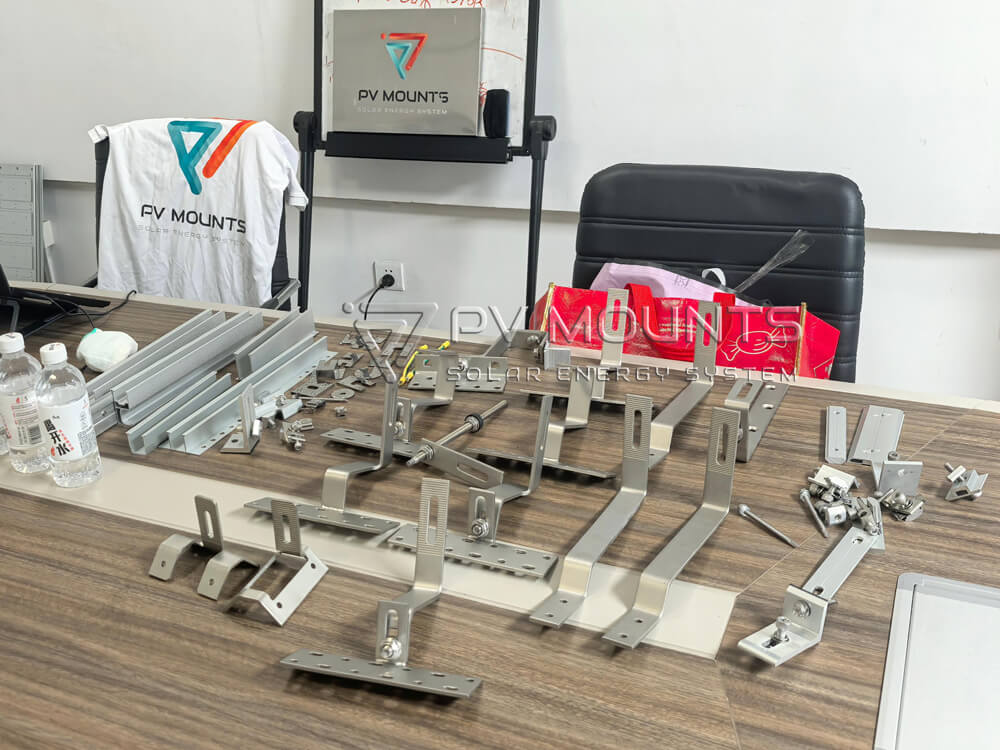
Solar mounting hardware includes all mechanical components used to secure photovoltaic systems to rooftops. Common hardware includes roof hooks, metal roof hooks, L feet, rails, clamps, grounding clips, cable clips, drainage clips, and fasteners. Selecting compatible hardware based on roof type, environmental conditions, and project requirements helps improve installation efficiency, structural safety, and long-term system reliability.
3.Solar Mounting Hardware Selection Workflow for EPC Projects
Selecting solar mounting hardware should follow a structured engineering process rather than choosing components individually.
A typical workflow includes:
Step 1 – Identify the roof type
(Tile, Trapezoidal Metal, Corrugated Metal, Standing Seam, Flat Roof)
Step 2 – Evaluate environmental conditions
(Wind load, snow load, coastal corrosion exposure)
Step 3 – Determine attachment method
(Roof Hook, L Feet, Mini Rail, Seam Clamp)
Step 4 – Select compatible mounting hardware
(Hooks, rails, clamps, grounding clips, cable clips)
Step 5 – Verify structural calculations
Step 6 – Confirm quantities and procurement plan
Following this workflow helps EPC contractors avoid compatibility issues and installation delays.
4.How Loads Are Transferred Through Solar Mounting Hardware
Solar mounting hardware is not only used to secure solar panels.
It also transfers wind loads, snow loads, and dead loads safely into the building structure.
Typical load transfer path:
Solar Module
→ Mid/End Clamp
→ Rail
→ Roof Hook or L Feet
→ Purlin / Rafter
→ Building Structure
Understanding load transfer helps EPC contractors select suitable hardware and avoid structural failures.
5.Why Solar Mounting Hardware Plays a Critical Role in Rooftop PV Systems
When discussing solar installations, most attention is often given to solar modules, inverters, and energy production.
However, rooftop solar projects depend heavily on the quality and compatibility of mounting hardware.
Proper hardware selection affects:
- Structural safety
- Installation speed
- Waterproof performance
- Korrózióállóság
- Electrical grounding
- Long-term maintenance costs
Choosing the right hardware can significantly reduce project risks and installation challenges. Working with an experienced roof solar mounting system manufacturer can also simplify engineering support and procurement management.
6.Solar Mounting Hardware Selection Starts with Roof Type
One of the most common mistakes in rooftop solar projects is selecting hardware before fully understanding roof conditions.
Different roof structures require different attachment methods.
6.1 Tile Roof Solar Mounting Hardware
Tile roofs typically require solar tile roof hooks installed beneath roofing tiles and attached directly to rafters.
Typical hardware includes:
- Stainless steel roof hooks
- Aluminum rails
- Mid clamps
- End clamps
- Grounding clips
Important considerations:
- Tile type
- Rafter location
- Wind load requirements
- Roof accessibility
6.2 Trapezoidal Metal Roof Hardware
Trapezoidal roofs require mounting hardware designed to match roof rib geometry.
Common solutions include:
Selection factors:
- Rib height
- Rib spacing
- Roof sheet thickness
- Structural load requirements
6.3 Corrugated Metal Roof Hardware
Corrugated roofs commonly utilize:
- L lábak
- Mini rail systems
- Roof fasteners
Hardware compatibility depends on roof profile dimensions and fastening locations.
6.4 Standing Seam Roof Hardware
Standing seam roofs often use non-penetrating attachment methods.
Common hardware includes:
- Standing seam clamps
- Rails
- Module clamps
This approach minimizes roof penetration while preserving waterproof performance.
6.5.Hardware Selection Examples by Project Type
Residential Tile Roof Project
Recommended Hardware:
- Roof Hook
- Vasút
- Középső bilincs
- End Clamp
Commercial Metal Roof Project
Recommended Hardware:
- TRH Roof Hook
- Vasút
- Grounding Clip
- Cable Clip
Coastal Industrial Roof Project
Recommended Hardware:
- SUS304 Roof Hook
- SUS304 Grounding Clip
- SUS304 Cable Clip
6.6 Example Hardware Configuration for a 500kW Commercial Rooftop Project
Project Type:
Commercial Rooftop PV System
Capacity:
500kW
Tető típusa:
Trapezoidal Metal Roof
Recommended Hardware:
- TRH Roof Hooks
- Aluminum Rails
- Mid Clamps
- End Clamps
- Grounding Clips
- Cable Clips
- Water Drainage Clips
Key Benefits:
- Faster installation
- Reduced cable management issues
- Improved corrosion resistance
- Lower maintenance requirements
Actual hardware requirements should always be verified according to local design codes and project conditions.
7. Essential Solar Mounting Hardware Components for EPC Procurement
Beyond the primary mounting structure, several supporting components are necessary for a complete installation.
7.1 Roof Hooks and Roof Attachments
Roof hooks provide the primary structural connection between the photovoltaic array and the building.
Selection should consider:
- Tető típusa
- Load requirements
- Corrosion exposure
7.2 L lábak and Attachment Brackets
L feet are among the most commonly used mounting hardware components for metal roof installations.
Benefits include:
- Cost efficiency
- Fast installation
- Broad compatibility
7.3 Grounding Hardware
Grounding components help ensure electrical continuity throughout the system.
Common hardware includes:
- Grounding clips
- Bonding washers
- Earthing components
7.4 Cable Management Hardware
Effective cable management improves safety and maintenance accessibility.
Common components include:
- Cable clips
- Wire holders
- Cable organizers
7.5 Water Drainage Hardware
Drainage clips help reduce water accumulation and dirt buildup beneath modules.
Benefits include:
- Improved drainage
- Reduced hotspot risk
- Better module cleanliness
8.Typical Solar Mounting Hardware Checklist for EPC Contractors
Before ordering materials, EPC contractors should verify the following items:
Structural Hardware
✔ Roof hooks
✔ L feet
✔ Roof clamps
✔ Rails
✔ Mid clamps
✔ End clamps
Grounding Hardware
✔ Grounding clips
✔ Bonding components
Cable Management Hardware
✔ Cable clips
✔ Wire holders
Drainage Components
✔ Water drainage clips
Fastening Components
✔ Bolts
✔ Screws
✔ Nuts
✔ Washers
9.Typical Hardware Configuration for Different Rooftop Projects
| Tető típusa | Recommended Hardware | Typical Material |
|---|---|---|
| Clay Tile Roof | Roof Hook + Rail | SUS304 + Aluminum |
| Concrete Tile Roof | Adjustable Roof Hook + Rail | SUS304 + Aluminum |
| Trapezoidal Metal Roof | TRH Hook / L Foot | SUS304 + Aluminum |
| Corrugated Roof | L Foot / Mini Rail | Alumínium |
| Standing Seam Roof | Standing Seam Clamp + Rail | Alumínium |
| Sandwich Roof | Mini vasúti rendszer | Alumínium |
10.How Environmental Conditions Affect Hardware Selection
Not all rooftop projects face the same environmental challenges.
Coastal Areas
Prioritize:
- SUS304 stainless steel hardware
- Enhanced corrosion resistance
High Wind Regions
Prioritize:
- Reinforced roof hooks
- Additional attachment points
High Wind Regions
Prioritize:
- Reinforced roof hooks
- Additional attachment points
Industrial Environments
Prioritize:
- Corrosion-resistant materials
- Protective coatings
11.Common Procurement Mistakes When Purchasing Solar Mounting Hardware for EPC projects
Even experienced buyers occasionally encounter hardware-related issues.
Common mistakes include:
Selecting Hardware Before Confirming Roof Type
Focusing Only on Price
Ignoring Corrosion Requirements
Forgetting Grounding Components
Overlooking Cable Management Hardware
Failing to Verify Fastener Specifications
Ordering Without Reviewing Roof Drawings
12.Questions EPC Contractors Should Ask Before Purchasing Mounting Hardware
Before placing an order, buyers should confirm:
- Is the hardware compatible with the roof profile?
- Is SUS304 available?
- Are engineering drawings available?
- Can custom designs be provided?
- Is inventory available for urgent projects?
- What is the production lead time?
- Are material certificates available?
- Has the hardware been tested for structural performance?
13.Stainless Steel vs Aluminum Solar Mounting Hardware
Stainless Steel Hardware
Common applications:
- Roof hooks
- Grounding clips
- Cable clips
- Drainage clips
- Fasteners
Advantages:
- High strength
- Excellent corrosion resistance
- Long service life
| Item | SUS304 | SUS430 |
|---|---|---|
| Korrózióállóság | Excellent | Good |
| Coastal Projects | Recommended | Limited |
| Service Life | Longer | Moderate |
| Költségek | Higher | Lower |
| Typical Applications | Roof Hooks, Clips | Cost-sensitive Projects |
For coastal and high-humidity environments, SUS304 stainless steel is generally preferred due to its superior corrosion resistance.
SUS430 is commonly used where cost optimization is a priority and environmental exposure is less aggressive.
Aluminum Hardware
Common applications:
- Rails
- Structural profiles
- Lightweight roof systems
Advantages:
- Lightweight
- Easy handling
- Cost-effective
Many rooftop systems combine aluminum structural components with stainless steel accessories to achieve an optimal balance of durability and cost.
14.Hardware Considerations for Different Regions
Southeast Asia
High humidity and corrosion resistance requirements.
Európa
Snow load and structural certification requirements.
Middle East
High temperature and UV exposure.
Coastal Areas
Enhanced corrosion resistance.
15.How to Choose a Reliable Solar Mounting Hardware Supplier
When evaluating suppliers, EPC contractors should consider:
Manufacturing Experience
Product Range
Inventory Availability
Customization Capability
Minőségellenőrzés
Technical Support
Global Project Experience
Delivery Reliability
16.Why Many EPC Contractors Prefer Working with a Manufacturer Instead of Multiple Suppliers
Purchasing roof hooks, grounding clips, cable clips, drainage clips, and fastening hardware from different suppliers can increase procurement complexity and create compatibility risks.
Working with a manufacturer capable of supplying complete solar mounting hardware solutions can simplify procurement, reduce lead times, improve consistency, and streamline project management.
17.Information EPC Contractors Should Prepare Before Requesting a Quote
To receive an accurate quotation and suitable hardware recommendation, EPC contractors should prepare the following information:
- Tető típusa
- Roof Profile Drawing
- Project Capacity
- Module Dimensions
- Wind Load Requirement
- Snow Load Requirement
- Installation Country
- Preferred Material (Aluminum, SUS304, SUS430)
- Expected Delivery Schedule
Providing this information at the beginning of the project helps reduce engineering revisions and accelerates quotation preparation.
Need assistance selecting solar mounting hardware for your next rooftop project?
Share your roof drawing and project details with our engineering team, and we will recommend suitable mounting solutions and hardware configurations based on these project details.
18.Manufacturing Considerations for Solar Mounting Hardware
- Material inspection
- Stainless steel grade verification
- Dimensional tolerance control
- Production consistency
- Inventory management
- Packaging Protection
19.Which Solar Mounting Hardware Components Are Usually Kept In Stock?
For urgent rooftop projects, EPC contractors often prioritize hardware that can be delivered immediately.
The components most commonly stocked include:
- Roof Hooks
- L lábak
- Grounding Clips
- Cable Clips
- Water Drainage Clips
- Standard Fasteners
Keeping these components available helps reduce project delays and improve installation scheduling flexibility.
Project delays are often caused by missing small mounting components rather than major structural parts.
Maintaining inventory of frequently used hardware such as roof hooks, grounding clips, cable clips, drainage clips, and fasteners helps EPC contractors reduce procurement risk and respond to urgent project schedules.
20.Conclusion
Solar mounting hardware is a fundamental part of every rooftop photovoltaic installation. Selecting compatible roof hooks, L feet, grounding clips, cable clips, drainage clips, and fastening components helps improve installation efficiency, structural safety, and long-term system performance. By evaluating roof conditions, environmental factors, and project requirements early in the design stage, EPC contractors can reduce procurement risks and improve project outcomes.
If you are evaluating hardware options for an upcoming rooftop solar project, sharing the above information can help engineers recommend suitable mounting hardware and provide a faster quotation.
21. FAQ about Solar Mounting Hardware Manufacturer & Supplier
Solar mounting hardware refers to the components used to secure photovoltaic systems to rooftops, including roof hooks, L feet, clamps, grounding clips, cable clips, and fasteners.
Roof attachments, grounding components, cable management hardware, and fastening systems are all essential for system safety and reliability.
Tile roof installations commonly use stainless steel roof hooks combined with aluminum rails.
Metal roof projects typically use roof hooks, L feet, rails, clamps, and fasteners depending on roof profile.
Aluminum and stainless steel are the most widely used materials due to their durability and corrosion resistance.
Selection depends on roof profile, rib dimensions, sheet thickness, load requirements, and environmental conditions.
Grounding clips create electrical continuity between modules and mounting structures, improving system safety.
The selection depends on roof type, environmental conditions, wind load, snow load, and project design requirements.
A typical tile roof system includes roof hooks, rails, mid clamps, end clamps, grounding clips, and cable management accessories.
Trapezoidal roofs commonly use roof hooks, L feet, mini rails, rails, clamps, and fasteners depending on roof profile design.
□ Roof Type Confirmed
□ Roof Drawings Available
□ Module Dimensions Confirmed
□ Wind Load Requirement Confirmed
□ Snow Load Requirement Confirmed
□ Hardware Material Selected
□ Quantity Calculated
□ Delivery Schedule Confirmed
□ Installation Location Verifiedsolar mounting hardware

 Hungarian
  English
  Spanish
  Portuguese
  Russian
  Arabic
  Romanian
  French