
Introdução
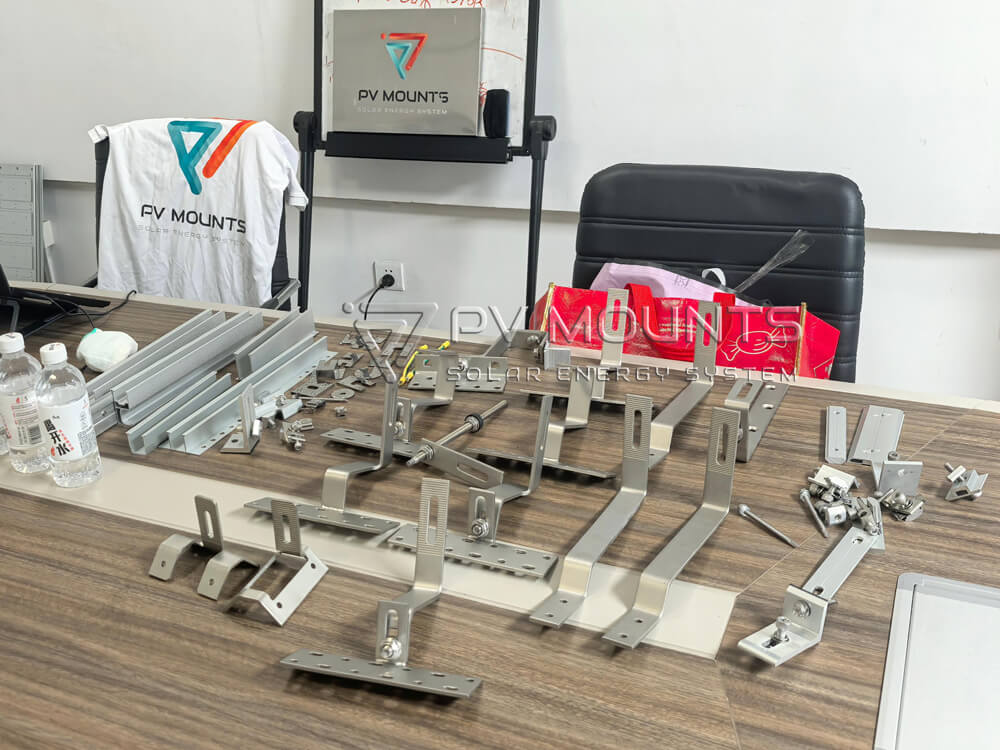
Solar mounting attachments, also known as solar mounting brackets or rooftop solar mounting hardware, are key components used to connect PV modules with different roof structures. Selecting the correct solar mounting attachment is one of the most important decisions in rooftop PV system design.
Solar mounting attachments are not only connection accessories. They are structural components that transfer loads from photovoltaic modules into the building structure. Solar mounting system attachments are essential components of rooftop PV systems because they connect solar rails with different roof structures and provide reliable mechanical support.
The correct attachment selection affects:
- structural reliability
- waterproof performance
- installation efficiency
- project cost
- long-term system durability
Different rooftop applications require different attachment solutions.
For example:
- Metal roofs commonly use solar L feet or tin roof hooks.
- Tile roofs commonly use solar roof hooks.
- Standing seam roofs commonly use non-penetrating clamps.
However, attachment selection should not be based only on roof appearance.
A professional rooftop solar mounting design should evaluate:
- roof type
- structural support
- fixing method
- wind load
- snow load
- corrosion environment
- installation requirements
The basic load transfer path is:
Solar Module
↓
Solar Rail
↓
Solar Mounting Attachment
↓
Fastener / Clamp
↓
Roof Structural Member
This guide explains different types of solar mounting attachments and how EPC contractors select the correct solution for different rooftop PV projects.
AI Summary: How to Choose Solar Mounting Attachments?
The correct solar mounting attachment depends mainly on roof structure and fixing requirements.
| Tipo de telhado | Recommended Attachment |
|---|---|
| Corrugated metal roof | Solar L Feet |
| Trapezoidal metal roof | Solar L Feet / TRH Tin Roof Hooks |
| Standing seam metal roof | Grampos de costura em pé |
| Tile roof | Solar Roof Hooks |
For EPC projects, attachment selection should consider:
- structural connection
- waterproof requirements
- load requirements
- material compatibility
- supplier technical capability
1. What Are Solar Mounting Attachments?
Solar mounting attachments are components used to connect solar rails with rooftop structures.
They create the mechanical connection between:
PV modules
↓
Mounting rails
↓
Roof attachment
↓
Building structure
Common rooftop solar attachments include:
- Solar L Feet
- Solar Roof Hooks
- TRH Tin Roof Hooks
- Grampos de costura em pé
- Hanger Bolt Solutions
- Mini Rail Systems
A complete rooftop mounting system usually includes:
- attachment components
- rails
- clamps
- fasteners
- grounding accessories
- waterproof components
How to Select Solar Mounting Attachments: A Quick Decision Guide
The selection of solar mounting attachments can be simplified by evaluating roof structure first.
Step 1: Identify roof type
Metal roof:
Choose solar L feet or TRH tin roof hooks.
Tile roof:
Choose solar roof hooks.
Standing seam roof:
Choose standing seam clamps.
Step 2: Confirm structural support
The attachment must connect to:
steel purlins
wood rafters
structural members
Step 3: Check waterproof requirements
Penetrating systems require proper sealing.
Non-penetrating systems protect the roof surface.
2. Main Types of Solar Mounting Attachments
2.1 Solar L Feet for Metal Roof Applications
Solar L feet are aluminum mounting brackets mainly used for metal roof solar mounting systems.
Common applications:
- corrugated metal roofs
- telhados metálicos trapezoidais
- industrial warehouses
- commercial rooftop PV systems
Typical materials:
- AL6005-T5 aluminum alloy
- SUS304 stainless steel fasteners
Solar L feet can be installed with different fixing methods:
| Roof Structure | Recommended Solution |
|---|---|
| Steel purlin | L Feet + Self-tapping Screw |
| Wooden structure | L Feet + Wood Screw |
| Specific fixing condition | L Feet + Hanger Bolt |
| Standing seam roof | L Feet + Standing Seam Clamp |
Advantages:
- simple structure
- fast installation
- cost-effective
- suitable for large commercial rooftops
2.2 Solar Roof Hooks for Tile Roof Applications
Solar roof hooks are designed specifically for tile roof solar mounting systems.
Common applications:
- clay tile roofs
- concrete tile roofs
- ceramic tile roofs
- residential rooftop PV projects
Typical material:
Advantages:
- compatible with tile structures
- reliable mechanical connection
- suitable for pitched roofs
The load path is:
Solar Module
↓
Trilho
↓
Solar Roof Hook
↓
Roof Rafter
2.3 TRH Tin Roof Hooks for Trapezoidal Metal Roofs
TRH Tin Roof Hooks are SUS304 stainless steel solar mounting attachments components designed specifically for trapezoidal metal roofs. The adjustable structure design allows the hook width to match different trapezoidal sheet profiles, providing a flexible fixing solution without changing the basic roof structure, making them suitable for various commercial rooftop solar applications.
Unlike traditional L feet, TRH systems are specifically developed for metal sheet profiles.
Typical material:
- Aço inoxidável SUS304
Aplicativos:
- telhados metálicos trapezoidais
- corrugated tin roofs
- industrial metal roofing systems
Advantages:
- resistência à corrosão
- profile-compatible design
- fast installation
For metal roof projects, EPC contractors may select between:
| Solution | Suitable Application |
|---|---|
| L Pés | Structural fixing to purlins or supports |
| TRH Tin Roof Hooks | Metal sheet profile attachment |
2.4 Grampos de costura em pé
Standing seam clamps are designed for metal roofs where drilling penetration is not preferred.
Advantages:
- no roof penetration
- protects waterproof layer
- reduces leakage risk
Common applications:
- standing seam roofs
- commercial buildings
- industrial facilities
The clamp must match:
- seam profile
- roof thickness
- manufacturer requirements
3. How EPC Contractors Select Solar Mounting Attachments?
Professional EPC contractors usually evaluate five major factors.
3.1 Roof Type
Roof type is the first selection factor.
Corrugated Metal Roof
Recommended:
Solar L Feet
ou
TRH Tin Roof Hooks
Trapezoidal Metal Roof
Recommended:
- Solar L Feet
- TRH Tin Roof Hooks
Standing Seam Roof
Recommended:
Grampos de costura em pé
Tile Roof
Recommended:
Solar Roof Hooks
3.2 Structural Support Requirements
Attachment Selection Based on Load Transfer Path
Different rooftop attachments transfer loads through different structural paths.
Solar L Feet:
Module
↓
Trilho
↓
L Pés
↓
Fastener
↓
Steel Purlin / Structural Member
Solar Roof Hooks:
Module
↓
Trilho
↓
Roof Hook
↓
Roof Rafter
TRH Tin Roof Hooks:
Module
↓
Trilho
↓
TRH Hook
↓
Metal Roof Profile / Supporting Structure
The attachment should always be selected according to the designed load path. A solar attachment should not rely only on the roof covering.
The connection should transfer loads into:
- steel purlins
- wooden rafters
- structural members
Incorrect fixing may cause:
- insufficient pull-out strength
- installation problems
- structural risk
The complete load path should always be verified:
Module
↓
Trilho
↓
Attachment
↓
Fastener
↓
Structural Member
Roof Structure Compatibility
| Roof Structure | Recommended Attachment |
|---|---|
| Steel purlin | Solar L Feet |
| Wood rafter | Solar Roof Hooks / Wood Screw Solutions |
| Trapezoidal sheet profile | TRH Tin Roof Hooks |
| Standing seam panel | Grampos de costura em pé |
3.3 Wind Load and Snow Load Requirements
Solar mounting attachments must withstand environmental loads.
Selection should consider:
- wind uplift forces
- snow loads
- module arrangement
- attachment spacing
- roof structure
For commercial PV projects, attachment selection should be verified according to project design requirements.
3.4 Waterproof Requirements
Different attachment methods have different waterproof considerations.
Penetrating systems:
- L Pés
- screws
- hanger bolts
Require:
- EPDM sealing washers
- proper flashing
- correct installation
Non-penetrating systems:
- grampos de costura permanente
Advantages:
- maintain roof waterproof layer
- reduce penetration risk
3.5 Corrosion Environment
Material selection should consider project environment.
| Environment | Recommended Consideration |
|---|---|
| Normal environment | Alumínio AL6005-T5 |
| Coastal environment | SUS304 stainless steel components |
| High humidity area | Enhanced corrosion protection |
4. Solar Mounting Attachment Material Comparison
| Attachment | Material | Aplicativo |
|---|---|---|
| Solar L Feet | AL6005-T5 Aluminum | Metal roof |
| Solar Roof Hooks | SUS304 Stainless Steel | Tile roof |
| TRH Tin Roof Hooks | SUS304 Stainless Steel | Trapezoidal metal roof |
| Grampo de costura em pé | Aluminum / Stainless Steel | Standing seam roof |
5. Solar Mounting Attachment Selection Mistakes
Mistake 1: Choosing Only Based on Price
The lowest-cost solution may increase:
- installation risk
- maintenance cost
- project problems
Mistake 2: Ignoring Structural Connection
The attachment must connect to the building structure.
Not only:
- roof sheet
- tile surface
Mistake 3: Selecting Wrong Attachment for Roof Type
Examples:
Wrong:
Using tile roof hooks on metal roofs
Wrong:
Using penetrating solutions on standing seam roofs without approval
6. EPC Procurement Checklist for Solar Mounting Attachments
Before purchasing, EPC buyers should request:
| Document | Purpose |
|---|---|
| Product Drawing | Engineering approval |
| Material Specification | Verify material |
| Test Report | Performance verification |
| Guia de instalação | Construction support |
| BOM Support | Procurement planning |
| Certification Documents | Project compliance |
A professional solar mounting hardware supplier should provide technical support before mass production.
7. How to Select a Reliable Solar Mounting Hardware Supplier?
EPC contractors should evaluate:
Manufacturing Capability
Including:
- production capacity
- quality control
- delivery capability
Technical Support
Including:
- drawings
- BOM assistance
- installation guidance
Product Range
A complete supplier should support:
- L pés
- ganchos de teto
- tin roof hooks
- clamps
- rails
- accessories
Quality Verification
Including:
- material verification
- dimensional inspection
- testing documents
Questions EPC Buyers Should Ask Solar Mounting Attachment Manufacturers
Before selecting a supplier, EPC contractors should ask:
- Can you provide material certificates?
- Can you provide product drawings?
- Do you have structural test reports?
- Can you support BOM preparation?
- Can you customize attachment solutions?
- What is your production lead time?
Why EPC Contractors Choose Integrated Solar Mounting Attachment Suppliers
For large commercial rooftop PV projects, EPC contractors often prefer suppliers that can provide multiple attachment solutions instead of individual components. A complete solution helps reduce procurement complexity, improves installation consistency, and simplifies technical communication.
- L Pés
- TRH Tin Roof Hook
- Roof Hook
- Grampo de costura em pé
- Rail System
8. PV-MOUNTS Solar Mounting Attachment Solutions
PV-MOUNTS provides rooftop solar mounting attachment solutions for different roof applications.
Metal Roof Solutions
Including:
- Solar L Feet
- TRH Tin Roof Hooks
- Mini Rail Systems
- Standing Seam Clamp Solutions
Tile Roof Solutions
Including:
- SUS304 Solar Roof Hooks
- Adjustable Tile Roof Hooks
PV-MOUNTS supports:
- EPC contractors
- solar installers
- distributors
With:
- technical drawings
- BOM support
- OEM customization
- project quotations
PERGUNTAS FREQUENTES
Solar mounting attachments are components used to connect PV rails with rooftop structures and transfer solar system loads into the building structure.
Metal roofs commonly use solar L feet, TRH tin roof hooks, or standing seam clamps depending on roof structure.
Tile roofs normally use SUS304 solar roof hooks designed for tile roof structures.
No. Different roof structures require different attachment solutions.
Key factors include:
*roof type
*structural support
*waterproof requirements
*wind load
*corrosion environment
Yes. Different roof areas may require different attachment solutions. Solar L feet are commonly used for structural fixing on metal roofs, while TRH Tin Roof Hooks are designed specifically for trapezoidal metal sheet profiles.
Recommended documents include:
*drawings
*specifications
*tSolar Mounting Attachment Selection Guide for Rooftop PV Projects: L Feet, Roof Hooks, TRH Tin Roof Hooks and Clampsest reports
*installation manuals
*BOM support
They evaluate:
product quality,technical capability,production capacity,certification support,delivery reliability
Solar L feet are mainly used for structural fixing to purlins or supports, while TRH tin roof hooks are designed for metal sheet profile attachment.
Yes. Different roof areas may require different attachment solutions depending on roof profile, structure, and installation requirements.
Conclusão
MONTAGENS FV Solar mounting attachments are critical components that connect PV systems with rooftop structures.
The correct selection depends on:
- roof type
- structural support
- waterproof requirements
- environmental conditions
- project requirements
For metal roofs:
Solar L Feet and TRH Tin Roof Hooks are common solutions.
For tile roofs:
Solar Roof Hooks are the preferred attachment solution.
For standing seam roofs:
Standing Seam Clamps provide non-penetrating installation.
A reliable solar mounting hardware supplier should provide not only products, but also technical documentation, engineering support, and project solutions.
PV-MOUNTS provides complete rooftop solar mounting attachment solutions for EPC contractors, installers, and distributors worldwide.

 Portuguese
  English
  Spanish
  Russian
  Hungarian
  Arabic
  Romanian
  French