
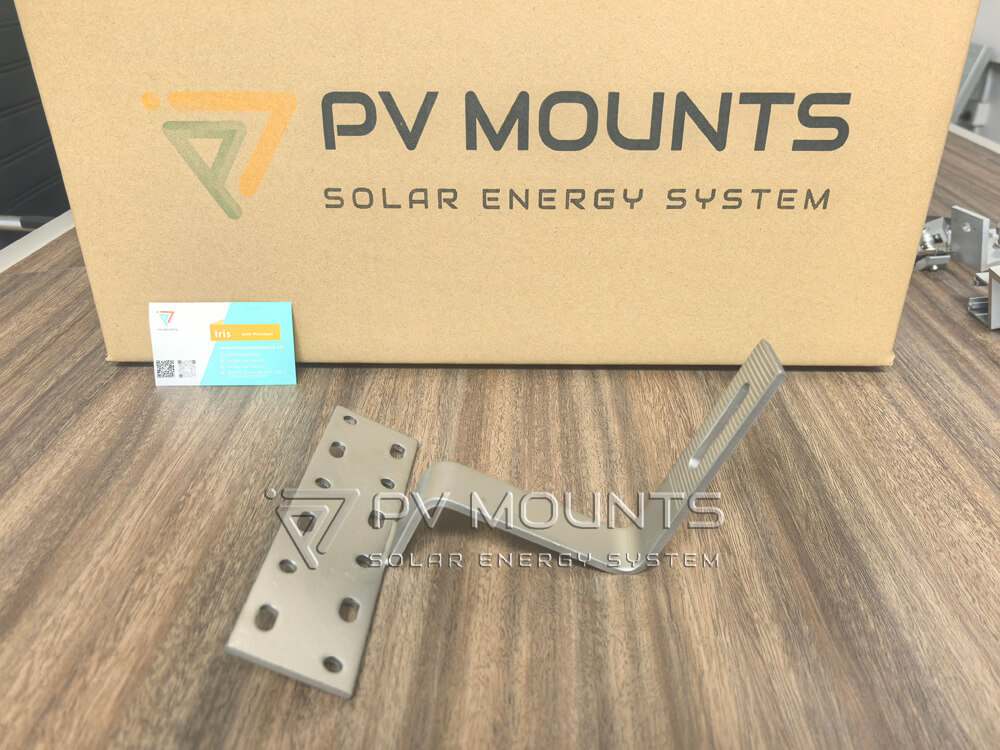
Not every roof tile can be matched with a standard solar roof hook.
When a roof tile has an unusual profile, thickness, curvature, overlap, or fixing condition, a standard hook may not provide the required clearance or alignment. In these situations, a custom solar tile roof hook can be developed specifically for the actual roof tile and supporting structure.
For OEM and mounting-system manufacturers, customization does not necessarily mean redesigning the entire sistema de montagem solar. If the existing system already uses a solar rail with a standard T-bolt and rail nut, the rail can often remain unchanged while the roof hook is redesigned around the tile and roof structure.
This guide focuses on how a custom solar tile roof hook is developed, what information is required, which dimensions can be modified, how an existing rail can be retained, and how the design moves from CAD and prototype to verification and mass production.
In most projects, a custom solar tile roof hook does not require a completely new mounting system. The hook geometry and fixing details are customized to match the roof tile and roof structure, while the existing rail, T-bolt, and rail nut interface can often remain standard.
Quick Answer: How Is a Custom Gancho para telhado de telha solar Developed?
A custom solar tile roof hook is developed by analyzing the actual roof tile profile, required clearance, roof structure, fixing position, load requirements, and existing rail connection.
The typical development process is:
Roof tile analysis → Hook geometry → Fixing design → CAD → Prototype → Fit verification → Mechanical verification → Approval → Mass production
The roof tile is normally the main driver of the custom hook geometry.
The roof structure determines how the hook is fixed.
The project loads determine the required mechanical performance.
The existing solar rail, T-bolt, and rail nut define the connection interface when the customer wants to keep an existing mounting system.
This approach allows a manufacturer to develop a dedicated roof hook without necessarily changing the complete PV mounting architecture.
Why Does a Non-Standard Roof Tile Require a Custom Hook?
A standard solar roof hook has predefined dimensions and geometry. It is therefore designed around a particular range of roof conditions.
Actual roof tiles can vary considerably in:
- Espessura
- Width
- Curvature
- Overlap
- Edge shape
- Underside profile
- Supporting position
- Batten relationship
A hook that fits one tile may not provide the same installation condition on another.
For example, a standard hook may:
- Sit too high on a thick tile
- Interfere with an overlapping tile
- Provide insufficient clearance
- Position the rail incorrectly
- Miss the required structural fixing point
- Create an unsuitable contact condition
The solution is not necessarily to replace the entire mounting system.
In many OEM applications, only the roof hook needs to be redesigned.
What Makes a Solar Roof Hook Custom?
A solar roof hook becomes a custom component when its geometry or technical specifications are developed specifically for a customer’s roof tile, roof structure, or existing mounting-system interface.
The most commonly customized parameters are:
| Parameter | Why It May Need Customization |
|---|---|
| Hook height | To match tile thickness and required clearance |
| Hook curvature | To follow the actual tile profile |
| Arm length | To position the rail correctly |
| Offset | To avoid tile or structural interference |
| Base plate | To suit the supporting structure |
| Hole diameter | To match the specified fastener |
| Hole position | To align with rafters, battens, or other supports |
| Material thickness | To meet mechanical requirements |
| Rail connection | To maintain compatibility with the existing mounting system |
The purpose of customization is not simply to change dimensions.
A properly designed custom hook should provide:
Correct tile fit + suitable clearance + secure fixing + required mechanical performance + mounting-system compatibility.
Can I Keep My Existing Solar Rail?
Yes, in many cases.
This is one of the most important considerations for OEM customers.
A customer may already have a complete mounting system, including:
- Solar rails
- T-bolts
- Rail nuts
- Mid clamps
- End clamps
- Grounding components
- Installation procedures
The only missing component may be a suitable roof hook for a specific tile profile.
If the existing rail uses a standard T-bolt and rail nut connection, the custom roof hook can often retain the required connection interface.
The hook geometry is then adapted mainly to:
Roof tile + roof structure + clearance + fixing requirements.
Therefore, a custom roof hook does not automatically require a new rail.
Example
A customer already uses an aluminum solar rail with a standard T-bolt and rail nut.
The customer’s problem is that the existing standard roof hook does not fit a particular curved clay tile.
Instead of changing the rail, T-bolt, rail nut, and module clamps, the manufacturer can develop a new hook geometry that:
- Fits the clay tile
- Provides the required clearance
- Aligns with the roof structure
- Maintains the existing rail connection
This is a typical OEM customization scenario.
Which Parts of a Solar Tile Roof Hook Can Be Customized?
1. Hook Height
Hook height affects the vertical relationship between the roof tile, hook, rail, and solar module.
It may need to be adjusted when:
- The tile is unusually thick
- The tile has a deep profile
- Additional clearance is required
- The existing rail needs to remain at a specific height
The correct height should be determined from the actual installation condition rather than from the tile name alone.
2. Hook Curvature
The curvature of the hook can be adapted to the actual roof tile profile.
This is particularly relevant for:
- Curved clay tiles
- Pantiles
- Roman tiles
- Deep-profile concrete tiles
- Regional tile designs
The objective is stable contact without creating unnecessary interference or unsuitable loading on the tile.
3. Arm Length and Offset
The arm connects the tile-supporting area of the hook to the rail connection.
Its length or offset may need to change when the standard design cannot place the rail in the required position.
Possible reasons include:
- Tile geometry
- Module clearance
- Roof edge conditions
- Existing rail position
- Installation access
4. Base Plate
The base plate connects the roof hook to the supporting roof structure.
Possible modifications include:
- Plate length
- Plate width
- Plate shape
- Hole position
- Hole spacing
- Hole diameter
- Plate thickness
The base plate should be designed according to the actual fixing method and load path.
5. Material Thickness
Material thickness can be modified according to the mechanical requirements of the custom design.
However, thickness should not be considered independently.
A thicker roof hook is not automatically a stronger roof hook.
Mechanical performance depends on the combination of:
- Material
- Espessura
- Geometry
- Bend radius
- Base-plate design
- Fastener arrangement
- Load direction
- Supporting roof structure
The final thickness should therefore be selected as part of the complete design.
6. Rail Connection Interface
The rail connection is usually an interface requirement, rather than the main reason for customization.
If the customer’s existing rail uses a standard T-bolt and rail nut, the hook can often retain the required connection dimensions.
The manufacturer may need to confirm:
- T-bolt size
- Nut specification
- Connection dimensions
- Slot requirements
- Required rail position
The complete rail profile may be useful for verification when the connection is proprietary, but it does not necessarily need to be redesigned.
What Information Is Needed to Design a Custom Roof Hook?
The most important information is the actual roof condition.
Roof Tile Information
Provide as much of the following as possible:
- Roof tile type
- Tile length
- Tile width
- Tile thickness
- Curvature
- Overlap
- Edge profile
- Underside profile
- Intended hook position
- Photos
- CAD drawing
- Physical sample, if available
A physical tile sample is especially useful when the profile is difficult to describe using measurements alone.
Roof Structure Information
The manufacturer may also need:
- Rafter spacing
- Batten spacing
- Roof construction
- Fixing position
- Fastener type
- Supporting member dimensions
- Existing fixing points
This information determines whether the proposed hook and base plate can transfer the required loads into the roof structure.
Existing Solar Mounting System
If an existing rail system must be retained, provide:
- T-bolt size
- Rail nut specification
- Connection dimensions
- Existing roof hook sample
- Existing mounting drawing, if available
If the connection interface is standardized, the complete rail drawing may not always be necessary for the initial evaluation.
Custom Roof Hook Design Inputs
Before CAD development begins, the main engineering inputs can be summarized as follows:
| Design Input | Main Purpose | Preferred Information |
|---|---|---|
| Tile profile | Determines hook geometry | CAD, dimensions, photos or sample |
| Tile thickness | Determines height and clearance | Actual measurement |
| Tile curvature | Determines contact geometry | Profile measurement/sample |
| Tile overlap | Prevents interference | Actual overlap |
| Roof structure | Determines fixing | Rafter/batten information |
| Fastener | Determines fixing holes | Bolt/screw specification |
| Existing rail | Defines connection interface | T-bolt and rail nut |
| Roof pitch | Defines installation geometry | Roof angle |
| Wind load | Defines design requirements | Project data |
| Snow load | Defines design requirements | Project data |
| Material | Defines material specification | SUS304 or specified grade |
| Quantidade | Supports production planning | Estimated order quantity |
Not all information must be available before the first engineering discussion.
A preliminary evaluation can often begin with roof tile photos, basic dimensions, fixing information, and the existing rail connection.
How Is a Custom Solar Roof Hook Designed?
A professional development process normally includes the following stages.
| Stage | Engineering Activity | Main Output |
|---|---|---|
| 1 | Requirement review | Preliminary design direction |
| 2 | Tile and roof analysis | Design parameters |
| 3 | CAD development | Engineering drawing/model |
| 4 | Prototype production | Physical sample |
| 5 | Fit verification | Installation confirmation |
| 6 | Mechanical verification | Test/inspection results |
| 7 | Customer approval | Approved drawing |
| 8 | Mass production | Production batch |
Step 1: Requirement Review
The manufacturer first reviews the available roof tile, roof structure, existing mounting interface, and project requirements.
The key question is:
Can an existing roof hook be modified, or is a new geometry required?
If a standard product can be modified without compromising the required performance, a modification may be more efficient than developing a completely new product.
Step 2: Roof Tile and Installation Analysis
The actual tile profile is analyzed to determine:
- Hook contact position
- Required clearance
- Hook height
- Curvature
- Arm length
- Rail position
- Fixing position
- Installation access
The hook should be designed around the actual installation condition.
Step 3: CAD Development
The manufacturer creates a CAD model or engineering drawing.
Critical dimensions may include:
- Overall height
- Overall width
- Hook curvature
- Arm length
- Base plate dimensions
- Hole diameter
- Hole position
- Material thickness
- Rail connection dimensions
For OEM projects, the approved CAD drawing becomes an important reference for prototype approval and future production.
[Recommended future image: Real custom solar roof hook CAD drawing with confidential customer information removed.]
Step 4: Prototype Production
A prototype is manufactured based on the approved preliminary drawing.
The prototype should ideally be checked against the actual roof tile.
Typical checks include:
- Hook seating
- Tile clearance
- Fixing alignment
- Rail position
- T-bolt and rail-nut compatibility
- Installation accessibility
[Recommended future image: Custom roof hook prototype installed on the actual non-standard roof tile.]
This physical fitting step is particularly valuable for unusual tile profiles because measurements alone may not reveal every installation issue.
Step 5: Fit Verification
The prototype should be evaluated in the actual installation configuration whenever possible.
The verification should confirm:
Tile → Hook → Rail → Module
and also:
Hook → Fastener → Roof Structure
The objective is to identify interference, clearance, fixing, or installation problems before mass production.
Step 6: Mechanical Verification
Depending on project requirements, the custom hook may require mechanical verification such as:
- Static load testing
- Pull/tensile testing
- Compression testing
- Bending verification
- Dimensional inspection
- Material verification
The testing method should correspond to the actual hook geometry and expected loading conditions.
A test result from one hook geometry should not automatically be treated as proof for every custom roof hook design.
[Recommended future evidence: Genuine mechanical test or inspection report/photo.]
Step 7: Customer Approval
After prototype fitting and verification, the final design can be reviewed and approved.
Items normally confirmed include:
- Geometry
- Dimensions
- Material
- Espessura
- Fixing arrangement
- Rail connection
- Surface finish
- Embalagem
- Labeling
The approved drawing should become the controlled reference for production.
Step 8: Mass Production
After final approval, the custom roof hook can enter mass production.
Production inspection may include:
- Material inspection
- Thickness inspection
- Dimensional inspection
- Hole-position inspection
- Bending-angle inspection
- Surface inspection
- Final sampling
For OEM customers, packaging and labeling can also be produced according to the customer’s requirements.
How Much Does a Custom Solar Roof Hook Cost?
There is no single fixed price for a custom solar roof hook because the manufacturing cost depends on the design and production requirements.
Typical cost factors include:
| Cost Factor | Potential Impact |
|---|---|
| Material grade | Affects raw material cost |
| Material thickness | Affects material consumption |
| Hook geometry | Affects forming/manufacturing |
| Manufacturing process | Affects production cost |
| Tooling | May be required for new geometry |
| Prototype quantity | Affects development cost |
| Testing | Depends on project requirements |
| Embalagem | Depends on OEM requirements |
| Order quantity | Higher volume can reduce unit cost |
Buyers should distinguish between:
Development/prototype cost
e
Mass-production unit cost.
A simple modification to an existing hook may require less development work than a completely new geometry.
For accurate pricing, the manufacturer normally needs the basic roof tile information, material requirement, approximate design requirements, and estimated order quantity.
Custom Solar Roof Hook vs. Modifying the Entire Mounting System
For customers with an existing PV mounting system, the key question is often whether the complete system needs to change.
In many cases, it does not.
| Existing Component | May It Need to Change? | Main Consideration |
|---|---|---|
| Solar rail | Often no | Retain existing connection interface |
| T-bolt | Often no | Confirm compatibility |
| Rail nut | Often no | Confirm compatibility |
| Mid clamp | Usually no | Existing module interface |
| End clamp | Usually no | Existing module interface |
| Roof hook | Yes, if standard hook does not fit | Main customization component |
| Base fixing | May change | Depends on roof structure |
| Hook geometry | Often yes | Adapt to tile profile |
This is why custom roof hook development can be an efficient solution for OEM mounting-system manufacturers.
The goal is to change only the component that needs to change while retaining compatible parts of the existing system.
Why Is SUS304 Commonly Used for Custom Solar Roof Hooks?
SUS304 stainless steel is commonly used for solar roof hooks because it provides corrosion resistance and suitable mechanical properties for many rooftop PV applications.
It can be considered for:
- Residential pitched roofs
- Commercial rooftops
- Tile roof installations
- Long-life PV systems
- OEM mounting hardware
- Applications requiring stainless steel corrosion resistance
However, material selection alone does not determine the final performance.
The complete engineering relationship is:
Material + thickness + geometry + fixing + connection + roof structure + applied loads
For projects with specific environmental, structural, or compliance requirements, the material grade and mechanical requirements should be confirmed during engineering review.
Custom Solar Roof Hooks for OEM Projects
Custom roof hooks are particularly useful for OEM and private-label mounting-system manufacturers.
A customer may already have its own mounting-system architecture but need a dedicated roof hook for a regional or proprietary tile.
The customer may already have:
- Solar rails
- T-bolts
- Rail nuts
- Mid clamps
- End clamps
- Grounding components
- Installation instructions
- Product drawings
The missing component is the roof hook.
In this situation, the manufacturer can focus development on the hook while retaining the existing mounting-system interface where technically appropriate.
OEM development may include:
- Custom dimensions
- CAD drawings
- Prototype production
- SUS304 material
- Custom geometry
- Mechanical verification
- Bulk manufacturing
- Private-label packaging
- Product documentation
This approach is suitable for solar mounting manufacturers, distributors, EPC contractors, importers, and private-label brands.
What Should Buyers Check Before Mass Production?
Before approving a custom solar roof hook, buyers should confirm:
| Checkpoint | What to Verify |
|---|---|
| Roof tile fit | Hook matches the actual tile |
| Clearance | No unacceptable interference |
| Fixing position | Aligns with the supporting structure |
| Rail connection | T-bolt/rail nut is compatible |
| Material | Correct material grade |
| Espessura | Matches approved design |
| Mechanical performance | Actual design is appropriately verified |
| Instalação | Hook can be installed efficiently |
| CAD drawing | Final dimensions are documented |
| Inspeção | Required inspection records are available |
| Embalagem | OEM requirements are confirmed |
Completing these checks before mass production helps reduce the risk of redesign, tooling changes, and installation problems.
What Should You Send to a Fabricante de ganchos solares para telhado?
For an initial custom roof hook evaluation, send:
- Roof tile photos
- Tile dimensions
- Tile profile or CAD drawing
- Existing roof hook sample, if available
- Required fixing method
- Existing rail connection
- Project location and load requirements
- Estimated order quantity
If the tile is unusual, a physical sample is highly recommended.
The manufacturer can then determine whether:
- A standard hook can be modified
- A new hook geometry is required
- A prototype is necessary
- Tooling is required
- Mechanical verification is required
The earlier the actual tile geometry is confirmed, the lower the risk of redesign during prototype development.
Frequently Asked Questions
A custom solar tile roof hook is a mounting hook designed specifically for a particular roof tile profile, roof structure, or existing mounting-system requirement. Its geometry, dimensions, fixing arrangement, material thickness, or connection interface can be adapted to the project.
Standard roof hooks have predefined geometry, while roof tiles vary in thickness, curvature, overlap, edge shape, and underside profile. A standard hook may therefore have insufficient clearance or incorrect contact and fixing positions on a non-standard tile.
Yes, in many cases. If the existing rail uses a compatible T-bolt and rail nut connection, the custom roof hook can retain the required connection interface while its main geometry is adapted to the specific roof tile.
Not necessarily. If the existing rail, T-bolt, rail nut, and module clamps meet the project requirements, the roof hook can often be customized without replacing the complete mounting system.
Common customizable dimensions include hook height, curvature, arm length, offset, base plate dimensions, fixing-hole diameter, hole position, hole spacing, material thickness, and the required rail connection interface.
Yes. Fixing-hole diameter, position, and spacing can be customized according to the supporting roof structure and fastener requirements. The final hole arrangement should be evaluated as part of the complete mechanical design.
No. CAD is helpful but not always required for the initial evaluation. Roof tile photos, dimensions, an existing hook sample, or a physical tile sample can provide enough information to begin the design discussion.
Yes. Prototype production is recommended when the tile profile is unusual or the hook is being developed for an OEM mounting system. A physical fitting check can identify clearance and fixing issues before mass production.
Depending on the project requirements, verification may include static load, tensile/pull, compression, bending, dimensional, or material inspection. The actual custom geometry should be evaluated according to its intended application.
SUS304 is commonly used for solar roof hooks because of its corrosion resistance and suitable mechanical properties. Final material selection should be based on the project environment, structural requirements, and applicable specifications. SUS304 should not be selected only because it is stainless steel. The final material grade should be confirmed according to the installation environment, corrosion exposure, structural requirements, and applicable project specifications.
Cost depends on material, thickness, geometry, manufacturing process, tooling, prototype quantity, testing, packaging, and order volume. The manufacturer normally needs basic tile and project information before providing an accurate quotation.
Yes. OEM production can include custom geometry, CAD development, prototype production, specified materials, verification, mass production, packaging, and private labeling. Xiamen PVMOUNTS is a professional solar roof hook manufacturer providing custom SUS304 roof hook solutions for OEM and private-label mounting-system projects.
The most useful information includes roof tile photos and dimensions, CAD drawings if available, the fixing method, existing roof hook samples, rail/T-bolt/rail-nut information, project loading requirements, and estimated order quantity.
Request a Custom Solar Tile Roof Hook
Have a non-standard roof tile that does not fit an existing solar roof hook?
Send your:
- Roof tile photos
- Tile dimensions
- CAD drawing, if available
- Existing hook sample
- Fixing requirements
- Existing rail connection
- Project requirements
- Estimated quantity
The engineering team in MONTAGENS FV can evaluate whether an existing hook can be modified or whether a new custom solar tile roof hook should be developed.
For OEM projects, the custom hook can often be designed around your existing solar rail, T-bolt, and rail nut interface, allowing the rest of the mounting-system architecture to remain unchanged where technically appropriate.
Send Your Roof Tile Profile
From roof tile profile to CAD, prototype, verification, and mass production, a custom solar roof hook should be developed around the actual installation condition—not simply selected from a standard product catalog.
You do not need a complete CAD drawing to start. Roof tile photos, basic dimensions are often enough for an initial feasibility review.
This guide explains the design, development, and manufacturing process for custom solar tile roof hooks used in OEM and private-label PV mounting systems.

 Portuguese
  English
  Spanish
  Russian
  Hungarian
  Arabic
  Romanian
  French