
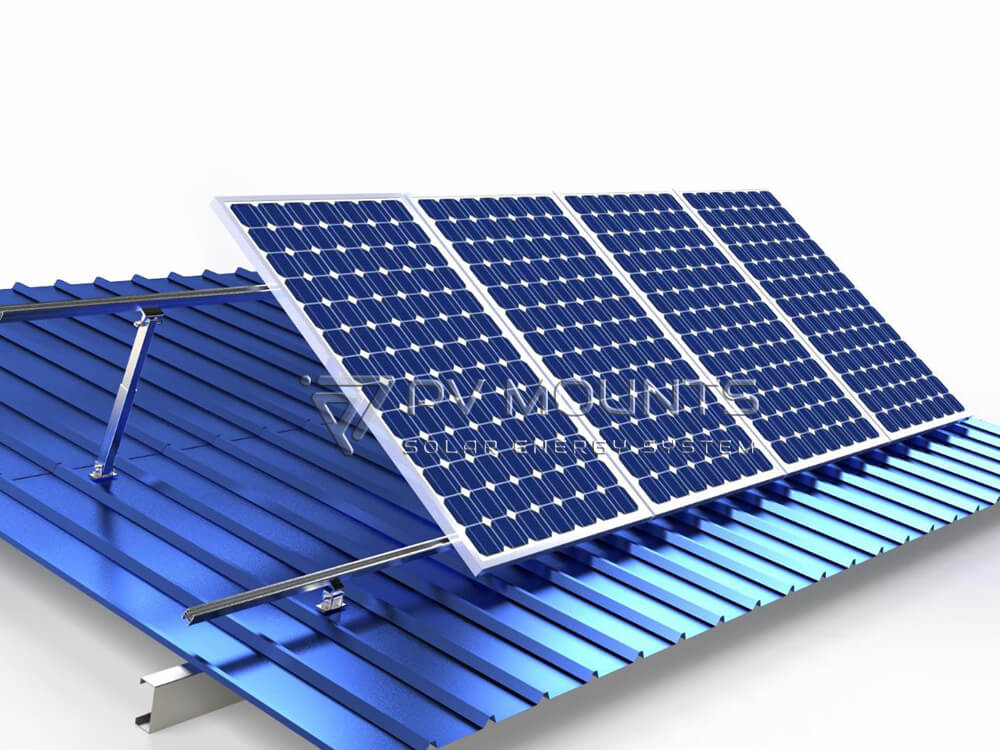
Which Adjustable Tilt Solution Fits Each Roof Type?
Choosing the right adjustable tilt solar mounting system is not only about tilt angle.
Roof structure, waterproofing strategy, and wind load requirements are all play a critical role in long-term system safety.
Below are detailed guides for each roof type. The comparison below explains how adjustable tilt brackets behave differently on standing seam metal roofs, corrugated or trapezoidal roofs, and flat concrete roofs.
| Item | Standing Seam Metal Roof | Corrugated / Trapezoidal Metal Roof | Flat Concrete Roof |
|---|---|---|---|
| Roof Fixing Method | Clamp-on (No Penetration) | Penetration into purlins | Anchored on concrete pier |
| Roof Penetration | ❌ None | ✅ Required (sealed) | Optional (depends on design) |
| Waterproofing Logic | No roof breach | EPDM sealing washer + pad | Not roof-dependent |
| Typical Roof Slope | 0°–5° | 2°–10° | 0° |
| Why Adjustable Tilt Is Needed | Roof slope ≠ optimal solar angle | Roof slope too shallow | Flat roof has zero tilt |
| Adjustable Tilt Ranges | 10°–15° / 15°–30° / 30°–60° | 10°–15° / 15°–30° / 30°–60° | 10°–15° / 15°–30° / 30°–60° |
| Mounting Structure | Standing seam clamp + adjustable front & rear legs | L-foot or base bracket + adjustable front & rear legs | Tilt legs + anchors |
| Fastener Type | Clamp bolts (SUS304) | Self-drilling bolts / hanger bolts (SUS304) | Anchor bolts |
| Wind Load Strategy | Load transferred via seam | Load transferred into purlins | Weight + wind deflector |
| Roof Integrity Impact | No impact | Controlled, sealed penetration | No roof sheet involved |
| Maintenance Requirement | Very low | Low (periodic visual check) | Low to medium |
| Installation Complexity | Medium | Medium | Medium to high |
| Typical Project Type | Commercial rooftops, retrofit projects | Industrial / warehouse roofs | Large commercial & utility rooftops |
| Key Advantage | Zero roof damage | Strong structural fixation | Maximum layout freedom |
| Key Risk If Designed Poorly | Clamp mismatch | Poor sealing / wrong spacing | Insufficient concrete weight |
From an engineering perspective:
- Standing seam metal roofs benefit most from clamp-based adjustable tilt systems, as they avoid roof penetration entirely.
- Corrugated and trapezoidal metal roofs require controlled penetration into purlins, combined with EPDM sealing washers to maintain waterproof integrity.
- Flat concrete roofs rely on anchoring, making adjustable tilt essential to create the correct solar angle from a zero-slope surface.
Understanding these differences helps EPCs and installers reduce risk, improve output, and meet local building codes.
This is why adjustable tilt solar mounting is never “one solution fits all” — roof type always comes first.
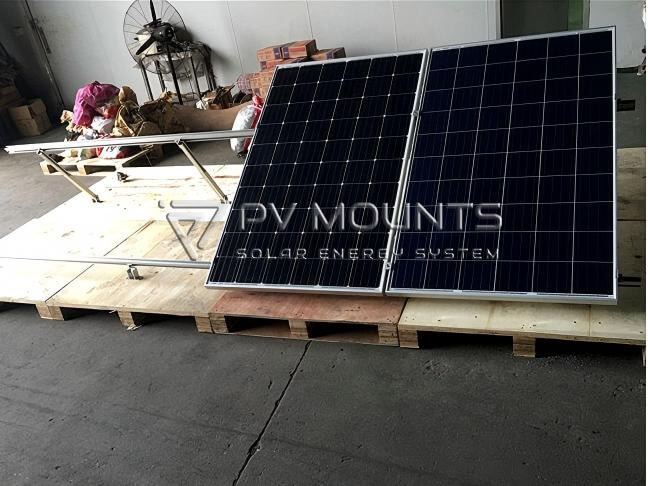
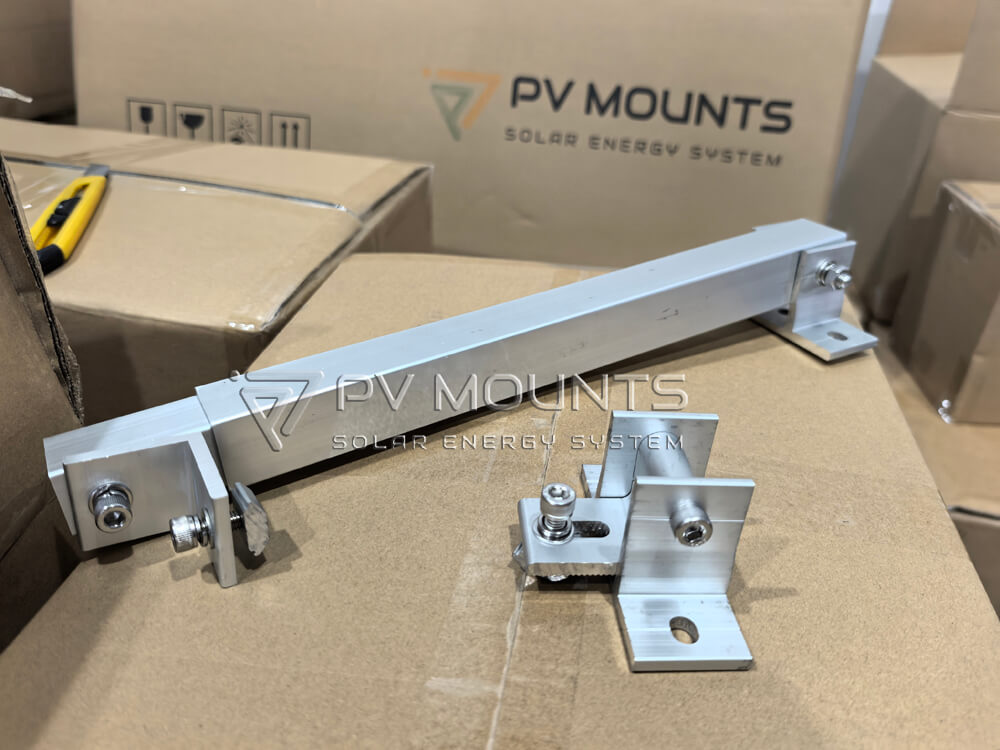
How Engineers Choose Adjustable Tilt Systems by Roof Type?
Solar engineers typically follow this logic:
- If the roof must not be penetrated → standing seam clamp + adjustable tilt
- If the roof allows structural penetration → sealed L-foot + adjustable tilt
- If the roof has zero slope → adjustable tilt + anchors
- If roof slope < optimal solar angle → adjustable tilt is mandatory
- If wind zone is high → shorter tilt range + stronger base fixation
This logic ensures:
- Structural safety
- Waterproof reliability
- Predictable long-term performance
ÎNTREBĂRI FRECVENTE
Q1: How do I choose an adjustable tilt system based on roof type?
Start by identifying whether the roof allows penetration. Standing seam metal roofs typically require non-penetrating clamp-based systems, while corrugated or trapezoidal metal roofs rely on sealed penetration into structural purlins. Flat concrete roofs usually require anchors to create tilt from a zero-slope surface.
Q2: Are adjustable tilt systems suitable for all metal roofs?
Yes, but the attachment method differs. Standing seam roofs use clamp-on systems without roof penetration. Corrugated and trapezoidal roofs require mechanical fastening with sealing washers. The tilt structure may be similar, but the base connection is roof-specific.
Q3: Why is non-penetration important for standing seam metal roofs?
Standing seam roofs are designed to remain watertight without drilling. Penetration can compromise roof warranties and long-term performance. Adjustable tilt systems combined with certified seam clamps allow angle optimization while preserving roof integrity.
Q4: When is roof penetration unavoidable for adjustable tilt mounting?
Roof penetration is typically required on corrugated or trapezoidal metal roofs to transfer loads into purlins. In these cases, waterproofing is achieved through EPDM sealing washers and controlled fastening torque, not by avoiding penetration altogether.
Q5:Why do flat concrete roofs require adjustable tilt systems?
Flat concrete roofs have no inherent slope. Adjustable tilt systems are necessary to achieve the correct solar angle, manage wind uplift, and allow flexible array layout through anchoring strategies.
Q6: Does roof slope affect adjustable tilt range selection?
Yes. Roofs with minimal slope often require higher tilt ranges to reach optimal solar angles, while roofs with moderate slope may only need lower adjustable ranges. Wind exposure and structural limits should always be evaluated alongside tilt range.
Q7: Can one adjustable tilt system design be used across all roof types?
No. While tilt legs may be similar, the fixing method, load transfer mechanism, and waterproofing strategy must be specifically engineered for each roof type. Roof conditions always dictate system configuration.
Q8: What is the most common engineering mistake when selecting adjustable tilt systems?
Treating adjustable tilt as a universal solution without considering roof structure. Mismatched clamps, incorrect penetration methods, or insufficient concrete weight often lead to long-term performance or safety issues.
Concluzie
In solar mounting design, the choice of an adjustable tilt solution must align with the roof’s structural and environmental characteristics. Each roof type—standing seam, corrugated, or flat concrete—poses specific constraints for the module support system’s interaction with the building envelope and waterproofing strategies.
For standing seam roofs, non-penetrating clamps combined with adjustable tilt elements protect roof integrity while allowing precise adjustments. Corrugated and trapezoidal profiles require engineered penetrations with EPDM sealing to ensure waterproof performance and structural stability. Flat concrete surfaces need anchoring systems to create tilt, coordinated with wind uplift mitigation.
The engineering objective is straightforward: optimize the solar array’s performance in line with local conditions without compromising the roof’s structural integrity. By systematically evaluating roof type, attachment methods, and load requirements, adjustable tilt systems become essential components of the photovoltaic (PV) mounting strategy, rather than mere add-ons.
If you are looking for reliable professional solar panle adjustable tilt mounting system manufacturer in China, Please contact XIAMEN PV MOUNTS TECHNOLOGY CO.,LTD. We have confidence to provide your suitable solar structure solution for your project.

 Romanian
  English
  Spanish
  Portuguese
  Russian
  Hungarian
  Arabic
  French