
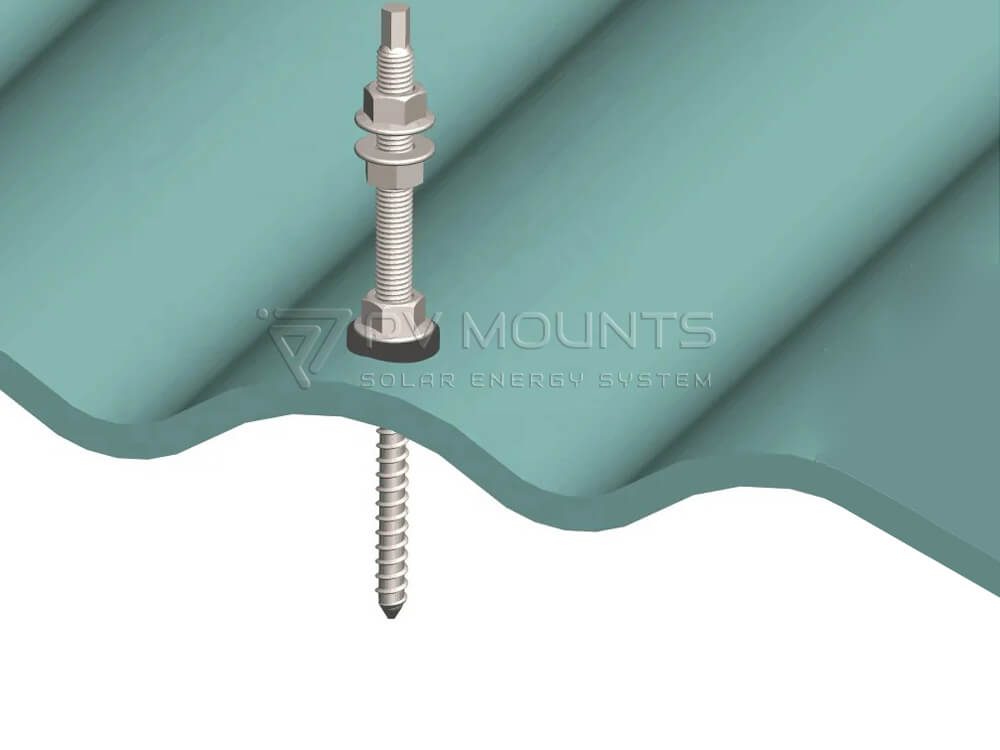
A solar hanger bolt is a key fastening component used to connect a rooftop PV mounting system to the underlying roof structure. It provides a structural fixing point through the roof covering and supports an L-foot or mounting plate for attaching the solar rail.
For EPC contractors, solar installers, distributors, and solar mounting hardware buyers, selecting a hanger bolt involves more than choosing an M10 diameter. The structural fixing thread must match the supporting roof structure, and the bolt length and upper mounting configuration must also match the roof build-up and mounting system.
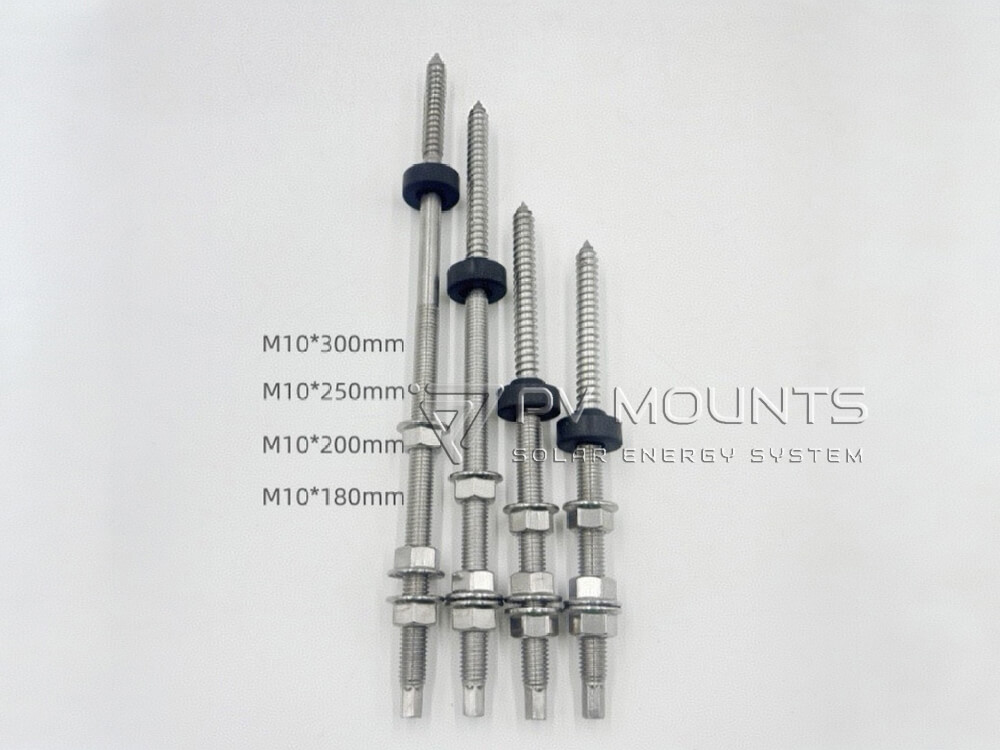
PV Mounts supplies M10 SUS410 solar hanger bolts in 200 mm, 250 mm, and 300 mm lengths, with two structural fixing configurations:
- Self-Tapping Screw Thread for Steel Purlins
- Wood Screw Thread for Wood Purlins
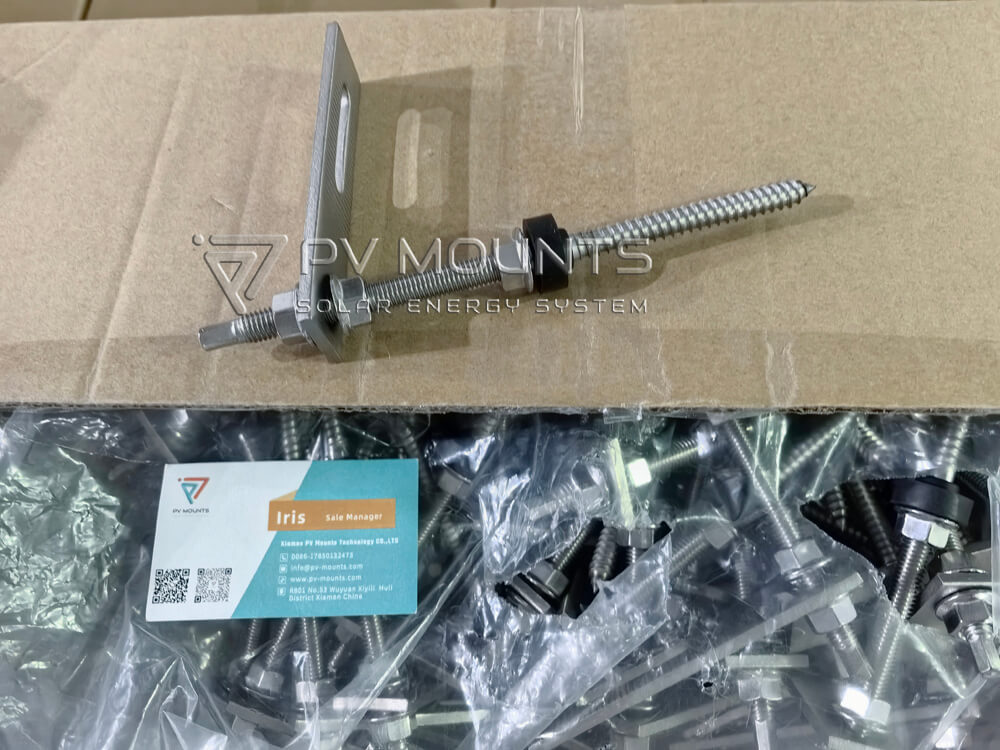
The upper mounting assembly can be configured with a SUS304 flange nut, EPDM pad, AL6005-T5 aluminum L-foot, AL6005-T5 aluminum plate, or SUS304 stainless steel plate, according to the mounting system and project requirements.
1. What Is a Solar Hanger Bolt?
A solar hanger bolt is a threaded roof fastener used to create a connection between a rooftop solar mounting system and an underlying structural member such as a steel purlin or wood purlin.
The hanger bolt passes through the roof covering and provides a mounting connection above the roof surface. An EPDM pad is used around the roof penetration, while the upper mounting end connects to an L-foot or mounting plate.
Typical connection path:
Roof covering → EPDM sealing interface → Hanger bolt → Upper mounting component (L-foot or mounting plate) → Flange nut → Solar rail
The exact position and arrangement of the flange nut and upper mounting components may vary according to the mounting system design.
A hanger bolt has two important connection functions:
- Structural fixing end — connects to the steel purlin or wood purlin.
- Upper mounting end — connects to the L-foot or mounting plate used to support the solar rail.
The structural fixing configuration is selected according to the roof structure.
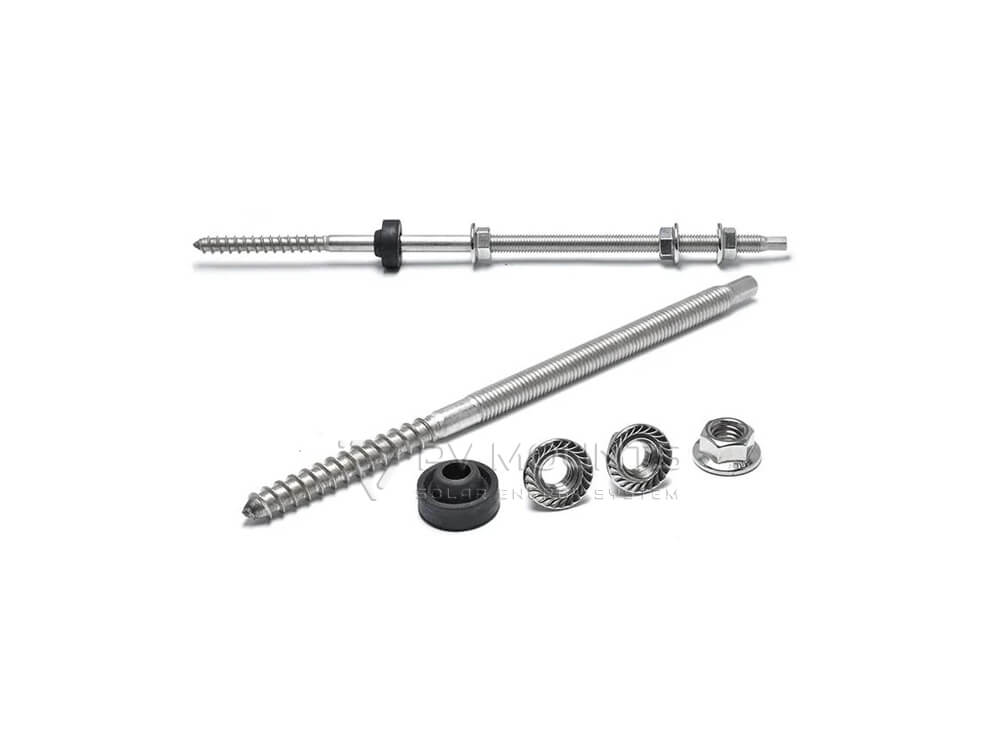
2. Steel Purlin vs. Wood Purlin Hanger Bolts
The main difference between the two hanger bolt versions is the fixing thread at the structural end.
| Version | Structural Support | Fixing Thread | Material | Standard Lengths |
|---|---|---|---|---|
| Steel Purlin Hanger Bolt | Steel purlin | Self-tapping screw thread | SUS410 | M10 × 200 / 250 / 300 mm |
| Wood Purlin Hanger Bolt | Wood purlin / timber rafter | Wood screw thread | SUS410 | M10 × 200 / 250 / 300 mm |
Steel Purlin Hanger Bolt
The steel-purlin version uses a self-tapping screw thread at the structural fixing end.
It is intended for suitable steel purlin structures used in rooftop PV applications.
The suitability of the fixing thread depends on the actual steel purlin material, thickness, profile, thread engagement, installation method, and project requirements.
Wood Purlin Hanger Bolt
The wood-purlin version uses a wood screw thread at the structural fixing end.
It is designed for suitable timber structures such as wood purlins or timber rafters.
The wood screw thread provides mechanical engagement with the timber structural member.
The Key Selection Rule
The simplest selection rule is:
Steel purlin → Self-tapping screw thread
Wood purlin → Wood screw thread
An M10 diameter alone does not determine whether a hanger bolt is suitable for a particular roof structure.
3. Quick Selection Guide
For EPC procurement teams and installers, the basic selection process can be reduced to three steps.
Step 1: Identify the Structural Support
Determine whether the hanger bolt will be fixed into:
- Steel purlin
- Wood purlin / timber rafter
Step 2: Select the Structural Fixing Thread
Choose:
- Self-tapping screw thread for suitable steel purlins
- Wood screw thread for suitable wood purlins
Step 3: Select the Length and Upper Mounting Interface
Choose one of:
- M10 × 200 mm
- M10 × 250 mm
- M10 × 300 mm
Then specify the required upper mounting component:
- AL6005-T5 aluminum L-foot
- AL6005-T5 aluminum plate
- SUS304 stainless steel plate
This gives buyers a straightforward specification process:
Structural material → Fixing thread → Bolt length → Upper mounting component
4. M10 SUS410 Solar Hanger Bolt Specifications
PV Mounts supplies solar hanger bolts in M10 SUS410 stainless steel.
Standard Lengths
- M10 × 200 mm
- M10 × 250 mm
- M10 × 300 mm
The appropriate length depends on the roof build-up, structural member position, mounting component thickness, and required exposed thread.
SUS410 Material
SUS410 is a martensitic stainless steel commonly selected for applications where hardness and mechanical strength are important.
For solar hanger bolts, SUS410 provides a suitable material option for the threaded fastening component.
Material selection should be evaluated according to the project environment, structural requirements, installation conditions, and applicable standards.
5. Self-Tapping Screw Thread for Steel Purlins
The M10 SUS410 Solar Hanger Bolt for Steel Purlins uses a self-tapping screw thread at the structural fixing end.
The purpose of this thread is to provide mechanical engagement with a suitable steel purlin during installation.
The steel-purlin version may be used in rooftop PV systems where the solar mounting structure is connected to suitable steel-supported roof structures.
However, the fastener should not be selected based only on the fact that the roof contains steel.
Before procurement, buyers should confirm:
- Steel purlin material
- Purlin thickness
- Purlin profile
- Required fixing depth
- Installation method
- Structural design requirements
This ensures that the selected hanger bolt is appropriate for the actual supporting structure.
Steel-Purlin Assembly
A complete assembly can include:
M10 SUS410 hanger bolt
- Self-tapping screw thread
- SUS304 flange nut
- EPDM pad
- AL6005-T5 aluminum L-foot
or
AL6005-T5 aluminum plate
or
SUS304 stainless steel plate
6. Wood Screw Thread for Wood Purlins
The M10 SUS410 Solar Hanger Bolt for Wood Purlins uses a wood screw thread at the structural fixing end.
The wood screw thread is designed to provide mechanical engagement with a suitable timber structural member.
Typical supporting structures include:
- Wood purlins
- Timber rafters
- Suitable timber roof structures
The fixing location should be positioned in an appropriate structural timber member rather than relying only on the roof covering.
Wood-Purlin Assembly
A complete assembly can include:
M10 SUS410 hanger bolt
- Wood screw thread
- SUS304 flange nut
- EPDM pad
- AL6005-T5 aluminum L-foot
or
AL6005-T5 aluminum plate
or
SUS304 stainless steel plate
The upper mounting configuration can therefore remain flexible while the structural fixing thread is selected according to the roof structure.
7. The Two Connection Functions of a Solar Hanger Bolt
Understanding the two connection areas is important when specifying a hanger bolt.
| Connection Area | Function | Configuration |
|---|---|---|
| Structural fixing end | Connects the hanger bolt to the roof structure | Self-tapping screw thread or wood screw thread |
| Upper mounting end | Connects the hanger bolt to the solar mounting system | Aluminum L-foot, aluminum plate, or SUS304 plate |
Structural Fixing End
The lower fixing end determines which roof structure the hanger bolt is designed for.
Steel purlin → Self-tapping screw thread
Wood purlin → Wood screw thread
Upper Mounting End
The upper connection interfaces with the solar mounting hardware.
Available configurations include:
- AL6005-T5 aluminum L-foot
- AL6005-T5 aluminum plate
- SUS304 stainless steel plate
This means the structural fixing configuration and the upper mounting interface can be specified independently according to the project requirements.
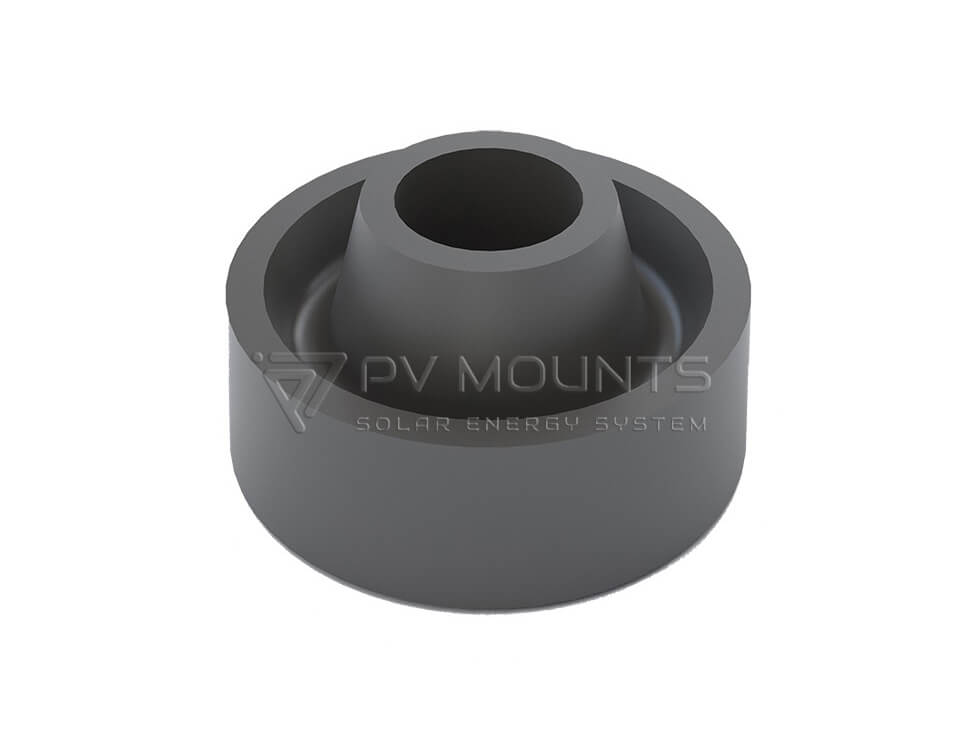
8. EPDM Pad and Roof Sealing
An EPDM pad is commonly used with solar hanger bolts at the roof penetration area.
Its functions include:
- Providing a sealing interface
- Helping reduce the risk of water ingress
- Accommodating minor surface irregularities
- Creating an interface between the hanger bolt assembly and roof surface
Correct installation is important for the overall roof sealing arrangement.
The EPDM pad should be correctly positioned and compressed according to the mounting system design and installation requirements.
The sealing arrangement should be considered together with the roof covering, fastener position, installation method, and overall roof waterproofing design.
9. Aluminum L-Foot, Aluminum Plate, or SUS304 Plate?
The upper mounting component can be selected according to the solar rail connection and project requirements.
AL6005-T5 Aluminum L-Foot
An aluminum L-foot provides a common connection between the hanger bolt and solar mounting rail.
AL6005-T5 aluminum offers a lightweight mounting component suitable for many aluminum rail systems.
AL6005-T5 Aluminum Plate
An aluminum mounting plate can be used when a plate-style connection is preferred.
The plate can be configured according to the hanger bolt assembly and solar rail connection requirements.
SUS304 Stainless Steel Plate
A SUS304 stainless steel plate can be selected when the project requires a stainless-steel mounting interface.
Therefore, the mounting plate is not limited to stainless steel.
The upper mounting options include:
- AL6005-T5 aluminum L-foot
- AL6005-T5 aluminum plate
- SUS304 stainless steel plate
For EPC projects, the final configuration should be selected according to the rail connection, material requirements, structural design, and installation conditions.
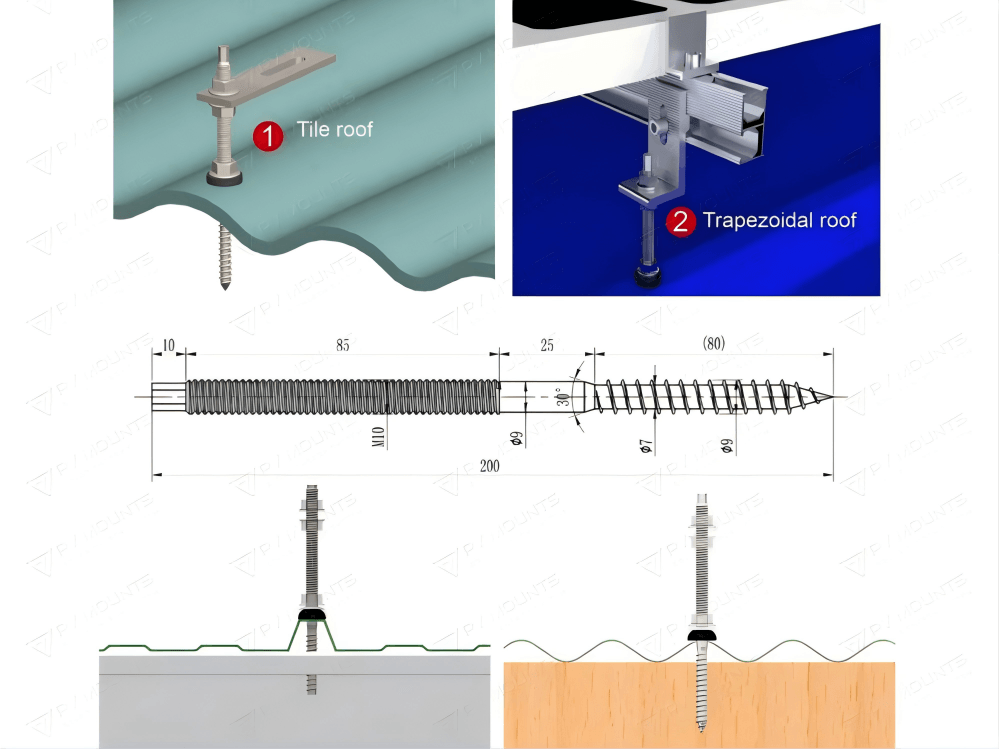
10. How to Choose M10 × 200, 250, or 300 mm
PV Mounts supplies three standard M10 hanger bolt lengths:
- 200 mm
- 250 mm
- 300 mm
The correct length depends on the actual roof construction rather than the roof name alone.
Consider:
- Roof covering thickness
- Distance from the roof surface to the structural member
- Required fixing depth
- EPDM pad and mounting component thickness
- Required exposed thread
- L-foot or plate configuration
- Solar rail connection requirements
A longer hanger bolt may be required when the structural member is positioned further below the roof surface.
For project procurement, the supplier should confirm the required length based on the actual roof build-up and mounting assembly.
11. How to Specify a Solar Hanger Bolt in an RFQ
For EPC procurement, requesting only an “M10 solar hanger bolt” leaves too many specifications undefined.
A complete RFQ description should identify the structural support, fixing thread, length, material, and upper mounting configuration.
Example: Steel Purlin
Solar Hanger Bolt, M10 × 250 mm, SUS410, self-tapping screw thread for steel purlin, with SUS304 flange nut, EPDM pad, and AL6005-T5 aluminum L-foot.
Example: Wood Purlin
Solar Hanger Bolt, M10 × 250 mm, SUS410, wood screw thread for wood purlin, with SUS304 flange nut, EPDM pad, and AL6005-T5 aluminum plate.
The length and upper mounting component can be changed according to the project.
This specification format helps EPC procurement teams and suppliers avoid ambiguity and quote the correct hanger bolt assembly.
12. Solar Hanger Bolt BOM for EPC Procurement
For EPC contractors, distributors, and solar installers, hanger bolts are often purchased as part of a complete rooftop mounting hardware package.
Steel Purlin Version
| Component | Specification |
|---|---|
| Hanger bolt | M10 SUS410 |
| Structural fixing thread | Self-tapping screw thread |
| Flange nut | SUS304 |
| Sealing pad | EPDM |
| L-foot option | AL6005-T5 aluminum |
| Plate option | AL6005-T5 aluminum |
| Stainless plate option | SUS304 |
| Standard length | 200 / 250 / 300 mm |
Wood Purlin Version
| Component | Specification |
|---|---|
| Hanger bolt | M10 SUS410 |
| Structural fixing thread | Wood screw thread |
| Flange nut | SUS304 |
| Sealing pad | EPDM |
| L-foot option | AL6005-T5 aluminum |
| Plate option | AL6005-T5 aluminum |
| Stainless plate option | SUS304 |
| Standard length | 200 / 250 / 300 mm |
The key difference between the two BOMs is the structural fixing thread.
13. What Information Should Buyers Provide?
When requesting a quotation, EPC contractors, distributors, and installers should provide:
Roof Structure
- Steel purlin
- Wood purlin / timber rafter
Fixing Thread
- Self-tapping screw thread
- Wood screw thread
Hanger Bolt Length
- M10 × 200 mm
- M10 × 250 mm
- M10 × 300 mm
Upper Mounting Component
- AL6005-T5 aluminum L-foot
- AL6005-T5 aluminum plate
- SUS304 stainless steel plate
Roof Covering
Provide the roof type and, where available, roof covering thickness.
Solar Rail
If the hanger bolt is being integrated into an existing mounting system, provide the rail and connection requirements where applicable.
Providing this information allows the supplier to evaluate the complete mounting assembly rather than quote the hanger bolt as an isolated fastener.
14. Solar Hanger Bolt Installation Considerations
Before installation, verify:
- The roof structural member has been correctly identified.
- The fixing thread matches the structural material.
- The fixing position aligns with the structural member.
- The hanger bolt length is appropriate for the roof build-up.
- The EPDM pad is correctly positioned.
- The L-foot or mounting plate is correctly installed.
- The flange nut is tightened according to the mounting system requirements.
- The roof waterproofing arrangement is maintained.
For steel purlin applications, the self-tapping screw thread should be checked against the actual purlin specifications.
For wood purlin applications, the wood screw thread should engage an appropriate structural timber member.
The hanger bolt should therefore be selected based on structural compatibility, dimensions, and mounting requirements, not diameter alone.
15. Solar Hanger Bolt for OEM and Custom Supply
For solar mounting distributors, EPC contractors, installers, and importers, hanger bolts may be purchased as part of a larger rooftop solar mounting system.
PV Mounts can configure the hanger bolt assembly according to project requirements, including:
- Customized packaging
- Private labeling
- Project-specific assembly BOM
- Mixed solar mounting hardware orders
- OEM configuration
For OEM procurement, the structural support and upper mounting interface should be clearly specified on the purchase order.
For example:
Steel purlin + self-tapping screw thread
or
Wood purlin + wood screw thread
This distinction helps prevent different hanger bolt configurations from being mixed during production and installation.
16. PV Mounts M10 SUS410 Solar Hanger Bolt
PV Mounts supplies M10 SUS410 solar hanger bolts for steel-purlin and wood-purlin rooftop solar mounting applications.
Standard Specifications
| Item | Specification |
|---|---|
| Hanger bolt material | SUS410 |
| Bolt size | M10 |
| Standard lengths | 200 / 250 / 300 mm |
| Steel purlin fixing | Self-tapping screw thread |
| Wood purlin fixing | Wood screw thread |
| Flange nut | SUS304 |
| Sealing pad | EPDM |
| L-foot option | AL6005-T5 aluminum |
| Plate option | AL6005-T5 aluminum |
| Stainless steel plate option | SUS304 |
| Application | Rooftop solar mounting |
The two structural fixing configurations allow the hanger bolt assembly to be matched to different roof structures while maintaining a consistent M10 platform.
For EPC projects and distributors, the complete assembly can be specified according to the roof structure, roof build-up, mounting interface, solar rail, and project BOM.
17. FAQ
Solar hanger bolt is a roof mounting fastener used to connect a rooftop solar mounting system to an underlying structural member such as a steel purlin or wood purlin.
PV Mounts supplies M10 SUS410 solar hanger bolts in standard lengths of 200 mm, 250 mm, and 300 mm.
The structural fixing thread is different.
A self-tapping screw thread is used for suitable steel purlins, while a wood screw thread is used for suitable wood purlins or timber rafters.
Not simply because it is M10. The structural fixing thread must match the supporting material.
M10 identifies the metric thread size of the hanger bolt, while 250 mm refers to the nominal hanger bolt length.
The required length depends on the roof covering, distance to the structural member, fixing requirements, mounting component thickness, and required exposed thread.
The PV Mounts standard hanger bolt is made from SUS410 stainless steel.
The EPDM pad provides a sealing interface around the roof penetration and helps reduce the risk of water ingress when correctly installed.
Yes. The assembly can be supplied with an AL6005-T5 aluminum L-foot.
Yes. The mounting plate can be supplied in AL6005-T5 aluminum.
Yes. A SUS304 stainless steel plate is also available as an upper mounting option.
Yes. The assembly can include the M10 SUS410 hanger bolt, SUS304 flange nut, EPDM pad, and an AL6005-T5 aluminum L-foot, AL6005-T5 aluminum plate, or SUS304 stainless steel plate.
The buyer should provide the roof structure, fixing thread, required hanger bolt length, roof covering, upper mounting component, and solar rail requirements where applicable.
Yes. OEM and project-specific configurations can be discussed based on the roof structure, dimensions, mounting interface, packaging, and project BOM.
Conclusion
Selecting a solar hanger bolt starts with identifying the roof structure and structural fixing thread, not simply the M10 diameter.
For steel-supported roofs, PV Mounts supplies M10 SUS410 solar hanger bolts with a self-tapping screw thread for suitable steel purlins.
For timber-supported roofs, PV Mounts supplies M10 SUS410 solar hanger bolts with a wood screw thread for suitable wood purlins.
Both versions are available in:
M10 × 200 mm
M10 × 250 mm
M10 × 300 mm
The upper mounting assembly can be configured with:
- SUS304 flange nut
- EPDM pad
- AL6005-T5 aluminum L-foot
- AL6005-T5 aluminum plate
- SUS304 stainless steel plate
For EPC contractors, installers, distributors, and solar mounting hardware buyers, specifying the structural support, fixing thread, bolt length, and upper mounting interface provides a clear way to procure the correct hanger bolt assembly.
For project BOMs, OEM requirements, or customized rooftop solar mounting hardware, provide the roof structure, required length, mounting interface, and project specifications so the hanger bolt assembly can be configured accordingly.

 English
  Spanish
  Portuguese
  Russian
  Hungarian
  Arabic
  Romanian
  French