
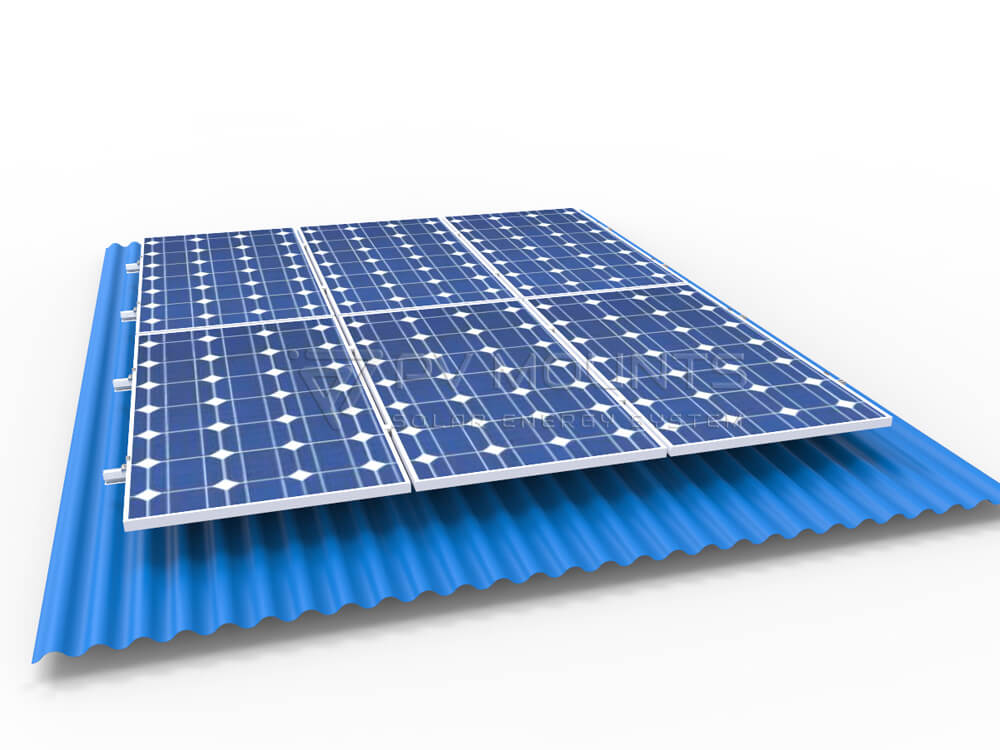
1.Introduction
Corrugated metal roofs are widely used in industrial and agricultural buildings due to their lightweight structure and cost efficiency. However, installing solar panels on corrugated sheets requires the right mounting solution to ensure structural safety and waterproof performance.
This guide explains how to properly install solar mounting systems on corrugated metal roofs, including system options, fixing methods, and best practices.
2.What is a Corrugated Metal Roof?
A corrugated roof is characterized by its wave-shaped profile, typically with rounded ridges and valleys. Unlike trapezoidal roofs, corrugated sheets:
- Have curved waves instead of flat tops
- Offer less direct mounting surface
- Require more careful load distribution
👉 This makes mounting design slightly more complex compared to trapezoidal roofs.
3.Common Solar Mounting Solutions for Corrugated Roofs
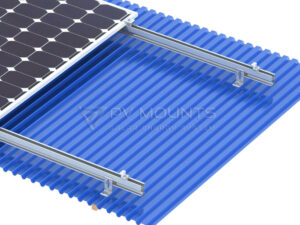
1️⃣ Mini Rail System
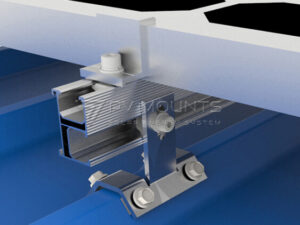
Mini rails are commonly used for corrugated roofs due to their:
- Lightweight design
- Fast installation
- Reduced material usage
👉 Suitable for most standard projects with moderate load requirements.
Mini rail systems are commonly used due to their lightweight and fast installation. 👉 Learn more: Mini Rail System Guide
2️⃣ L-Foot with Rail System
This is a more traditional solution:
- L-feet are fixed to the roof
- Full-length rails are installed above
👉 Ideal for:
- Higher wind/snow load areas
- Projects requiring stronger structural support
3️⃣ Hanger Bolt Solution
Used when fixing to underlying purlins:
- Bolt penetrates the roof sheet
- Anchors directly into steel or wood structure
👉 Provides strong anchoring but requires precise waterproofing.
3️⃣ Hanger Bolt Solution
Used when fixing to underlying purlins:
- Bolt penetrates the roof sheet
- Anchors directly into steel or wood structure
👉 Provides strong anchoring but requires precise waterproofing.
✔ Crest Fixing (Recommended)
- Installed on the top of the wave
- Less water accumulation
- Lower leakage risk
✔ Valley Fixing (Less common)
- Installed in the lower part of the sheet
- Requires additional waterproof measures
👉 In most cases, crest fixing is the preferred solution.
4.Waterproofing Considerations
Waterproofing is crucial for corrugated roof solar brackets installations.
Key practices include:
- Use EPDM rubber washers
- Ensure proper compression (not over-tightened)
- Avoid installing in water flow paths
- Seal all penetrations properly
👉 Poor sealing is the main cause of roof leakage in solar projects.
5.Load and Structural Considerations
Corrugated roofs are generally thinner than trapezoidal sheets, so:
- Load must be transferred to purlins when necessary
- Fixing spacing must be carefully designed
- Wind uplift must be considered
👉 Always verify:
- Roof thickness
- Purlin spacing
- Material strength
6.Installation Steps Overview
- Inspect roof condition and structure
- Determine fixing positions (crest or purlin)
- Install mounting base (mini rail / L-foot / hanger bolt)
- Apply waterproof sealing
- Install rails (if applicable)
- Mount solar panels and clamps
- Final inspection
7.Common Mistakes to Avoid
❌ Installing directly on thin sheet without structural support
❌ Incorrect screw positioning
❌ Over-tightening screws (damaging EPDM)
❌ Ignoring thermal expansion
❌ Poor layout planning
👉 These mistakes often lead to leakage or system failure.
8.Corrugated vs Trapezoidal Roof Mounting
| Feature | Corrugated Roof | Trapezoidal Roof |
|---|---|---|
| Surface shape | Curved | Flat top |
| Installation difficulty | Medium | Facile |
| Mounting options | Limited | More flexible |
| Waterproof risk | Higher | Lower |
👉 Trapezoidal roofs are generally easier for solar mounting.
Corrugated roofs are more complex compared to trapezoidal roofs. 👉 Read: Trapezoidal Roof Mounting Guide
9.When to Choose Each System?
- Choisir mini rail → for cost-effective standard projects
- Choisir L-foot + rail → for higher strength requirements
- Choisir hanger bolts → when fixing to structural beams is needed
10.Conclusion
Installing solar panels on corrugated metal roofs requires careful consideration of fixing position, waterproofing, and structural support.
By selecting the right mounting system and following best practices, you can achieve a safe, durable, and cost-effective solar installation.
You may also interest in:
👉 Trapezoidal Roof Mounting Guide
👉 Metal Roof Solar Mounting System

 French
  English
  Spanish
  Portuguese
  Russian
  Hungarian
  Arabic
  Romanian