
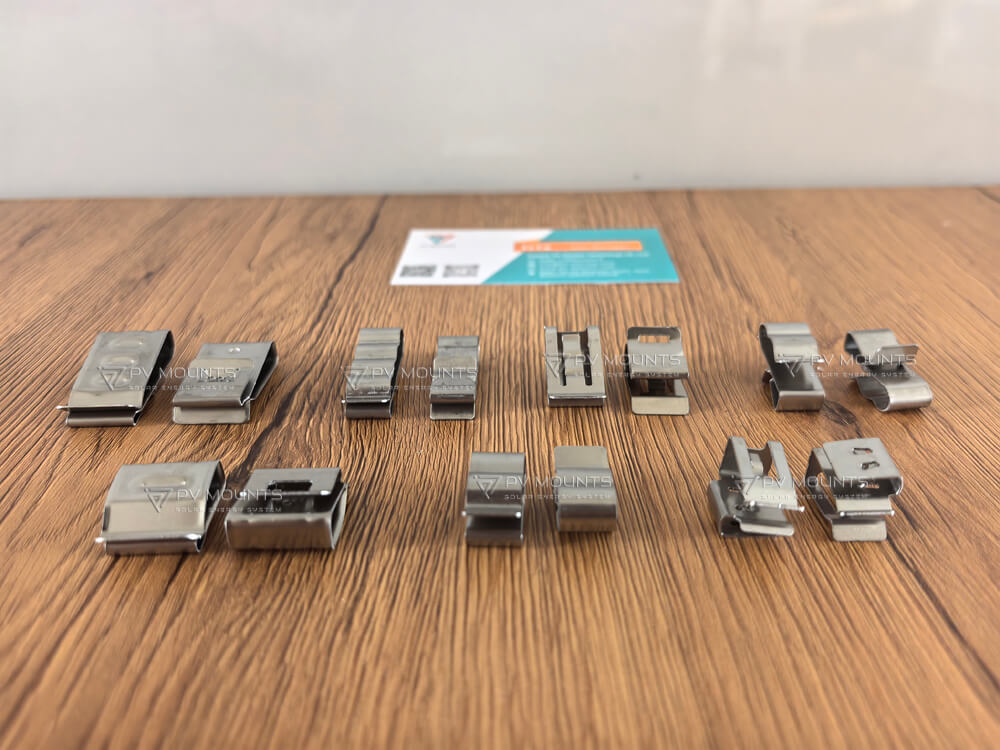
Definition
A solar cable clip is a photovoltaic (PV) mounting accessory used to securely fix and route DC cables on solar panels or mounting rails.
👉 In EPC solar projects, solar cable clips are classified into different types based on material, mounting method, and installation structure, which directly affects system safety, cable lifespan, and long-term maintenance cost.
🟢 1. Introduction
Solar cable clips are essential components in photovoltaic (PV) systems used to secure and route DC cables on solar panels and mounting structures.
👉 In EPC solar projects, selecting the correct type of solar cable clip is critical for ensuring long-term system safety, installation efficiency, and lifecycle reliability.
Different types of solar cable clips are designed for different installation environments, cable sizes, and structural conditions.
🧠 2. Why Solar Cable Clip Type Selection Matters
PV systems operate in extreme outdoor environments for 20–30 years, including:
- UV radiation
- Wind load stress
- Temperature cycling
- Coastal corrosion
👉 Incorrect clip selection may cause:
- Cable insulation damage
- Mechanical loosening
- Increased O&M cost
- Reduced EPC system reliability
⚙️ 3. Main Types of Solar Cable Clips
🟢 3.1 SUS304 Stainless Steel Solar Cable Clips (EPC Standard Type)
👉 Preferred solar cable clip for EPC solar projects worldwide
Caractéristiques principales :
- SUS304 stainless steel material
- 20–25 years service life
- High spring tension stability
- UV + corrosion resistance
Engineering Advantages:
✔ Stable long-term cable fixation
✔ Suitable for utility-scale PV plants
✔ Low lifecycle maintenance cost
✔ High mechanical reliability
Application Scenarios:
- Rooftop solar PV systems
- Ground-mounted solar farms
- Utility-scale EPC solar projects
- Coastal and high-humidity environments
👉 This is the global EPC engineering standard solar cable clip type.
🟡 3.2 Plastic Solar Cable Clips (Nylon / UV-Resistant Polymer)
Caractéristiques principales :
- Low cost
- Lightweight design
- Easy installation
Engineering Limitations:
- UV aging degradation
- Reduced grip strength over time
- 3–8 year lifespan
Application :
- Residential rooftop solar systems
- Temporary PV installations
- Low-cost projects
👉 Not recommended for EPC utility-scale solar systems.
🟢 3.3 Frame-Mounted Solar Cable Clips
Installed directly on solar module aluminum frames.
Features:
- Direct module integration
- Fast installation speed
- Clean cable routing design
Application :
- Rooftop PV systems
- Commercial solar installations
👉 Suitable for module-level cable management.
🟢 3.4 Rail-Mounted Solar Cable Clips
Installed on PV mounting rails.
Features:
- High mechanical stability
- Suitable for long cable routing
- Strong wind resistance performance
Application :
- Ground-mounted solar farms
- Utility-scale EPC projects
- Large commercial PV systems
👉 Preferred for large-scale PV engineering projects.
📊 4. Engineering Comparison Table
| Type | Matériau | Durée de vie | EPC Suitability | Cost Level | Engineering Status |
|---|---|---|---|---|---|
| SUS304 Stainless Steel Clip | SUS304 | 20–25 years | ⭐⭐⭐⭐⭐ | Medium | EPC Standard |
| Plastic Clip | Nylon / Polymer | 3–8 years | ⭐⭐ | Low | Residential Only |
| Frame-Mounted Clip | Mixed | ~20 years | ⭐⭐⭐⭐ | Medium | Rooftop PV |
| Rail-Mounted Clip | SUS304 / Steel | 20–25 years | ⭐⭐⭐⭐⭐ | Medium–High | Utility EPC |
🧠 5. EPC Engineering Selection Guidelines (Critical)
✔ SUS304 stainless steel clips are the default EPC standard
✔ Plastic clips are only used in residential low-budget systems
✔ Frame-mounted clips are preferred for rooftop PV layouts
✔ Rail-mounted clips are required for utility-scale PV plants
👉 Selection must consider:
- wind load design
- system voltage layout
- cable routing structure
- project lifetime requirement
🏗️ 6. SUS304 vs Plastic Engineering Comparison
🟢 SUS304 Advantages:
- Long-term corrosion resistance
- Stable spring force over 25 years
- No UV degradation
- High mechanical locking reliability
🟡 Plastic Limitations:
- UV aging
- Brittle failure risk
- Loss of tension over time
👉 Material selection directly impacts EPC lifecycle reliability.
We suggest, SUS304 stainless steel solar cable clips are the default procurement standard for EPC solar projects.
🌍 7. Application Scenarios
| Project Type | Recommended Clip Type |
|---|---|
| Residential rooftop | Plastic / SUS304 |
| Commercial rooftop | SUS304 preferred |
| Ground-mounted PV | SUS304 rail-mounted |
| Utility-scale EPC | SUS304 mandatory |
| Coastal PV plants | SUS304 only |
💰 8. EPC Cost vs Lifecycle Value
Although plastic clips are cheaper initially:
👉 SUS304 stainless steel clips reduce total lifecycle cost by:
- reducing replacement frequency
- lowering maintenance labor
- minimizing failure risk
9. Solar Cable Clip Selection Flow Chart
In EPC photovoltaic engineering, solar cable clip selection follows a simple decision logic based on installation environment and project scale.
🧠 Engineering Selection Flow:
👉 Rooftop PV system
→ Frame-mounted solar cable clip
→ SUS304 or plastic (depending on budget)
👉 Commercial rooftop PV system
→ SUS304 stainless steel frame-mounted clip
→ Preferred EPC standard
👉 Ground-mounted solar farm
→ Rail-mounted solar cable clip
→ SUS304 stainless steel required
👉 Utility-scale EPC solar project
→ Rail-mounted SUS304 stainless steel clip
→ Mandatory engineering standard
👉 Coastal / high corrosion environment
→ SUS304 stainless steel clip only
→ Plastic clips not recommended
🏢 10. PV Mounts – Solar Cable Clip Manufacturer Solution
PV Mounts is a professional solar cable clip manufacturer in China, specializing in SUS304 stainless steel PV cable clips for EPC solar projects worldwide.
We provide:
- EPC solar cable management solutions
- OEM & ODM solar cable clip manufacturing
- Wholesale PV mounting accessories supply
- Utility-scale solar project hardware supply
👉 Our SUS304 solar cable clips are widely used in rooftop, ground-mounted, and EPC solar installations in global markets.
Keywords covered:
solar cable clip supplier, PV mounting accessories manufacturer, wholesale solar cable clips China, EPC solar cable management supplier
❓ 11.FAQ
Stainless steel, plastic, frame-mounted, and rail-mounted clips.
SUS304 stainless steel clips are best for EPC solar projects.
20–25 years in outdoor PV environments.
No, only for residential or temporary systems.
Frame-mounted clips attach to modules, rail-mounted clips attach to mounting structures.
Because of corrosion resistance and long-term mechanical stability.
Rail-mounted SUS304 stainless steel clips.
Yes, they directly affect cable protection and electrical safety.
UV degradation and loss of mechanical strength.
Yes, it affects maintenance cost and lifecycle performance.
SUS304 stainless steel clips.
Yes, they are standard components in EPC solar installations.
🧠 12.Engineering Design Formula for Solar Cable Clip Systems
In photovoltaic cable management engineering, system reliability can be simplified into a core design equation:
⚙️ Formula:
Solar Cable System Reliability = Clip Spacing + Material Selection + Environmental Conditions
🟢 Explanation:
- Clip Spacing → determines mechanical stability of cable routing
- Sélection des matériaux → determines corrosion resistance and lifespan
- Environmental Conditions → determines UV, wind, and coastal durability requirements
🧠 Engineering Insight:
👉 Even small changes in clip spacing or material selection can significantly impact long-term PV system performance.
👉 Therefore, SUS304 stainless steel clips are widely used in EPC projects to ensure stable system reliability under harsh outdoor conditions.
🟢 10. Conclusion
Solar cable clip type selection is a key engineering decision in photovoltaic system design.
Different clip types are used depending on installation structure, environmental conditions, and project requirements.
👉 SUS304 stainless steel solar cable clips are the global EPC standard due to their long-term durability, mechanical stability, and resistance to harsh outdoor environments.
👉 Proper selection of solar cable clip type directly improves PV system safety, reliability, and lifecycle cost efficienty and performance in photovoltaic cable management systems.

 French
  English
  Spanish
  Portuguese
  Russian
  Hungarian
  Arabic
  Romanian