
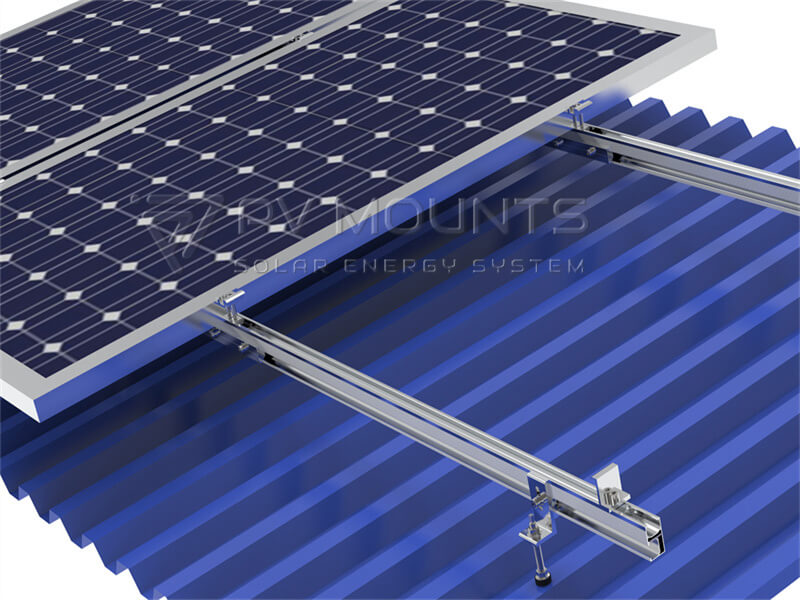
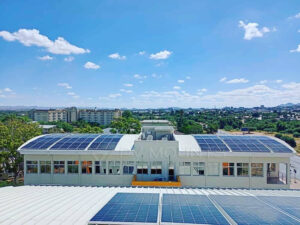
Trapezoidal metal roofs are widely used in industrial and commercial buildings.Solar mounting for trapezoidal metal roofs requires proper system design, including fixing methods, rail spacing, and waterproof sealing to ensure long-term performance and safety.
This guide explains the best solar mounting systems for trapezoidal roofs, including fixing methods, spacing design, and installation best practices.
1. What Is a Trapezoidal Metal Roof?
A trapezoidal metal roof is formed by steel or aluminum sheets with repeating trapezoidal profiles. These roofs are commonly used in factories, warehouses, and commercial buildings due to their:
- High strength and durability
- Lightweight structure
- Fast installation
Their regular geometry also makes them suitable for solar mounting systems when properly designed.
2. What is the best solar mounting solution for trapezoidal metal roofs?
The best solution for trapezoidal metal roofs is typically a mini rail mounting system fixed with self-drilling screws and EPDM sealing. It offers a balance of cost, installation speed, and structural reliability, making it widely used in commercial and industrial solar projects.
3. Best Solar Mounting Solution for Trapezoidal Roof
There are two common mounting solutions for trapezoidal metal roofs:
3.1. Système de mini rail (Most Recommended)
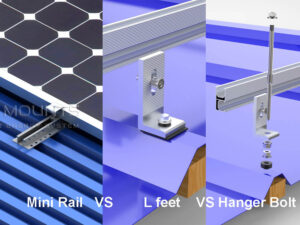
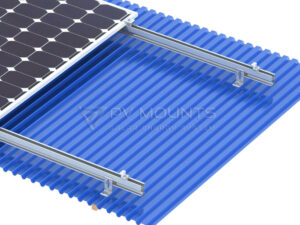
Mini rail systems are widely used for solar mounting on trapezoidal metal roofs due to their cost efficiency and fast installation. Pre-assembled mini rail solutions can significantly reduce installation time on site.
- Short aluminum rails fixed directly to the roof sheet
- Lower material cost
- Faster installation
- Suitable for most industrial roofs
👉 This is the most widely used solution in Europe due to its balance of cost, speed, and structural reliability.
One of the most popular solutions for trapezoidal roofs is the mini rail mounting system, which offers fast installation and cost efficiency.
👉 Read the full guide: Mini Rail Solar Mounting System
3.2. L Foot + Full Rail System (Most Popular)
- Traditional mounting solution
- Higher material consumption
- More flexible for complex layouts
👉 In most standard projects, mini rail systems are the preferred choice.
Choisir le bon système de montage solaire pour votre toit trapézoïdal
Selecting the appropriate solar mounting system is crucial. Factors like roof size, angle, and material play a key role. It’s important to consider the local climate and potential shading issues as well. Consulting with experts ensures the chosen system fits the specific needs of the trapezoidal roof. They can guide through options and recommend the best solution. If you have no idea, please contact with XIAMEN PV MOUNTS experts. info@pv-mounts.com
4. How to Fix Solar Mounting on Trapezoidal Roof
Proper fixing is critical for solar mounting on trapezoidal metal roofs to ensure both safety and waterproof performance.
Fixing Method
- Use self-drilling screws
- Fix on the crest (top of rib), not the valley
- Apply EPDM rubber sealing to prevent leakage
👉 Key point:
Trapezoidal roofs are designed for controlled penetration, so correct sealing and screw positioning are essential for long-term waterproof performance.
5. Rail / Fixing Spacing for Trapezoidal Roof
Spacing design is one of the most important factors in system safety.
Typical Spacing
- 600 mm – 1000 mm (common range)
Depends on:
- Wind load
- Snow load
- Roof sheet thickness
- Building height
Example
For a wind load of 0.85 kN/m², the recommended fixing spacing is approximately 800 mm.
Recommended Fixing Spacing by Wind Load
Wind Load (kN/m²) Recommended Spacing ≤ 0.6 1000 mm 0.6 – 0.85 800 mm 0.85 – 1.2 600 mm 👉 Correct spacing ensures:
- Structural stability
- Reduced uplift risk
- Longer system lifespan
6. Wind Load Considerations (EN 1991)
For European projects, wind load calculation should follow EN 1991 standards.
Key factors include:
- Building height
- Roof zone (edge / corner / middle)
- Local wind conditions
👉 Proper load calculation helps determine:
- Fixing quantity
- Rail spacing
- System safety margin
7. Installation Process (Step-by-Step)
A typical installation process includes:
- Mark rail positions based on layout
- Place mini rails on roof crest
- Fix with self-drilling screws
- Apply EPDM sealing (pre-assembled)
- Install solar panels
👉 Professional installation ensures:
- Accurate alignment
- Strong fixing
- Waterproof performance
8. Common Mistakes to Avoid
Incorrect installation can lead to serious issues.
Typical mistakes:
- Fixing in the valley instead of crest
- Over-tightening screws
- Ignoring waterproof sealing
- Incorrect spacing design
👉 Avoiding these mistakes is critical for long-term reliability.
9. Why Use Stainless Steel Fasteners?
Material selection is especially important for roof mounting systems.
Advantages of stainless steel (SUS304 / SUS410):
- Excellent corrosion resistance
- Suitable for coastal and humid environments
- Longer service life
👉 Stainless steel components significantly improve system durability.
10. Cost Considerations
Compared to other roof types, trapezoidal roof systems offer:
- Lower installation cost
- Faster installation time
- Reduced material usage (especially mini rail systems)
👉 This makes them one of the most cost-effective solar mounting solutions.
11. Design Considerations for Solar Panels on Trapezoidal Roofs
Lorsqu'il s'agit d'équiper des toits trapézoïdaux de panneaux solaires, les considérations de conception jouent un rôle essentiel. La forme unique de ces toits exige une approche réfléchie pour garantir que le champ solaire s'intègre non seulement esthétiquement, mais aussi qu'il fonctionne de manière optimale. L'orientation et l'inclinaison sont cruciales ; elles doivent être minutieusement calculées pour exploiter au mieux les rayons du soleil. Une orientation vers le sud, par exemple, maximise l'exposition au soleil dans l'hémisphère nord, tandis que l'angle d'inclinaison doit être ajusté en fonction de la latitude de l'emplacement pour une absorption optimale de l'énergie.
La répartition de la charge est un autre facteur critique, car le poids des panneaux solaires doit être uniformément réparti sur les arêtes trapézoïdales pour éviter les tensions structurelles. En outre, l'intégration de la technologie solaire doit améliorer, et non compromettre, l'apparence et la fonctionnalité de la toiture. Cet équilibre délicat entre forme et fonction met en évidence l'art et la science des installations solaires sur les toits trapézoïdaux, en montrant l'ingéniosité nécessaire pour fusionner les solutions d'énergie renouvelable avec l'intégrité architecturale.
12. Maintaining Your Solar Panel System on a Trapezoidal Roof
Après l'installation, l'accent est mis sur l'entretien du système de panneaux solaires afin de garantir sa longévité et son efficacité. Les contrôles de routine sont essentiels ; ils permettent d'identifier et de résoudre des problèmes tels que l'accumulation de poussière, l'ombrage ou l'usure, qui peuvent affecter les performances. Il est également essentiel de nettoyer régulièrement les panneaux afin d'éliminer les débris susceptibles de bloquer la lumière du soleil.
En outre, la maintenance ne consiste pas seulement à préserver la fonctionnalité, mais aussi à maintenir l'efficacité. Les réparations, lorsqu'elles sont nécessaires, doivent être effectuées rapidement afin d'éviter que des problèmes mineurs ne se transforment en problèmes majeurs. Cet entretien permanent permet non seulement de prolonger la durée de vie du système solaire, mais aussi de garantir qu'il continue à fonctionner avec une efficacité maximale, ce qui fait de la maintenance un chapitre clé de l'histoire de l'énergie solaire sur les toits trapézoïdaux.
13. Cost Analysis of Installing Solar Panels on Trapezoidal Metal Roofs
L'aspect financier de l'installation de panneaux solaires sur les toits métalliques trapézoïdaux mérite un examen approfondi. Le coût initial peut sembler impressionnant, mais il s'agit d'un investissement à long terme qui porte ses fruits. Au fil du temps, les économies d'énergie réalisées peuvent compenser les dépenses initiales. Pour analyser ces coûts, il faut comparer le prix de l'installation, de l'équipement et de l'entretien avec les économies d'énergie attendues et la durée de vie du système.
Les mesures d'incitation et les subventions peuvent réduire considérablement les dépenses initiales. De nombreux gouvernements proposent des allègements fiscaux, des remises ou des subventions pour encourager l'adoption de l'énergie solaire. Ces mesures incitatives peuvent rendre les installations solaires beaucoup plus abordables. En fin de compte, le retour sur investissement des panneaux solaires sur les toits trapézoïdaux est favorable, surtout si l'on tient compte des avantages environnementaux et de l'augmentation potentielle de la valeur de la propriété.
FAQ
No, when using proper EPDM sealing and correct installation methods.
Typically 600–1000 mm, depending on wind load and roof conditions.
Yes, but screw selection and pull-out strength must be verified.
Mini rail is more cost-effective for standard projects. L foot is more stable than mini rail.
Trapezoidal roofs can enhance efficiency due to their shape, allowing optimal panel placement.
Yes, but the mounting system must be compatible with the roof’s design and load capacity.
Typically, these systems last 25-30 years, mirroring the lifespan of solar pan
Properly installed systems withstand various weather conditions, ensuring durability and performance.
Regular cleaning and occasional inspections are necessary to maintain efficiency and longevity.
Yes, but a roof assessment is essential to ensure it can support the solar system.
Mini rail systems can be used on most trapezoidal metal roofs, but not all.
Compatibility depends on several factors:
Roof sheet thickness
Rib height and spacing
Load requirements (wind and snow load)
Structural condition of the roof
In general, mini rail systems are suitable for standard industrial trapezoidal roofs with sufficient strength. However, for very thin sheets or high load conditions, additional reinforcement or a full rail system may be required.
👉 For solar mounting on trapezoidal metal roofs, it is recommended to verify pull-out strength and structural capacity before installation.
Pre-assembled mini rail solutions can simplify installation and improve efficiency on site.
Screws should always be installed on the crest (top of the rib) of the trapezoidal metal sheet, not in the valley.
Key reasons:
The crest area provides better structural support
It reduces the risk of water leakage
It ensures stronger pull-out resistance
Additionally, all screws should be installed with EPDM sealing washers to maintain long-term waterproof performance.
👉 Correct screw positioning is critical for safe and durable solar mounting on trapezoidal roofs.
Engineering Summary for Trapezoidal Roof Solar Mounting
- Recommended solution: Mini rail system
- Typical spacing: 600–1000 mm
- Fixing method: Self-drilling screws with EPDM
- Material: Aluminum + Stainless Steel (SUS304 / SUS410)
Conclusion et perspectives d'avenir
Solar mounting systems for trapezoidal metal roofs provide a reliable and cost-effective solution for industrial and commercial solar projects. By using the right mounting method, proper spacing design, and high-quality materials, you can ensure long-term system performance and safety.
Les systèmes de montage solaire sur les toits trapézoïdaux représentent un investissement intelligent dans les énergies renouvelables. Ils allient fonctionnalité, efficacité et durabilité. Au fur et à mesure des progrès technologiques, ces systèmes deviendront de plus en plus intégrés et efficaces. L'avenir de l'énergie solaire sur les toits trapézoïdaux est prometteur d'une planète plus propre et plus verte.
As a professional solar mounting system manufacturer, Xiamen PV Mounts provides reliable solutions for trapezoidal metal roofs, including mini rail systems, stainless steel fasteners, and customized mounting structures.
For project-specific design support or quotation, feel free to contact our engineering team.
Compared to corrugated roofs, trapezoidal roofs offer a flatter surface and easier installation.
👉 See also: Corrugated Roof Solar Mounting Guide

 French
  English
  Spanish
  Portuguese
  Russian
  Hungarian
  Arabic
  Romanian